
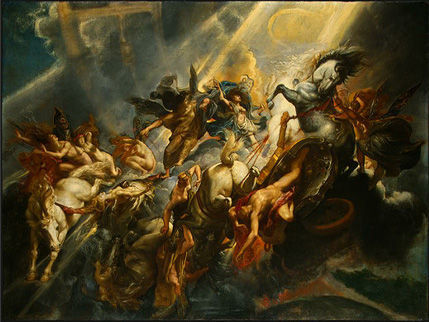
The Fall of Phaeton, by Rubens
Like the Phaeton of mythology, as a youth Edward de Vere, 17th Earl of Oxford, seemed to have everything one could desire – wealth, status, friends, attractive physical appearance, athletic ability, and talent as a writer and musician. Yet in many ways his life resembles Phaeton’s dramatic fall, and Oxford himself appreciated the parallel, signing a sonnet in 1591 ‘Phaeton to his friend Florio’.
The documents reprinted below illustrate Oxford’s fall from a position of wealth and 63/power to a nadir in 1590-1. In 1591 he remarried, and in 1592 his first surviving male heir was born. From that time on Oxford gradually attempted to rebuild his fortunes, a project which met with little success during the reign of Elizabeth, but which took a marked turn for the better when James I became King of England. However it was cut short by Oxford’s death on 24 June 1604, only a year after King James’ accession.
THIS PAGE CONTAINS TRANSCRIPTS OF DOCUMENTS RELATING TO EDWARD DE VERE, 17TH EARL OF OXFORD, AND WORKS HE MAY HAVE AUTHORED (INCLUDING THE LANGHAM LETTER); HIS FRONT MAN, THE ACTOR WILLIAM SHAKESPEARE OF STRATFORD UPON AVON; AND THE FIRST AND SECOND BLACKFRIARS THEATRES, ARRANGED IN ORDER BY DATE OF COMPOSITION
FOR MYTHS CONCERNING OXFORD AND WILLIAM SHAKESPEARE OF STRATFORD UPON AVON, SCROLL TO THE FOOT OF THIS PAGE
ADDITIONAL TRANSCRIBED DOCUMENTS CAN BE FOUND ON OTHER PAGES OF THIS WEBSITE
1415
Last will of Richard Vere, 11th Earl of Oxford, dated 6 August 1415, and acquittance issued to his widow and executrix Alice (Sergeaux) Vere on 22 September 1417
1442
Last will and testament of Edward Tyrrell of Downham, whose wife, Anne, was a first cousin of John de Vere (d.1462), 12th Earl of Oxford
1445
Last will and testament, dated 12 April 1445, of John Throckmorton of Fladbury, ancestor of Oxford's friend, Sir Arthur Throckmorton, of Thomas Russell, overseer of the will of William Shakespeare of Stratford upon Avon, of Job Throckmorton, who assisted with the printing of the Marprelate tracts, and of Sir Richard Knightley, at whose home of Fawsley Martin Marprelate's Epitome was printed on a secret press in November 1588
1458
Last will and testament, proved 4 November 1458, of John Rich, mercer of London, great-grandfather of Lord Chancellor Richard Rich (d.1567)
1464
Last will and testament, dated 8 October 1464, of William Marowe, Lord Mayor of London, father-in-law of Sir William Clopton, grandfather of Mary Clopton, wife of Sir William Cordell, one of the five trustees appointed by Oxford in an indenture of 30 January 1575 prior to his departure on his continental tour
1471
Last will and testament, dated 16 March 1471, of Sir William Tyrrell of Beeches in Rawreth, Essex, whose grandson, Edward Tyrrell, was the first husband of Alice Cloville, who later married Oxford's maternal uncle, Henry Golding
1475
Last will and testament, dated 16 May 1475, of Sir Thomas Tyrrell, whose wife was a descendant of Robert de Vere, 3rd Earl of Oxford
1484
Last will and testament, dated 5 March 1484, of Thomas Darcy, esquire, whose grandson, Thomas, 1st Lord Darcy of Chiche, married Oxford's aunt, Elizabeth de Vere
1485
Testamenta Eboracensia, Vol. 3, pp. 297-9
Last will and testament, dated 4 April 1485, of Richard Scrope, father of Elizabeth Scrope Beaumont de Vere (d.1537), second wife of the 13th Earl of Oxford
1487
Last will and testament, dated 7 April 1487 (will of lands) and 21 February 1489 (will of goods), of Sir Edmund Rede, whose grandson and heir, Sir William Rede, married Anne Don, sister of Oxford's great-grandmother, Margaret Don
Undated last will and testament, proved 9 August 1487 of John Lynne
1488
Last will and testament, dated 20 March 1488, of Sir Edmund Shaa, who as Lord Mayor of London is said to have offered the crown to Richard III
1489
Last will and testament, dated 9 July 1489, of Margaret Harleston Darcy, whose grandson, Thomas, 1st Lord Darcy of Chiche, married Oxford's aunt, Elizabeth de Vere
Plea of 13th Earl of Oxford before Justices in Eyre dated 17 August 1489 for confirmation of rights in the Forest of Essex and the keeping of the house and park of Havering, later claimed by Oxford in his own lifetime and restored to him by King James
1490
Last will and testament, dated 13 May 1490, of Margaret Chedworth Wyfold Norreys Howard (d.1494), Duchess of Norfolk, mother-in-law of John Bourchier, 2nd Baron Berners, translator of Froissart’s Chronicles, and stepmother of Sir William Norreys, who married Joan Vere, daughter of John de Vere, 12th Earl of Oxford
Last will and testament, dated 1 August 1490, of Thomas Peyton, a descendant of Robert de Vere, 3rd Earl of Oxford, whose niece, Elizabeth Peyton Wigston, was the mother of Roger Wigston at whose home, Wolston Priory, the last two Marprelate tracts, the Theses Martinianae and the Just Censure and Reproof of Martin Junior, were printed on a secret press in July 1589
Last will and testament, dated 20 December 1490 and 18 January 1491, of Thomas Mery, whose daughter, Elizabeth Mery, was the grandmother of William Lewin, who accompanied Oxford on his continental tour in 1575, and who left Oxford a bequest of 100 ounces of gilt plate in his will
1491
Last will and testament, dated 1 March 1491, of Hugh Shaa, son of Sir Edmund Shaa, Lord Mayor of London in 1482
Last will and testament, dated 27 October 1491, of Richard Bodley, great-grandfather of Sir John Bodley of Streatham, landlord of the Globe playhouse from 1601-1622
Last will and testament, dated 27 November 1491, of Thomas Bodley, great-grandfather of William Leveson, who acted as trustee in the allocation of shares in the Globe playhouse for William Shakespeare of Stratford upon Avon and other members of the Lord Chamberlain's Men
1492
Last will and testament, dated 20 September 1492, of Edmund Danyell, nephew of John Howard, 1st Duke of Norfolk, and father of John Danyell, receiver to Elizabeth (nee Scrope), Beaumont De Vere, Countess of Oxford
Last will and testament, dated 17 October 1492, of William Saunders, whose daughter, Alice Saunders, was the grandmother of Oxford's mother-in-law, Lady Burghley
1493
Last will and testament, dated 20 December 1493, of John Tyrrell of Beeches in Rawreth, Essex, whose son, Edward Tyrrell, was the first husband of Alice Cloville, who later married Oxford's maternal uncle, Henry Golding
1494
Last will and testament, dated 31 May 1494, of Sir William Calthorpe, whose daughter, Anne Calthorpe, married Sir Robert Drury, Speaker of the House of Commons, and chief steward and executor to John de Vere, 13th Earl of Oxford
Last will and testament, dated 3 July 1494, of John, Lord Scrope of Bolton, paternal uncle of Elizabeth Scrope Beaumont de Vere (d.1537), Countess of Oxford, wife of the 13th Earl of Oxford, who names the Earl as one of the supervisors of his will
Last will and testament, dated 13 July 1494, of Julyan Shaa, wife of Sir Edmund Shaa, Lord Mayor of London in 1482
Last will and testament, dated 4 November 1494, of John Clopton, who escaped execution for the conspiracy in which John de Vere, 12th Earl of Oxford, was executed, and who requested that John de Vere, 13th Earl of Oxford, be supervisor of his will
1495
Petition brought in 1495 by John de Vere, 13th Earl of Oxford, alleging that during the Christmas season of 1472 the future Richard III had used coercion to obtain the inherited lands of the Earl’s mother, Elizabeth Howard
1496
Last will and testament, dated 8 April 1496, of Benedict Trotter, whose widow married John Fitzherbert, Remembrancer of the Exchequer, whose great-granddaughters, Dorothy Port (d.1607) and Margaret Port (d.1613), married into families related to Oxford’s second wife, Elizabeth Trentham
Last will and testament, dated 15 September 1496, of John Spencer of Hodnell, Warwickshire, ancestor of Sir Edward Greville (1565-c.1628), lord of the manor of Stratford, and of Lady Burghley and Sir Walter Cope
Last will and testament, dated 12 October 1496, of Sir Edmund Bedingfield, who fought under the 13th Earl of Oxford at the Battle of Stoke and entertained Henry VII at Oxburgh in the company of the 13th Earl
1497
Norfolk Record Office NCC Will Register CAGE 135
Last will and testament, dated 14 July 1497, of Elizabeth Fitz Lewes Wingfield, whose grandson, Sir Anthony Wingfield, married Elizabeth Vere, sister of John de Vere (1499-1527), 14th Earl of Oxford
Last will and testament, dated 1497, of Sir Thomas Cokesey alias Greville, whose family was related to the family of Oxford's grandmother, Elizabeth Trussell
1498
Last will and testament, dated 26 October 1498, of Sir Robert Fouleshurst, maternal ancestor of Oxford's second wife, Elizabeth Trentham
1499
Last will and testament, dated 11 August 1499, of John Newport of Rushden
Last will and testament, dated 17 August 1499, of Sir Henry Wentworth, great-grandfather of John Darcy, 2nd Baron Darcy of Chiche, co-guarantor of Oxford's debt to the Court of Wards
1500
Last will and testament, dated 13 June 1500, of Richard Martyn of Long Melford, paternal great-grandfather of Humphrey Martyn, addressee of the Langham Letter
Last will and testament, dated 19 August 1500, of Robert Harding, whose nephew, Robert Harding, was the grandfather of Ellen Harding Knyvet Browne, wife of Sir Thomas Browne, who signed Lady Russell's petition against James Burbage's Blackfriars theatre, and stepmother of Sir Matthew Browne, who in 1601 purchased properties owned by Nicholas Brend, including the Globe playhouse
Last will and testament dated 21 August 1500, with an annexed schedule dated 24 December 1502, of Sir George Vere, younger brother of John de Vere, 13th Earl of Oxford, and father of John de Vere, 14th Earl of Oxford
1501
Last will and testament, dated 10 January 1501, of John Crosby, son of Sir John Crosby
Last will and testament, dated 18 January 1501, of Jane Radmyld, half sister of Sir William Norreys, who married Joan Vere, daughter of John de Vere, 12th Earl of Oxford
Last will and testament, dated 19 January 1501, of Nicholas Chedworth, brother-in-law of Sir William Carew (see below)
Last will and testament, dated 23 February 1501, of Peter Peckham, whose granddaughter, Jane Drayton, was the great-grandmother of Henry Wriothesley, 3rd Earl of Southampton, to whom Shakespeare dedicated Venus and Adonis and The Rape of Lucrece
Last will and testament, dated 26 May 1501, of Sir William Carew, a descendant of Robert de Vere, 3rd Earl of Oxford, and a half brother of John de Vere (d.1486), father of John de Vere (d.1482-1540), 15th Earl of Oxford
1502
Last will and testament, dated 24 June 1502, of Robert Russell, great-grandfather of Thomas Russell, overseer of the will of William Shakespeare of Stratford-upon-Avon
Last will and testament, dated 13 October 1502, of John Fitzherbert, Remembrancer of the Exchequer, whose great-granddaughters, Dorothy Port (d.1607) and Margaret Port (d.1613), married into families related to Oxford’s second wife, Elizabeth Trentham
1503
Last will and testament, dated 6 August 1503, of Robert Drayton, whose daughter, Jane Drayton, was the great-grandmother of Henry Wriothesley, 3rd Earl of Southampton, to whom Shakespeare dedicated Venus and Adonis and The Rape of Lucrece
Last will and testament, dated 26 December 1503, of Sir John Shaa, Lord Mayor of London in 1501, whose wife, Margaret Ilam, was by her second marriage to Sir John Raynsford the grandmother of Sir William Waldegrave (d.1613), co-guarantor of Oxford's debt to the Court of Wards
1504
Last will and testament, dated 25 March 1504, of John Writhe, great-great-grandfather of Henry Wriothesley, 3rd Earl of Southampton, to whom Shakespeare dedicated Venus and Adonis and The Rape of Lucrece
Last will and testament, dated 20 June 1504, of Sir Robert Broughton, a close associate of John de Vere, 13th Earl of Oxford, said to have married the Earl's illegitimate daughter, Katherine
1505
Last will and testament, dated 1505, of William Lynne, father of Anne Lynne, who married, as his second wife, Sir John Tyrrell of Little Warley, Essex, and of Audrey Lynne, who married Sir Richard Gresham, Lord Mayor of London
Last will and testament, dated 20 January 1505, of Thomas Appleton, whose son, Richard Appleton, was an annuitant in the will of John de Vere, 13th Earl of Oxford
Last will and testament, dated 24 January 1505, of George Peckham, whose niece, Jane Drayton, was the great-grandmother of Henry Wriothesley, 3rd Earl of Southampton, to whom Shakespeare dedicated Venus and Adonis and The Rape of Lucrece
Last will and testament, dated 31 March 1505, of Thomas Marowe, serjeant at law, whose great-niece married Sir William Cordell, one of the five trustees appointed by Oxford in an indenture of 30 January 1575 prior to his departure on his continental tour
Last will and testament, dated 18 November 1505, of Thomas Blake, whose niece, Elizabeth Danyell, married Anthony Bedingfield, uncle of Oxford's friend, Thomas Bedingfield, who dedicated his translation of Cardanus' Comfort to Oxford, and whose niece, Margaret Danyell, married Sir William More of Loseley
Last will and testament, dated 10 December 1505, of Humphrey Tyrrell of East Horndon, a descendant of Robert de Vere, 3rd Earl of Oxford, and grandfather of the 16th Earl of Oxford's executor, Sir John Wentworth
Last will and testament, dated 12 December 1505, of Eleanor Washbourne Scrope Wyndham, mother of Elizabeth Scrope Beaumont de Vere (d.1537), second wife of the 13th Earl of Oxford, containing a bequest to the 13th Earl and his first wife
1506
Last will and testament, dated 7 April 1506, of Sir Richard Guildford, whose property in the Blackfriars later became the mansion of Lord Cobham, and who was the grandfather of Queen Elizabeth's favourite, Robert Dudley, Earl of Leicester
Last will and testament, dated 22 September 1506, of William Dormer
1507
Last will and testament, proved 24 January 1507, of Elizabeth Tyrrell Darcy Haute, a descendant of Robert de Vere, 3rd Earl of Oxford, and great-grandmother of Oxford's uncle, Thomas Darcy, 1st Baron Darcy of Chiche
Last will and testament, dated 29 November 1507, of Elizabeth Hastings Don (c.1450-1508), whose daughter, Margaret Don, was Oxford’s great-grandmother
Last will and testament, dated 31 December 1507, of Sir Robert Tyrrell, controller of the household to John de Vere, 13th Earl of Oxford
1508
Last will and testament, dated 28 July 1508, of Thomas Crafford, whose nephew, Avery Rawson, was the grandfather of Anne Rawson, whose husband, Sir Michael Stanhope, was involved in the Protector Somerset's extortion against Oxford's father, the 16th Earl
Last will and testament, dated 23 August 1508, of Thomas West, whose granddaughter married William Golding, brother of Oxford's mother, Margery Golding
Last will and testament, proved 26 September 1508, of Dorothy Clopton, aunt of Mary Clopton, who married Sir William Cordell, one of the five trustees appointed by Oxford in an indenture of 30 January 1575 prior to his departure on his continental tour
Last will and testament, dated 6 December 1508, of Grace (nee Baynard) Langley Danyell, whose second husband was the nephew of John Howard, 1st Duke of Norfolk, and whose son was receiver to Elizabeth (nee Scrope), Beaumont de Vere, Countess of Oxford
1509
Last will and testament, dated 10 April 1509, of John de Vere (d.1513), 13th Earl of Oxford
Last will and testament, dated 23 April 1509, of Sir Robert Corbet, whose sister, Elizabeth, married Thomas Trentham, great-grandfather of Oxford's second wife, Elizabeth Trentham
Notes dating to mid-1509 written in her own hand by Jane Drayton, mother of Thomas Wriothesley, 1st Earl of Southampton, recording her own birthdate, that of her brother, Peter Drayton, and the birthdates of four of her children, including the 1st Earl of Southampton
Last will and testament, dated 7 September 1509, of Ralph Leigh, step-grandfather of Queen Katherine Howard and of Oxford's friend, Sir George Howard
Last will and testament, dated 19 November 1509, of Roger North, whose granddaughter, Jane Wilkinson, was the wife of Michael Lok, who persuaded Oxford to invest heavily in Martin Frobisher's third expedition in search of a route to Cathay
1510
Last will and testament, dated 26 August 1510, of Sir Thomas Tyrrell, servant to John de Vere, 13th Earl of Oxford
1512
Last will and testament, dated 4 August 1512, of Thomas Fogge, whose widow, by her second marriage, was the grandmother of Alice (nee Kempe) Hales Lee (d.1592), to whom Robert Greene dedicated Menaphon
Last will and testament, dated 5 August 1512, of Sir Thomas Knyvet, great-grandfather of Oxford's mistress, Anne Vavasour, and grandfather of Sir Thomas Knyvet, who fought with Oxford over the 'quarrel of Anne Vavasour' in 1582
Last will and testament, dated 14 September 1512, of John Newport, grandfather of Sir Richard Newport, the owner of a copy of Hall's Chronicle, formerly Loan 61 in the British Library, now in the hands of a trustee, Lord Hesketh, containing annotations thought to be by Shakespeare
Last will and testament, dated 21 December 1512, of Edward Jerningham, whose second wife, Mary Scrope, was the sister of Elizabeth, Countess of Oxford, second wife of John de Vere, 13th Earl of Oxford
1513
Last will and testament, dated 7 February 1513, of William Cope, whose great-grandson, Sir Walter Cope, a long-time servant of Oxford's father-in-law, Lord Burghley, employed Shakespeare's fellow Globe Theatre shareholder, Cuthbert Burbage
Last will and testament, dated 14 February 1513, of Beatrice Cokayne Sutton Tyrrell, whose husband and son were in the service of John de Vere, 13th Earl of Oxford
Last will and testament, dated 24 February 1513, of Henry Smyth, whose daughter married John Onley, who after her death married Elizabeth Rolleston, maternal grandmother of the poet Thomas Watson (d.1592), who dedicated Hekatompathia to Oxford in 1582, and whose son was connected by marriage to the grandfather of Oxford's second wife, Elizabeth Trentham
Inventory of the goods and chattels of John de Vere, 13th Earl of Oxford, prepared by Thomas Mercer on 20 May 1513, two months after the Earl's death on 10 March 1513
Last will and testament, dated 31 May 1513, of Sir Alexander Baynham, whose sister, Elizabeth Baynham Russell Throckmorton, was the great-grandmother of Thomas Russell, overseer of the will of William Shakespeare of Stratford-upon-Avon
Last will and testament, dated 4 September 1513, of William Bedell, Treasurer to Henry VII's mother, whose wife, Cecily, was the grandmother of Robert Burbage, who sold his manor of Theobalds to Lord Burghley, who built his mansion of Theobalds on the site
Last will and testament, dated 26 September 1513, of Reginald Hammond, first husband of Oxford's maternal grandmother, Elizabeth Towe, and father of Agnes Hammond, half sister of Oxford's mother, Margery Golding
1514
Last will and testament, dated 12 April 1512, of Robert Maye, whose widow, Alice Maye, married Thomas Spring, who together with John de Vere, 13th Earl of Oxford, was a major benefactor of the Church of St Peter and St Paul in Lavenham
Last will and testament, dated 29 May 1514, of Sir William Browne, Lord Mayor of London, whose daughter, Anne Browne, married John Tyrrell (d.1540), esquire, of Heron in East Horndon, and Sir William Petre
Last will and testament, dated 5 November 1514, of Thomas Brewes, brother-in-law of Elizabeth Scrope Beaumont de Vere (d.1537), Countess of Oxford, wife of the 13th Earl
1515
Last will and testament, dated 18 January 1515, of Sir Henry Vernon, ancestor of Elizabeth Vernon, wife of Henry Wriothesley, 3rd Earl of Southampton, to whom Shakespeare dedicated Venus and Adonis and The Rape of Lucrece
Last will and testament, proved 15 May 1515, of Margaret de la Pole, Countess of Suffolk, sister of Elizabeth Scrope Beaumont de Vere (d.1537), Countess of Oxford, wife of the 13th Earl
Last will and testament, dated 22 August 1515, of Robert Harding, grandfather of Ellen Harding Knyvet Browne, wife of Sir Thomas Browne, who signed Lady Russell's petition against James Burbage's Blackfriars theatre, and stepmother of Sir Matthew Browne, who in 1601 purchased properties owned by Nicholas Brend, including the Globe playhouse
1516
Last will and testament, dated 7 October 1516, of John Cooke, grandfather of Oxford's mother-in-law, Mildred Cooke Cecil, Lady Burghley, and first cousin of Sir Richard Shelley, source of genealogical information for A Conference about the Next Succession to the Crown of England
Last will and testament, dated 14 November 1516, of Lawrence Martyn of Long Melford, paternal grandfather of Humphrey Martyn, addressee of the Langham Letter
1517
Last will and testament, dated 9 July 1517, of John Broughton, whose mother, Katherine de Vere, is said to have been an illegitimate daughter of John de Vere, 13th Earl of Oxford
Last will and testament, dated 12 August 1517, of John Maye, brother of Alice Maye, whose stepfather, Thomas Spring, together with John de Vere, 13th Earl of Oxford, was a major benefactor of the Church of St Peter and St Paul in Lavenham
Last will and testament, dated 18 December 1517, of Sir John Dawtrey of Southampton, whose second wife, Isabel Shirley, was connected to the family of Henry Wriothesley, 3rd Earl of Southampton, to whom Shakespeare dedicated Venus and Adonis and The Rape of Lucrece
1518
Last will and testament, dated 18 January and 18 March 1518, of Sir Robert Peyton, grandfather of Roger Wigston at whose home, Wolston Priory, the last two Marprelate tracts were printed on a secret press in July 1589
Last will and testament, dated 1 May 1518, of Sir Robert Throckmorton, great-grandfather of both Oxford’s friend, Arthur Throckmorton, and of Job Throckmorton, who assisted with the printing of the Marprelate tracts in 1589, and grandfather of Mary Throckmorton, who married Sir John Huband, who held the half interest in the Stratford tithes later purchased by William Shakespeare of Stratford upon Avon
Last will and testament, dated 1 May 1518, of John Danyell, who leaves a bequest that a priest shall 'specially pray for the soul of the full noble and valiant knight, my late singular good Lord and master, John de Vere, late Earl of Oxenford'
Last will and testament, dated 28 July 1518, of Henry Eden, father of the translator, Richard Eden, whose widow married Oxford's kinsman, Sir Griffith Don
Extracts from the last will and testament, dated 25 September 1518, of John Hosier, whose daughter Isabel married, as his third wife, Sir Richard Gresham, Lord Mayor of London
Last will and testament, dated 1518, of Peter Drayton, whose sister, Jane Drayton, was the great-grandmother of Henry Wriothesley, 3rd Earl of Southampton, to whom Shakespeare dedicated Venus and Adonis and The Rape of Lucrece
Last will and testament, dated 4 October 1518, of Thomas Trentham, great-grandfather of Oxford's second wife, Elizabeth Trentham
1519
Last will and testament, dated 20 July 1519, of Sir Edmund Denny, whose daughter married Sir John Gates, named as an executor in the 1552 will of the 16th Earl of Oxford
1520
Last will and testament, dated 20 July 1520, of Margery Danyell, whose husband was in the service of John de Vere, 13th Earl of Oxford, and an executor of the Earl's will
Last will and testament, dated 2 August 1520, of William Whitlock, whose wife, Elizabeth was the grandmother of the poet, Thomas Watson, who dedicated Hekatompathia to Oxford
1521
Last will and testament, dated 28 April 1521, of Sir John Peche, whose wife, Elizabeth Scrope Peche, was a first cousin of Elizabeth Scrope Beaumont de Vere (d.1537), Countess of Oxford, wife of the 13th Earl
Last will and testament, dated 8 August 1521, of John Newport, whose manor of Soberton was later owned by Henry Wriothesley, 3rd Earl of Southampton, to whom Shakespeare dedicated Venus and Adonis
Last will and testament, dated 21 September 1521, of Sir John Raynsford, whose ward and son-in-law, Thomas Darcy, 1st Baron Darcy of Chiche, was the father of John Darcy, 2nd Baron Darcy of Chiche, co-guarantor of Oxford's debt to the Court of Wards
Last will and testament, dated 22 October 1521, of Sir Thomas Wyndham, brother-in-law of Elizabeth Scrope Beaumont de Vere (d.1537), Countess of Oxford, wife of the 13th Earl
Last will and testament, proved 25 November 1521, of John Colte, father-in-law of Sir Thomas More
1522
Last will and testament, dated 12 April 1522, of Sir John Spencer, whose son-in-law was the brother of Sir Edmund Knightley, husband of Ursula de Vere, sister and coheir of John de Vere, 14th Earl of Oxford
Last will and testament, dated 28 May 1522, of John Lake, whose grandson, Richard Warren, was the first husband of Elizabeth Hayward, who later married Oxford's foe, Thomas Knyvet
Last will and testament, dated 24 September 1522, of John Meautys, servant of Henry VII and Henry VIII, who is mentioned as a target of the rioters in the anonymous play, The Book of Sir Thomas More
Last will and testament, dated 26 December 1522, of Richard Thurston, whose widow, Thomasine Worsop, married Sir Richard Gresham, Lord Mayor of London
1523
Last will and testament, dated 22 May 1523, of Henry Marney, 1st Baron Marney, who appointed Sir John Vere, the future 15th Earl of Oxford, as one of his feoffees
Last will and testament, dated 2 June 1523, of David ap Gwllim Morgan, great-grandfather of Anne Morgan Carey, wife of Henry Carey, 1st Baron Hunsdon, patron of the Lord Chamberlain's Men
Last will and testament, dated 13 June 1523, of Thomas Spring of Lavenham, who together with John de Vere, 13th Earl of Oxford, was a major benefactor of the Church of St Peter and St Paul in Lavenham
Last will and testament, dated 31 August 1523, of Sir Walter Mantell, whose widow, Margaret, initiated the lawsuit Hales v Petit, alluded to in the gravedigger's speech in Shakespeare's Hamlet
1524
Last will and testament, dated 25 April 1524, of Elizabeth Walwyn Tyrrell, wife of Humphrey Tyrrell, a descendant of Robert de Vere, 3rd Earl of Oxford
Last will and testament, dated 28 May 1524, of Richard Sackville, whose great-grandson, Sir Thomas Browne, signed Lady Russell's 1596 petition against James Burbage's Blackfriars theatre, and whose daughter was the second wife of Lady Russell's grandfather
Last will and testament, dated 26 July 1524, of William Muncaster, uncle of Robert Burbage, who sold his manor of Theobalds alias Tongs to Lord Burghley, who built the mansion of Theobalds on the site
Last will and testament, dated 1 August 1524 and 12 July 1525, of John Josselyn, auditor to the 13th Earl of Oxford and executor of his will, appointed by Cardinal Wolsey to manage the 14th Earl of Oxford's lands, household and person, and servant of the 15th Earl of Oxford
Last will and testament, dated 1 August 1524, of Sir William Scott, great-grandfather of Thomas Keyes, Sergeant Porter to Queen Elizabeth, who married Lady Mary Grey, and grandfather of Jane Scott, whose daughter married Edward Windsor, grandson of Oxford's half sister, Katherine de Vere
Last will and testament, dated 20 September 1524, of Sir Alexander Baynham, whose sister, Elizabeth Baynham Russell Throckmorton, was the great-grandmother of Thomas Russell, overseer of the will of William Shakespeare of Stratford-upon-Avon
Inquisition post mortem taken after the death of John Carew, one of whose feoffees was Oxford’s grandfather, John de Vere, 15th Earl of Oxford, and whose widow, Margery (nee Kelly) Carew, married James Tyrrell, by whom she was the mother of Oxford’s stepfather, Charles Tyrrell
Last will and testament, dated 24 October 1524, of William Pounde, whose son married Ellen (nee Beverley) Pounde, great-aunt (of the half blood) of Henry Wriothesley, 3rd Earl of Southampton, to whom Shakespeare dedicated Venus and Adonis and The Rape of Lucrece
1525
Last will and testament, dated 26 January 1525, of Sir William Waldegrave, great-grandfather of Sir William Waldegrave (d.1613), co-guarantor of Oxford's debt to the Court of Wards
Last will and testament, dated 10 March 1525, of John Marney, 2nd Baron Marney, who appointed Sir John Vere, the future 15th Earl of Oxford, as one of his feoffees
Last will and testament, dated 21 March l 525, of Sir Richard Jerningham, whose brother Edward married Mary Scrope, sister of Elizabeth, Countess of Oxford, wife of the 13th Earl of Oxford
Last will and testament, dated 5 April 1525, of Sir Richard Wingfield, who leased the mansion at London Stone later granted to the Earls of Oxford, and who was given a gilt cup by Elizabeth Scrope Beaumont de Vere (d.1537), Countess of Oxford, wife of the 13th Earl
1526
Last will and testament, dated 20 January 1526, of Jane (nee Spencer) Saunders Cope, whose great-grandson, Sir Walter Cope, a long-time servant of Oxford's father-in-law, Lord Burghley, employed Shakespeare's fellow Globe Theatre shareholder, Cuthbert Burbage
Last will and testament, dated 1 May 1526, of Sir John Wiltshire, whose son-in-law, Sir Richard Wingfield, leased the mansion at London Stone later granted to the Earls of Oxford
Last will and testament, dated 4 May 1526, of William, Lord Willoughby, whose daughter, Katherine, Duchess of Suffolk, was the mother-in-law of Oxford's sister, Mary de Vere, and whose niece, Elizabeth Hussey, was the 'Mistress Crane' of the Marprelate tracts
Last will and testament, dated 21 August 1526, of Sir Richard Wentworth, whose sister, Dorothy Wentworth, married Sir Robert Broughton, whose first wife, Katherine de Vere, was allegedly the illegitimate daughter of John de Vere, 13th Earl of Oxford
Last will and testament, dated 2 October 1526, of Richard Verney, whose grandson, Sir Richard Verney, was accused by the author of Leicester's Commonwealth of the murder of Leicester's first wife, Amy Robsart, and whose executor, Roger Wigston,was the grandfather of Roger Wigston, at whose house, Wolston Priory, the final two Marprelate tracts were secretly printed in July 1589
1527
Last will and testament, dated 12 January 1527, of Sir John Audley, whose son married the sister of Elizabeth Scrope Beaumont de Vere (d.1537), Countess of Oxford, and whose grandson was a ward of the Countess
Last will and testament, dated 6 April 1527, of Isabel Worsley Culpeper Leigh, grandmother of Queen Katherine Howard and of Oxford's friend, Sir George Howard, and great-grandmother of Oxford's friend, and later enemy, Charles Arundel
Last will and testament, dated 24 August 1527, of Thomas Lee, maternal grandfather of the poet, Thomas Watson (d.1592), who dedicated Hekatompathia to Oxford in 1582
Last will and testament, dated 16 September 1527, of Nicholas Trotter, whose mother married John Fitzherbert, Remembrancer of the Exchequer, whose great-granddaughters, Dorothy Port (d.1607) and Margaret Port (d.1613), married into families related to Oxford’s second wife, Elizabeth Trentham
Last will and testament, dated 14 November 1527, of Elizabeth Tracy Langley Baynham, whose sister-in-law, Elizabeth Baynham Russell Throckmorton, was the great-grandmother of Thomas Russell, overseer of the will of William Shakespeare of Stratford-upon-Avon
1528
Last will and testament, dated 1528, of Roger Appleyard, whose widow, Elizabeth Scott, was the mother of Amy Robsart, first wife of Queen Elizabeth's favourite, Robert Dudley, Earl of Leicester, and whose son, like Oxford, was involved in attempts to free Thomas Howard, 4th Duke of Norfolk
Last will and testament, dated 7 March 1528, of Thomas Saunders, the uncle of George Saunders, murdered on 25 March 1573 by Oxford's former servant, George Browne
Last will and testament, dated 16 April 1528, of Nicholas Mynne, first husband of Joan Marston, the sister of Oxford's step-grandmother, Ursula Marston
Last will and testament, dated 6 July 1528, of George Waldegrave, grandfather of Sir William Waldegrave (d.1613), co-guarantor of Oxford's debt to the Court of Wards
Last will and testament, dated 4 August 1528, of Sibyl Scott, great-grandmother of Thomas Keyes, Sergeant Porter to Queen Elizabeth, who married Lady Mary Grey
Last will and testament, dated 27 November 1528, of Sir William Butler, Lord Mayor of London, whose first wife, Isabel Bodley, was a member of the Bodley family which had ties to the Globe theatre
1529
Last will and testament, dated 22 January 1529, of Sir Richard Knightley, whose son, Edmund Knightley, married Ursula de Vere, sister of John de Vere, 14th Earl of Oxford
Last will and testament, dated 2 June 1529, of Robert Wade, whose wife, Elizabeth was the grandmother of the poet, Thomas Watson, who dedicated Hekatompathia to Oxford
Last will and testament, dated 7 July 1529, of Thomas Brooke, 8th Baron Cobham, whose grandson William Brooke, 10th Baron Cobham, was patron of the Lord Chamberlain's Men in 1596-7
Last will and testament, dated 1 August 1529, of Sir Robert Clere, grandfather of Roger Wigston at whose home, Wolston Priory, the last two Marprelate tracts were printed on a secret press in July 1589
Last will and testament, dated 20 October 1529, of Henry Barlee, whose widow, Anne Jerningham, leased a house in the Blackfriars, and married Sir Robert Drury, chief steward and executor of the 13th Earl of Oxford, and legatee of the Ellesmere manuscript of Chaucer's Canterbury Tales owned by the Earls of Oxford
TNA C 1/685/22, TNA C 1/685/23
Bill of complaint of John de Vere, 15th Earl of Oxford, for delivery of documents concerning his reversionary interest in the manor of Mountnessing, and answer of defendants, Henry Wentworth and Agnes, his wife
1530
Last will and testament, dated 10 February 1530, of Edmund West, whose daughter married William Golding, brother of Oxford's mother, Margery Golding
Last will and testament, dated 2 March 1530, of Joan Leche Bodley Bradbury, great-grandmother of William Leveson, one of the trustees used by William Shakespeare of Stratford upon Avon in the transfer of shares in the Globe Theatre in 1599
Howard, Visitation of Suffolke, pp. 48-51
Last will and testament, dated 14 October 1530, of Sir William Clopton, whose granddaughter, Mary Clopton, married Sir William Cordell, one of the five trustees appointed by Oxford in an indenture of 30 January 1575 prior to his departure on his continental tour
Last will and testament, dated 15 October 1530, of Philippa Bradbury Josselyn, whose husband was auditor to John de Vere, 13th Earl of Oxford, and one of the executors of the Earl's will
Last will and testament, dated 28 December 1530, of Goditha Peyto, paternal grandmother of Francis Peyto, who wished to meet with Oxford when he passed through Milan in 1576 and was the source of genealogical information used in A Conference About the Next Succession to the Crown of England (1594)
1531
Undated bill of complaint in a Chancery suit brought between 1529 and 1532 by Oxford's kinsman, Sir Griffith Don, concerning property called the Hoo Ground in Wheathampstead, and answer of Richard Eden, uncle of the translator, Richard Eden
Last will and testament, dated 3 January 1531, of Thomas Rich of South Weald, Essex, whose son, Edward Rich (d.1599) was the residuary legatee of Richard Rich (d.1567), 1st Baron Rich, Lord Chancellor of England
Last will and testament, dated 1 May 1531, of Sir Robert Drury, chief steward and executor of the 13th Earl of Oxford, and legatee of the Ellesmere manuscript of Chaucer's Canterbury Tales owned by the Earls of Oxford
Last will and testament, dated 3 July 1531, of Robert Amadas, goldsmith and Master of the Jewels to King Henry VIII
Letter from Gregory Cromwell reqesting that his father thank John de Vere, 15th Earl of Oxford, for taking Cromwell and his cousins hunting
Last will and testament, dated 4 September 1531, of Dorothy Lake, whose grandson, Richard Warren, was the first husband of Elizabeth Hayward, who later married Oxford's foe, Thomas Knyvet
Last will and testament, dated 6 September 1531, of Nicholas Jenyn, whose son, Barnard Jenyn, was the stepbrother of Queen Katherine Howard; of Oxford's friend, Sir George Howard; and of Margaret Howard, mother of Oxford's one- time friend and later bitter enemy, Charles Arundel, son of Sir Thomas Arundell
1532
Last will and testament, dated 31 January 1532, of Thomas Spencer of Hodnell, Warwickshire, whose sister, Jane Spencer, was the great-grandmother of Lady Burghley, and the great-grandmother of Sir Walter Cope, who employed Shakespeare’s fellow Globe Theatre shareholder, Cuthbert Burbage.
Last will and testament, dated 27 March 1532, of Sir Philip Calthorpe, whose daughter-in-law, Amata Boleyn, was the aunt of Queen Elizabeth, and whose aunt, Anne Calthorpe, was the wife of Sir Robert Drury, executor to the 13th Earl of Oxford
Last will and testament, dated 17 June 1532, of Sir William Spencer, whose wife's nephew was Sir Richard Knightley, at whose home at Fawsley, Northamptonshire, Martin Marprelate's Epitome was printed in November 1588
Last will and testament, dated 22 October 1532, of Thomas Baynham, whose aunt, Elizabeth Baynham Russell Throckmorton, was the great-grandmother of Thomas Russell, overseer of the will of William Shakespeare of Stratford-upon-Avon
Last will and testament, dated 24 October 1532, of John Salter, whose daughter Jane married Sir William Sneyd, and whose grand-daughter, Mary Chetwynd, married Oxford's trustee, Ralph Sneyd, maternal uncle of Oxford's second wife, Elizabeth Trentham
Last will and testament, dated 8 December 1532, of Sir Philip Tilney, great-grandfather of Philip Tilney, who purchased Oxford's manor of Aldham and was the father of the Babington conspirator, Charles Tilney
1533
Last will and testament, dated 2 April 1533, of John Pyke, whose widow, Isabel, married, as his third wife, Sir Richard Gresham, Lord Mayor of London
Last will and testament, dated 8 April 1533, of James Tyrrell, father of Charles Tyrrell, second husband of Oxford's mother, Margery Golding, and son of Sir James Tyrrell, alleged murderer of the two young sons of Edward IV, prisoners in the Tower of London
Last will and testament, dated 10 August 1533, of Stephen Cope, half-brother of Sir Anthony Cope (d.1551) and Sir John Cope (d.1558) [I]
1534
Last will and testament, dated 10 February 1534, of Robert Fabyan, steward of the household to Elizabeth de Vere, Countess of Oxford
Letters patent dated 23 March 1534 by which Henry VIII granted to Lord Audley the Great Garden property at Aldgate which was later purchased by Oxford
Last will and testament, dated 15 April 1534, of Edward Scott, whose son, William Scott, was the brother-in-law of Oxford's half sister, Katherine de Vere, and whose granddaughter married Edward Windsor, grandson of Oxford's half sister, Katherine de Vere
Last will and testament, dated 28 May 1534, of Sir William Fitzwilliam, grandfather of Oxford's mother-in-law, Lady Burghley
Last will and testament, dated 18 July 1534, of Sir Thomas Englefield, to whom Oxford was related through Joan de Vere, the daughter of John de Vere, 12th Earl of Oxford, and whose daughter, Anne Englefield married, as her second husband, Sir John Huband (d. 24 December 1583), who held the lease of the Stratford tithes later purchased by William Shakespeare of Stratford upon Avon
Last will and testament, dated 25 November 1534, of Clement Cave, whose two nephews, Roger Cave and Erasmus Smith, were successively the brothers-in-law of Oxford's father-in-law, Lord Burghley, and whose wife, Margery Mallory, was the great-granddaughter of Sir Thomas Malory, author of Le Morte d'Arthur
Last will and testament, dated 21 December 1554, of George Vernon, grandfather of Elizabeth Vernon, wife of Henry Wriothesley, 3rd Earl of Southampton, to whom Shakespeare dedicated Venus and Adonis and The Rape of Lucrece
1535
Last will and testament, dated 28 January 1535, of Roger Winter, whose son married Katherine Throckmorton, daughter of Sir George Throckmorton, grandfather of both Oxford's friend, Arthur Throckmorton, and Job Throckmorton, who assisted with the printing of the Marprelate tracts in 1589
Last will and testament, dated 20 April 1535, of Roger Martyn of Long Melford, paternal great-uncle of Humphrey Martyn, addressee of the Langham Letter
Last will and testament, proved 1 May 1535, of Sir Robert Norwich, husband of Julyan Tyrrell Norreys Norwich
Last will and testament, dated 10 November 1535, of Elizabeth Kerdeston, wife of Sir Thierry Robsart, and grandmother of Leicester’s first wife, Amy Robsart
1536
Last will and testament of Dr William Throckmorton, Warden of the Collegiate Church at Shottesbrooke, where the manor was owned by the Earls of Oxford
Last will and testament of Brian Annesley, father of Brian Annesley (d.1604), one of the defenders against Oxford in a tournament at Westminster on 1-3 May 1571
Last will and testament, dated 27 April 1536, of Agnes Bradman Basford Butler, third wife of Sir William Butler, Lord Mayor of London, whose first wife, Isabel Bodley, was a member of the Bodley family which had ties to the Globe theatre
Last will and testament, dated 29 April 1536, of Richard Patten, grandfather of Mercury Patten, Bluemantle Pursuivant, who is associated with the sketch of the arms of William Shakespeare of Stratford upon Avon labelled 'Shakespeare the Player by Garter'
Last will and testament, dated 26 June 1556, of William Wigston, whose younger brother, Roger Wigston, was the grandfather of Roger Wigston at whose home, Wolston Priory, the last two Marprelate tracts were printed on a secret press in July 1589
Description of the triple wedding at Holywell on 2 July 1536 of Oxford's father to Dorothy Neville, Henry Neville to Anne Manners, and Henry Manners to Margaret Neville
Grant dated 22 July 1536 from King Henry VIII to John de Vere, 15th Earl of Oxford, of Colne Priory and Hedingham Nunnery
Last will and testament, dated 7 November 1536, of Nicholas Leveson, grandfather of William Leveson (d.1621), one of two trustees employed in the allocation of shares in the ground lease of the Globe Theatre in 1599
Last will and testament, dated 23 November 1535, of Robert Pakington, great-uncle of Humphrey Martyn, addressee of the Langham Letter describing Leicester's entertainment of Queen Elizabeth at Kenilworth in July 1575
Indenture dated 20 December 1536 by which the last Prior of the Blackfriars leased premises in the Blackfriars formerly in the tenure of Henry VIII's governess, Elizabeth Denton, to Lady Mary Kingston, whose sister, Elizabeth, was the wife of John de Vere, 13th Earl of Oxford
1537
Last will and testament, dated 29 March 1537, of Richard Knightley, at the home of whose nephew, Sir Richard Knightley, Martin Marprelate’s Epitome was printed on a secret press in November 1588
Last will and testament, dated 12 May 1537 and proved 26 June 1537, of Thomas Bodley, great-uncle of Sir John Bodley of Streatham, landlord of the Globe playhouse from 1601-1622
Last will and testament, dated 12 May 1537 and proved 17 December 1537, of Thomas Bodley, great-uncle of Sir John Bodley of Streatham, landlord of the Globe playhouse from 1601-1622
Last will and testament, dated 30 May 1537, of Elizabeth Scrope Beaumont de Vere, Countess of Oxford, wife of John de Vere, 13th Earl of Oxford, and godmother of Oxford's father, the 16th Earl
Last will and testament, dated 12 July 1537, of Sir John Munday, whose daughter, Margaret, was the stepmother of Queen Katherine Howard; of Oxford's friend, Sir George Howard; and of Charles Arundel's mother, Margaret Howard, wife of Sir Thomas Arundell
Last will and testament, dated 20 September 1537, of Julian Browne Munday, wife of Sir John Munday (see above)
Last will and testament, dated 12 October 1537, of the judge and legal writer, Sir Anthony Fitzherbert, whose daughter, Dorothy Fitzherbert, was the stepmother of Dorothy Port (d.1607) and Margaret Port (d.1613), who married into families related to Oxford’s second wife, Elizabeth Trentham
Last will and testament, dated 11 November 1537, of John Onley, ancestor of Elizabeth Vernon, wife of Henry Wriothesley, 3rd Earl of Southampton, to whom Shakespeare dedicated Venus and Adonis and The Rape of Lucrece
1538
Last will and testament, dated 1538, of William Baldwin, only son of Sir John Baldwin, Lord Chief Justice of the Common Pleas, and brother-in-law of Robert Pakington, great-uncle of Humphrey Martyn, the addressee of the Langham Letter describing Leicester’s entertainment of Queen Elizabeth at Kenilworth in the summer of 1575
Last will and testament, dated 14 April 1538, of Alice Appleton Maye Spring, who requests John de Vere, 15th Earl of Oxford, to exercise patrocination over her will
Last will and testament, dated 14 August 1538, of John Worsop, whose daughter, Thomasine Worsop, married Sir Richard Gresham, and whose son, Edward Worsop, bound himself in a recognizance to Sir William Cecil in connection with the purchase of Theobalds
Last will and testament, dated 28 October 1538, of Alice Boleyn Clere, aunt of Queen Anne Boleyn, whose grandson, Sir Edward Clere, purchased Oxford's manor of Weybourne
Last will and testament, dated 27 November 1538, of Roger Corbet, ward of the 13th Earl of Oxford, and uncle of Sir Richard Newport, the owner of a copy of Hall's Chronicle containing annotations thought to be by Shakespeare
Last will and testament, dated 28 November 1538, of Sir William Kempe, grandfather of Alice (nee Kempe) Hales Lee (d.1592), to whom Robert Greene dedicated Menaphon
1539
Last will and testament, dated 12 January 1539, of Sir William Haute, whose widow, Margaret, initiated the lawsuit Hales v Petit, alluded to in the gravedigger's speech in Shakespeare's Hamlet
Last will and testament, dated 21 January 1539, of Edward Dormer, citizen and haberdasher of London
Last will and testament, dated 15 March 1539, of Sir Thomas Bedingfield, whose father fought under the 13th Earl of Oxford at the Battle of Stoke and entertained Henry VII at Oxburgh in the company of the 13th Earl
Last will and testament, dated 15 March 1539, of Sir Robert Wingfield, whose nephew, Sir Anthony Wingfield, married Elizabeth de Vere, the eldest sister of John de Vere, 14th Earl of Oxford
Last will and testament, dated 4 June 1539, of Thomas Hakluyt, who married Katherine Trentham, the sister of Richard Trentham, grandfather of Oxford's second wife, Elizabeth Trentham
Last will and testament, dated 6 June 1539, of Henry Mackwilliam, whose stepfather, Sir Robert Tyrrell, was controller of the household to John de Vere, 13th Earl of Oxford
Grant by King Henry VIII by letters patent dated 8 June 1539 to John de Vere, 15th Earl of Oxford, of the mansion near London Stone known as Oxford Place
Last will and testament, dated 26 June 1539, of Sir William Kingston, brother-in-law of Elizabeth de Vere, Countess of Oxford, wife of the 13th Earl
Last will and testament, proved 13 October 1539, of Thomas Campion, whose son-in-law, William Blackwell, granddaughter, Anne Blackwell Bacon, and great grandson, Mathy or Matthew Bacon of Gray's Inn, are mentioned in the indenture by which William Shakespeare of Stratford upon Avon purchased the Blackfriars Gatehouse on 10 March 1613
Last will and testament, dated 1 December 1539, of William Bodley, whose daughter-in-law became the stepmother of Nicholas Brend, who leased the ground on which the Globe was built to William Shakespeare of Stratford upon Avon and others
1540
Last will and testament, dated 11 January 1540, of John Peyto, father of Francis Peyto, who wished to meet with Oxford when he passed through Milan in 1576 and was the source of genealogical information used in A Conference About the Next Succession to the Crown of England (1594)
Last will and testament, dated 11 January 1540, of John Berners, whose eldest son married Barbara Cornwall, later the wife of Oxford's paternal uncle, Robert Vere
Last will and testament, dated 6 March 1540, of Sir John Port, whose granddaughters, Dorothy Port (d.1607) and Margaret Port (d.1613), married into families related to Oxford’s second wife, Elizabeth Trentham
Last will and testament, dated 12 March 1540, of Margery Wentworth Waldegrave, whose great-grandson, Sir William Waldegrave, was a co-guarantor of Oxford's debt to the Court of Wards
Account of annual rental values of lands inherited, both in possession and in reversion, by John de Vere, 16th Earl of Oxford, upon the death of his father John de Vere, 15th Earl of Oxford, on 20 March 1540
Last will and testament, dated 22 March 1540, of Margaret Ryther, who was for many years in the service of Elizabeth Scrope Beaumont de Vere (d.1537), Countess of Oxford
Last will and testament, dated 30 April 1540, of Margery (nee Trafford) Longford Gerard Port, whose daughter, Katherine Gerard, was the sister-in-law of Alexander Hoghton, who employed William Shakshafte, considered by Honigmann to have been William Shakespeare of Stratford upon Avon
Particulars of E 315/212, ff. 134-5 below
Indenture dated 6 May 1540 by which Henry VIII leased premises in the Blackfriars which adjoined James Burbage's later Blackfriars theatre to Sir William Kingston, brother-in-law of Elizabeth de Vere, wife of John de Vere, 13th Earl of Oxford
Last will and testament, dated 6 June 1540, of John Tyrrell of Heron, which establishes that the Charles Tyrrell who married Oxford's mother, Margery Golding, was not the testator's brother, Charles Tyrrell, as erroneously stated in The Complete Peerage
Last will and testament, dated 12 July 1540, of John Mynne, whose widow married Francis Southwell, uncle of the Francis Southwell who was involved in allegations against Oxford in 1581
Last will and testament, dated 20 July 1540, of Thomas Fabyan, great-nephew of the chronicler, Robert Fabyan
Last will and testament, dated 4 August 1540, of George Verney, whose nephew, Sir Richard Verney, was accused by the author of Leicester's Commonwealth of the murder of Leicester's first wife, Amy Robsart
Last will and testament, dated 11 September 1540, of Sir Thomas Kitson of Hengrave, Suffolk, whose son, Sir Thomas Kitson, was a close associate of Oxford's friends, Lord Henry Howard, Charles Arundel and Francis Southwell, and whose daughter, Katherine Kitson, was the mother of Alice Spencer, Countess of Derby
Last will and testament, dated 16 November 1540, of William Thynne, editor of the first published collection of the works of Chaucer, whose son, Francis Thynne, was under Lord Burghley's patronage, and worked on the continuation of Holinshed's Chronicles
1541
Last will and testament, dated 3 February 1541, of Joan Fitzherbert, widow of John Fitzherbert, Remembrancer of the Exchequer, whose great-granddaughters, Dorothy Port (d.1607) and Margaret Port (d.1613), married into families related to Oxford’s second wife, Elizabeth Trentham
Last will and testament, dated 20 February 1541, of Sir John Tyrrell of Little Warley, Essex, a descendant of Robert de Vere, 3rd Earl of Oxford, who married Anne Norreys, the great-granddaughter of John de Vere, 12th Earl of Oxford, and whose nephew, Sir John Wentworth, was a friend and executor of John de Vere, 16th Earl of Oxford
Last will and testament, dated 30 April 1541, of Elizabeth Chedworth Blake Audley, aunt of Margery (nee Kelly) Carew Tyrrell, whose son, Charles Tyrrell, was Oxford's stepfather
Petition for payment of a marriage portion filed in the Court of Chancery c.1541 by Sir Henry Jerningham and Frances Baynham Jerningham, whose son sold the Jerningham mansion in the Blackfriars in 1596 to George Carey, 2nd Baron Hunsdon
Last will and testament, dated 1 May 1541, of Sir William Morgan, uncle of Henry Poole, part of whose former property in the Blackfriars was sold in 1610 to Richard and Cuthbert Burbage
Last will and testament, dated 16 May 1541, of Agnes Wigston, whose brother-in-law, Roger Wigston, was the grandfather of Roger Wigston at whose home, Wolston Priory, the last two Marprelate tracts were printed on a secret press in July 1589
Last will and testament, dated 1 August 1541, of Elizabeth Scrope Peche, a first cousin of Elizabeth Scrope Beaumont de Vere (d.1537), Countess of Oxford, wife of the 13th Earl
Grant dated 25 November 1541 to James Strelley, who appears to have been the grandfather of Margaret Strelley, wife of Nicholas Brend, first landlord of the Globe playhouse
1542
Last will and testament, dated 6 February 1542, of William Saunders, the father of George Saunders, murdered on 25 March 1573 by Oxford's former servant, George Browne
Last will and testament, dated 12 May 1542, of John Holland, one of the household chaplains of John de Vere, 16th Earl of Oxford
Last will and testament, dated 23 May 1542, of Sir Thomas Neville of Mereworth, grandfather of Francis Southwell, who was involved with Lord Henry Howard and Charles Arundel in libellous allegations against Oxford in late 1580 and early 1581
Last will and testament, dated 18 June 1542, of Joan Fyneux Roper
Last will and testament, dated 12 September and 6 October 1542, of John Neville, 3rd Baron Latimer, whose first wife was Dorothy de Vere, sister and co-heir of John de Vere, 14th Earl of Oxford, and whose third wife was Katherine Parr, later the wife of Henry VIII
Last will and testament, dated 2 October 1542, of Oxford's kinsman, Sir Griffith Don
Last will and testament, dated 4 November 1542, of Roger Wigston, grandfather of Roger Wigston at whose home, Wolston Priory, the last two Marprelate tracts were printed on a secret press in July 1589, and whose daughters married into the family of Henry Higford or Hugford, town clerk of Stratford upon Avon who sued John Shakespeare
1543
Last will and testament, dated 13 March 1543, of Sir Humphrey Wingfield, who was appointed one of the executors of the 13th Earl of Oxford, and whose nephew, Sir Anthony Wingfield, married the eldest sister of the 14th Earl
Last will and testament, dated 16 March 1543, of Andrew Windsor, 1st Baron Windsor, a descendant of Robert de Vere, 3rd Earl of Oxford, whose grandson, Edward Windsor, 3rd Baron Windsor, married Oxford's half-sister, Katherine de Vere
Inquisition post mortem dated 2 July 1543, taken after the death of Oxford's kinsman, Sir Griffith Don
Indenture dated 10 July 1543 by which Henry VIII leased premises in the Blackfriars to Lady Mary Kingston, whose sister, Elizabeth, was the wife of John de Vere, 13th Earl of Oxford
Last will and testament, dated 31 August 1543, of Elizabeth Throckmorton Englefield, whose daughter, Anne Englefield married, as her second husband, Sir John Huband (d. 24 December 1583), who held the lease of the Stratford tithes later purchased by William Shakespeare of Stratford upon Avon
Last will and testament, dated 7 September 1543, of John Waldegrave, whose son married the stepdaughter of Oxford’s uncle, Henry Golding
Last will and testament, dated 8 October 1543, of William Cardinall, to whose son, William Cardinall (c.1509-1568), John de Vere, 16th Earl of Oxford, granted the office of receiver of the profits of the Earl's office of Great Chamberlain of England
1544
Last will and testament, dated 5 January 1544, of Thomas Brooke, whose nephew, William Brooke, Lord Cobham, was patron of the Lord Chamberlain's Men in 1596-7, and whose nephew, Thomas Brooke the younger, wrote verses commemorating the death of Arthur Brooke, author of Romeus and Juliet
Last will and testament, dated 17 February 1544, of Edward Borlase, brother-in-law of Robert Pakington, great-uncle of Humphrey Martyn, the addressee of the Langham Letter describing Leicester’s entertainment of Queen Elizabeth at Kenilworth in the summer of 1575
Last will and testament, dated 10 April 1544, of Sir John Cornwallis, whose grandson, Sir William Cornwallis, purchased Oxford's interest in Fisher's Folly, and who, like Oxford, was descended from King John of England and his mistress, Clemence, through Philippa Arundel
Last will and testament, dated 19 April 1544, of Lord Chancellor Thomas Audley, whose Great Garden property in the parish of St Botolph's, Aldgate, mentioned in the will, was later puchased by Oxford
Grant by King Henry VIII, dated 29 April 1544, to the 16th Earl of Oxford of various manors and lands owned by the King in exchange for eight manors belonging to the 16th Earl and a payment by the Earl of £1719 19s 11-1/2
Last will and testament, dated 20 May 1544, of Oxford's maternal uncle, Edmund, Lord Sheffield
Last will and testament, dated 6 June 1544, of Thomas Clere, who died at the siege of Montreuil while saving the life of Oxford's uncle, Henry Howard, Earl of Surrey, and whose nephew purchased Oxford's manor of Weybourne
Last will and testament, dated 8 June 1544, of Sir John Spring of Lavenham, whose brother-in-law, George Waldegrave, was the grandfather of Sir William Waldegrave, co-guarantor of Oxford's debt to the Court of Wards
Last will and testament, dated 20 June 1544, of Lawrence Saunders, grandfather of Sir Christopher Hatton, and uncle of George Saunders, murdered on 25 March 1573 by Oxford's former servant, George Browne
Last will and testament, dated 28 June 1544, of Sir Thomas Morgan, whose first cousin, Sir George Baynham, was the father of Frances Baynham Jerningham, who leased the Jerningham mansion in the Blackfriars in 1580 to George Carey, 2nd Baron Hunsdon
Last will and testament, dated 7 July 1544, of William Arden of Park Hall, who is said to have been a second cousin of Mary Arden (mother of William Shakespeare of Stratford Upon Avon), and whose daughter, Barbara Arden, married Oxford's relation Richard Neville, claimant of the barony of Latimer
Last will and testament, dated 20 July 1544, of Sir Thomas Willoughby, uncle of Katherine, Duchess of Suffolk, mother-in-law of Oxford's sister, Mary de Vere
Last will and testament, dated 20 September 1544, of Edward Waldegrave, whose grandson married the stepdaughter of Oxford’s uncle, Henry Golding
1545
Last will and testament, dated 19 February 1545, of Florence Brydges Morgan, aunt of Henry Poole, part of whose former property in the Blackfriars was sold in 1610 to Richard and Cuthbert Burbage
Last will and testament, dated 1 March 1545, of Lady Anne Hussey, aunt of 'Mistress Crane' at whose manor of East Molesey the first of the Marprelate tracts was printed by Robert Waldegrave on a secret press in October 1588
Last will and testament, dated 23 March 1545, of Margaret Neville, daughter of John Neville, 3rd Lord Latimer, and Dorothy de Vere, sister and co-heir of John de Vere, 14th Earl of Oxford, and step-daughter of Queen Katherine Parr
Last will and testament, dated 8 April 1545, of James Leveson, great-uncle of William Leveson (d.1621), one of two trustees employed in the allocation of shares in the ground lease of the Globe Theatre in 1599
Last will and testament, dated 17 April 1545, of William Castelyn, whose daughter was the stepmother of Humphrey Martyn, addressee of the Langham Letter, and whose son married Humphrey Martyn's sister
Last will and testament, dated 30 July 1545, of Henry Browne, whose son signed Lady Russell's petition against James Burbage's Blackfriars playhouse, and whose grandson was the trustee of Nicholas Brend, owner of the land on which the Globe Theatre was built
Extract from the last will and testament, dated 3 August 1545, of Sir John Aleyn, Lord Mayor of London, whose nephew, Giles Aleyn, leased the former priory of Holywell to James Burbage, who built the first London theatre on the premises
Memorandum dated 29 August 1545 concerning Lord Cobham's property in the Blackfriars, which was situated north of the premises which became the first Blackfriars theatre, and whose previous tenant was Lady Jane Guildford
Letters patent dated 5 September 1545 by which Henry VIII granted to Lady Mary Kingston and her heirs the freehold of premises in the Blackfriars which adjoined on the south and west the premises which became James Burbage's Blackfriars theatre
Last will and testament, dated 14 September 1545, of Mary (nee Fortescue) Stonor Fettiplace Englefield, to whom Oxford was related through Joan de Vere, the daughter of John de Vere, 12th Earl of Oxford
Last will and testament, dated 16 September 1545, of Robert Beale, whose son was dispatched by the Privy Council to the Low Countries to complain of the attack on Oxford's ship by pirates from Flushing on his return to England in April 1576
Last will and testament, dated 17 September 1545, of Sir Michael Dormer, Lord Mayor of London, whose son-in-law, Anthony Stapleton, was left a bequest by the widow of John de Vere, 13th Earl of Oxford, and was a member of the council of John de Vere, 16th Earl of Oxford
Last will and testament, dated 11 October 1545, of Sir John Baldwin, Lord Chief Justice of the Common Pleas, father-in-law of Robert Pakington, great-uncle of Humphrey Martyn, the addressee of the Langham Letter describing Leicester’s entertainment of Queen Elizabeth at Kenilworth in the summer of 1575
Last will and testament, dated 4 November 1545, of Thomas Yonge, who was related to the family of Oxford's second wife, Elizabeth Trentham, and was the uncle of George Saunders, murdered on 25 March 1573 by Oxford's former servant, George Browne
Last will and testament, dated 19 November 1545, of Sir Robert Hussey, father of 'Mistress Crane' at whose manor of East Molesey the first of the Marprelate tracts was printed by Robert Waldegrave on a secret press in October 1588
Last will and testament, dated 21 November 1545, of Elizabeth Clere Bedingfield Peyton, grandmother of Roger Wigston at whose home, Wolston Priory, the last two Marprelate tracts were printed on a secret press in July 1589
Last will and testament, dated 25 November 1545, of Robert Forster, whose daughter-in-law, Alice, married Oxford's uncle, Henry Golding; whose grandson, William Forster, was related by marriage to the owners of the Blackfriars gatehouse purchased in 1613 by William Shakespeare of Stratford upon Avon; and whose great-granddaughter, Frances Forster, married William Strachey, author of an account widely believed to be a principal source of Shakespeare's The Tempest
Worcestershire Archive U56/07/02G
Last will and testament, dated 6 December 1545, of Edward Bushell whose son or grandson may have been the 'Mr Bushell' of Richard Quiney's letter dated 28 October 1598 to William Shakespeare of Stratford (see SBTRO ER 27/4)
1546
Last will and testament, dated 20 January 1546, of Alice Baldwin, sister-in-law of Robert Pakington, great-uncle of Humphrey Martyn, the addressee of the Langham Letter describing Leicester’s entertainment of Queen Elizabeth at Kenilworth in the summer of 1575
Last will and testament, dated 9 June 1546, of Sir George Baynham, father of Frances Baynham Jerningham, who leased the Jerningham mansion in the Blackfriars in 1580 to George Carey, 2nd Baron Hunsdon
Last will and testament, dated 12 July 1546, of Mary Scrope Jerningham Kingston, sister of Elizabeth Scrope Beaumont de Vere (d.1537), Countess of Oxford, wife of the 13th Earl, who owned property in the Blackfriars
Last will and testament, dated 7 August 1546, of Sir Henry Knyvet, grandfather of Oxford's mistress, Anne Vavasour, and father of Sir Thomas Knyvet, who fought with Oxford over the 'quarrel of Anne Vavasour' in 1582
Last will and testament, dated 25 November 1546, of Sir John Seyntclere, brother-in-law of Elizabeth de Vere, Countess of Oxford, wife of the 13th Earl
Last will and testament, dated 20 December 1546, of Richard Trentham, grandfather of Oxford's second wife, Elizabeth Trentham
1547
Last will and testament, dated 19 January 1547, of Edward Underhill, whose son purchased New Place, and whose grandson, William Underhill, sold New Place to William Shakespeare of Stratford
Last will and testament, dated 25 February 1547, of Eustace Sulyard, whose great-nephew, Sir William Cornwallis, purchased Oxford's interest in the mansion of Fisher's Folly, and who was the father of Sir Edward Sulyard, to whom William Webbe dedicated A Discourse of English Poetry, in which Oxford is praised
Last will and testament, dated 27 March 1547, of Sir John Greville, great-grandfather of Sir Edward Greville (1565-c.1628), lord of the manor of Stratford
Last will and testament, dated 1 May 1547, of William Mery, whose sister, Elizabeth Mery, was the grandmother of William Lewin, who accompanied Oxford on his continental tour in 1575 and who left Oxford a bequest of 100 ounces of gilt plate in his will
Last will and testament, dated 18 May 1547, of Grissel Writtle Rochester West Waldegrave, whose son, Sir Robert Rochester, 'may have been brought up in the household of the earls of Oxford'
Extract from the Acts of the Privy Council stating that on 21 May 1547 Somerset forced the 16th Earl to surrender his patent for the office of Lord Great Chamberlain of England
Extract from the pedigree of the Lucas family stating that John Lucas, 'being a great gamester', won the wardship of Mary Roydon from the 16th Earl of Oxford
Inquisition post mortem taken after the death of John Carew, whose widow, Margery (nee Kelly) Carew, married James Tyrrell, by whom she was the mother of Oxford’s stepfather, Charles Tyrrell
Last will and testament, dated 2 September 1547, of Ellis Bodley, great-uncle of Sir John Bodley of Streatham, landlord of the Globe playhouse from 1601-1622
Last will and testament, dated 10 October 1547, of Robert Spring, whose father, Thomas Spring, together with John de Vere, 13th Earl of Oxford, was a major benefactor of the Church of St Peter and St Paul in Lavenham
Last will and testament, dated 3 November 1547, of Richard Pranke, chaplain to Anne de Vere, Dowager Countess of Oxford, in which the testator appoints the Countess as his sole executrix and beneficiary
Undated last will and testament of Oxford's maternal grandfather, John Golding, father of Oxford's mother, Margery Golding
1548
Licence dated 30 January 1548 from King Edward VI to John, 16th Earl of Oxford, authorizing alienation of manors held from the Crown in chief by knight service to Edward, Duke of Somerset, Michael Stanhope, Thomas Darcy, and John Lucas
Survey dated 18 March 1548 taken by Hugh Losse of premises in the western range of the Blackfriars which later became the first and second Blackfriars theatres
Letters patent dated 4 April 1548 by which premises in the western range of the Blackfriars which later became the first and second Blackfriars theatres were leased for 21 years to Sir Thomas Cawarden
Exemplification dated 18 April 1548 of the fine in the Court of Common Pleas dated 10 February 1548 and 16 April 1548 by which the lands of the Oxford earldom were extorted from the 16th Earl by Somerset
Letter of 27 June 1548 from Sir Thomas Darcy to his first cousin, Sir Michael Stanhope, brother-in-law of the Protector Somerset, proposing that the 16th Earl's marriage to Mistress Dorothy be stayed, and that he marry a daughter of Thomas, Lord Wentworth
Last will and testament, dated 1 July 1548, of Sir Anthony Windsor, whose great-nephew, Edward Windsor, 3rd Baron Windsor, married Oxford's half-sister, Katherine de Vere
Last will and testament, dated 24 July 1548, of Thomas Newport, father of Sir Richard Newport, the owner of a copy of Hall's Chronicle, formerly Loan 61 in the British Library, now in the hands of a trustee, Lord Hesketh, containing annotations thought to be by Shakespeare
Entry in parish register of Belchamp St. Paul of marriage of 16th Earl of Oxford and Margery Golding on 1 August 1548
Last will and testament, dated 10 August 1548, of Robert Bacon, father of both Lord Burghley’s brother-in-law, Sir Nicholas Bacon, and James Bacon, brother-in-law of Sir Roger Martyn, and uncle of Humphrey Martyn, the addressee of the Langham Letter which describes Leicester’s entertainment of Queen Elizabeth at Kenilworth in the summer of 1575
Extract from the Acts of the Privy Council stating that on 13 September 1548 the 16th Earl was forced to enter into a recognizance for 500 marks, to be forfeited if he granted any annuities, disposed of his personal possessions, or failed to accept the advice of his own servants
Last will and testament, dated 18 December 1548, of Humphrey Tyrrell of South Ockendon, husband of Jane Ingleton, a ward of John de Vere, 13th Earl of Oxford
1549
Last will and testament, dated 3 April 1549, of Sir Philip Calthorpe, whose wife, Amata Boleyn, was the aunt of Queen Elizabeth I, and whose great-aunt, Anne Calthorpe, was the wife of Sir Robert Drury, executor to the 13th Earl of Oxford
Extract from the Acts of the Privy Council stating that on 10 April 1549 Sir John Williams, Treasurer of the Augmentations, had a warrant for £29 from the sale of chantry lands for the 16th Earl and Thomas Almot
Last will and testament, dated 28 June 1549, of Sir Christopher More, whose son, Sir William More, sold property in the Blackfriars to James Burbage, and whose granddaughter, Elizabeth More, was the wife of Oxford's trustee, Sir John Wolley
Last will and testament, dated 30 July 1549, of Sylvester Danvers, whose son bought Oxford's manor of Christian Malford, and whose daughter-in-law, Elizabeth Neville Danvers Carey, was Oxford's kinswoman
Last will and testament, dated 6 September 1549, of William Harding, father of Ellen Harding Knyvet Browne, wife of Sir Thomas Browne, who signed Lady Russell's petition against James Burbage's Blackfriars theatre, and stepmother of Sir Matthew Browne, who in 1601 purchased properties owned by Nicholas Brend, including the Globe playhouse
Letter dated 5 October 1549 from the Protector Somerset to his servant, Thomas Golding, directing Golding to order the 16th Earl to have his forces in readiness
Last will and testament, dated 16 September 1549, of Bridget Waldegrave, great-aunt of Sir William Waldegrave, one of the co-guarantors of Oxford's debt to the Court of Wards
Last will and testament, dated 6 December 1549, of Richard Eden, uncle of the translator, Richard Eden, whose sister-in-law married Oxford's kinsman, Sir Griffith Don
1550
Last will and testament, dated 8 February 1550, of Sir Edmund Walsingham, Lieutenant of the Tower of London, whose second wife, Lady Anne Grey, leased a house in the Blackfriars, and whose grandson, Sir Thomas Walsingham, was the patron of Christopher Marlowe
Last will and testament, dated 20 February 1550, of Barnard Jenyn, stepbrother of Queen Katherine Howard; of Oxford's friend, Sir George Howard; and of Margaret Howard, mother of Oxford's one- time friend and later bitter enemy, Charles Arundel, son of Sir Thomas Arundell
Last will and testament, dated 27 February 1550, of Robert Crane, whose son, Anthony Crane, was the husband of 'Mistress Crane' at whose manor of East Molesey the first of the Marprelate tracts was printed by Robert Waldegrave on a secret press in October 1588
Letters patent dated 12 March 1550 by which extensive premises in the Blackfriars, including premises in the western range which later became the first and second Blackfriars theatres, were granted to Sir Thomas Cawarden
Privy Council warrant of 17 April 1550 authorizing Sir Anthony Aucher, Master of the Jewels and Plate, to deliver to Edward VI's gentleman usher, Philip Mainwaring, a gilt standing cup to be delivered as the King's gift at Oxford's christening
Last will and testament, dated 18 and 20 April 1550, of Sir Edmund Knyvet, great uncle of Oxford's mistress, Anne Vavasour, and uncle of Sir Thomas Knyvet, who fought with Oxford over the 'quarrel of Anne Vavasour' in 1582
Last will and testament, dated 28 June 1550, of Thomas Langton, who appoints as overseer Thomas Bacon, brother of Lord Burghley's brother-in-law, Sir Nicholas Bacon
Last will and testament, dated 21 July 1550, of Thomas Wriothesley, 1st Earl of Southampton, grandfather of Henry Wriothesley, 3rd Earl of Southampton, to whom Shakespeare dedicated Venus and Adonis and The Rape of Lucrece
Last will and testament, dated 10 August 1549, of William Brace, whose son, Francis Brace, was involved in property transactions with Sir Thomas Russell, father of Thomas Russell, overseer of the will of William Shakespeare of Stratford upon Avon, and courted Anne Digges, whom Thomas Russell later married
Last will and testament, dated 12 August 1550, of Geoffrey Gates, brother of the 16th Earl's executor, Sir John Gates, uncle of Jane Josselyn, whose second husband, Roger Harlakenden, defrauded Oxford in the sale of Colne Priory, and father of Geoffrey Gates, who dedicated The Defense of Military Profession to Oxford
Last will and testament, dated 22 September 1550, of Anne (nee Windsor) Corbet, whose grandson, Robert Corbet, may have been the 'Mr Corbek' mentioned by Oxford in his letter to Lord Burghley written from Paris on 17 or 18 March 1575
Last will and testament, dated 22 September 1550, of Sir Richard Morison, with whose widow Oxford's daughters, Bridget Vere and Susan Vere, were placed after the death of Lord Burghley
1551
Last will and testament, dated 5 January 1551, of Sir Anthony Cope, whose grandson, Sir Walter Cope, a long-time servant of Oxford's father-in-law, Lord Burghley, employed Shakespeare's fellow Globe Theatre shareholder, Cuthbert Burbage
Last will and testament, dated 7 February 1551, of Sir Nicholas Wentworth, who married Jane Josselyn, the daughter of John Josselyn, auditor to John de Vere, 13th Earl of Oxford, and one of the executors of the Earl's will
Last will and testament, dated 8 March 1551, of Emmott Henslowe, grandmother of Ellen Henslowe, whose husband was the John Fortescue, gentleman, mentioned in the indenture by which William Shakespeare of Stratford upon Avon and others purchased the Blackfriars gatehouse on 10 March 1613
Superseded last will and testament, dated 31 March 1551, of George Brooke, 9th Baron Cobham, whose son William Brooke, 10th Baron Cobham, was patron of the Lord Chamberlain's Men in 1596-7, and whose son, Thomas Brooke the younger, wrote verses commemorating the death of Arthur Brooke, author of Romeus and Juliet
Last will and testament, dated 3 April 1551, of Mary (nee Harbottle) Fitton, whose great-granddaughter, Mary Fitton, is thought by some scholars to have been the Dark Lady of Shakespeare's Sonnets, and whose grandson, Edward Fitton, Mary Fitton's father, was Oxford's steward in Cheshire
Last will and testament, dated 12 June 1551, of Sir Thomas Tyrrell, paternal uncle of Charles Tyrrell, second husband of Oxford's mother, Margery Golding, and eldest son of Sir James Tyrrell, alleged murderer of the two young sons of Edward IV, prisoners in the Tower
Last will and testament, dated 26 June 1551, of Margaret Peyto, mother of Francis Peyto, who wished to meet with Oxford when he passed through Milan in 1576 and was the source of genealogical information used in A Conference About the Next Succession to the Crown of England (1594)
Last will and testament, dated 10 July 1551, of Sir Michael Lyster, whose son, Richard Lyster, married Mary Wriothesley, aunt of Henry Wriothesley, 3rd Earl of Southampton, to whom Shakespeare dedicated Venus and Adonis, and whose grandson, Michael Lyster, married Elizabeth Southwell, sister of the Jesuit priest and poet, Robert Southwell
Last will and testament, dated 10 July 1551, of Nicholas Hussey, brother of 'Mistress Crane' at whose manor of East Molesey the first of the Marprelate tracts was printed by Robert Waldegrave on a secret press in October 1588
Last will and testament, dated 10 July 1551, of Francis Mery, whose aunt, Elizabeth Mery, was the grandmother of William Lewin, who accompanied Oxford on his continental tour in 1575 and who left Oxford a bequest of 100 ounces of gilt plate in his will
Last will and testament, dated 10 July 1551, of Walter Yonge, who was related to the family of Oxford's second wife, Elizabeth Trentham, and was the uncle of George Saunders, murdered on 25 March 1573 by Oxford's former servant, George Browne
Last will and testament, dated 11 July 1551, of Robert Bull, whose wife, by her second husband, was the mother of Mary Robotham, wife of William Leveson (d.1621), trustee for William Shakespeare of Stratford upon Avon in the allocation of shares in the Globe Theatre in 1599
Nuncupative last will and testament, dated 11 July 1551, of Thomas Knolles, first husband of Elizabeth Martyn, the stepmother of Humphrey Martyn, addressee of the Langham Letter
Last will and testament, dated 20 July 1551, of Francis Hall, father of the translator Arthur Hall, a ward of Oxford's father-in-law, Lord Burghley
Last will and testament, dated 16 August 1551, of Sir John Pakington, maternal great-uncle of Humphrey Martyn, addressee of the Langham Letter describing Leicester’s entertainment of Queen Elizabeth at Kenilworth in the summer of 1575
Last will and testament, dated 20 and 24 December 1551, of Sir Edward Don, whose sister, Margaret Don, was Oxford's great-grandmother
1552
Private Act of Parliament passed on 22 or 23 January 1552 which restored the 16th Earl's lands to him after Somerset’s extortion
Private Act of Parliament passed on 13 April 1552 which repealed the private Act of Parliament of April 1540 by which the lands of the 16th Earl had become secretly entailed to Somerset and his heirs, and by which the King and others had also lost rights of inheritance
Last will and testament, dated 14 April 1552, of John Newport of Sandon and Rushden, Hertfordshire
Last will and testament, dated 23 April 1552, of Sir Charles Herbert, stepfather of Frances Baynham Jerningham, who leased the Jerningham mansion in the Blackfriars in 1580 to George Carey, 2nd Baron Hunsdon
Copy made 17 May 1552 of Act of Parliament of 22 or 23 January 1552 by which the 16th Earl’s lands were restored to him after Somerset’s fraud and extortion
Last will and testament, dated 20 June 1552, of Sir Robert Dormer
Last will and testament, dated 17 July 1552, of Anne Lynne Hopton Tyrrell, widow of Sir John Tyrrell (d. 1541), of Little Warley, Essex, a descendant of Robert de Vere, 3rd Earl of Oxford
Last will and testament, dated 20 July 1552, of Sir George Throckmorton, who was the grandfather of both Oxford’s friend, Arthur Throckmorton, and of Job Throckmorton, who assisted with the printing of the Marprelate tracts in 1589, and whose daughter, Mary Throckmorton, married Sir John Huband, who held the half interest in the Stratford tithes later purchased by William Shakespeare of Stratford upon Avon
Last will and testament, dated 9 August 1552, of Sir Edmund Bedingfield, grandfather of Thomas Bedingfield, who dedicated his translation of Cardanus' Comfort to Oxford
Last will and testament, dated 13 August 1552, of Sir Anthony Wingfield, brother-in-law of John de Vere, 14th Earl of Oxford
Last will and testament, dated 5 October 1552, of John Ryther, controller of the household to Elizabeth de Vere (d.1537), Countess of Oxford, and to the 16th Earl of Oxford, and Cofferer of the Royal Household
Last will and testament, dated 10 October 1552, of Sir Richard Lyster, whose grandson, Richard Lyster, married Mary Wriothesley, aunt of Henry Wriothesley, 3rd Earl of Southampton, to whom Shakespeare dedicated Venus and Adonis, and whose great-grandson, Michael Lyster, married Elizabeth Southwell, sister of the Jesuit priest and poet, Robert Southwell
Last will and testament, dated 8 November 1552, of Sir Thomas Windsor, whose brother, Edward Windsor, 3rd Baron Windsor, married Oxford's half-sister, Katherine de Vere, and whose sister-in-law, Magdalen Dacre, was the second wife of Anthony Browne, 1st Viscount Montagu, grandfather of Henry Wriothesley, 3rd Earl of Southampton, dedicatee of Shakespeare’s Venus and Adonis and The Rape of Lucrece
Nuncupative last will and testament, made 9 December 1552, of Robert Cheyne, whose niece, Jane Cheyne, was the grandmother of Henry Wriothesley, 3rd Earl of Southampton, to whom Shakespeare dedicated Venus and Adonis and The Rape of Lucrece
First surviving last will and testament of John de Vere, 16th Earl of Oxford, dated 21 December 1552, with a memorandum dated 28 January 1554
1553
Letters patent of King Edward VI dated 22 January 1553 restoring to the 16th Earl bonds, goods and chattels which had escheated to the crown as a result of Somerset's extortion against the 16th Earl and his subsequent attainder and execution
Last will and testament, dated 29 January 1553, of Guy Crafford, whose wife, Joan Bodley, was the niece of Dionyse Leveson, grandmother of William Leveson, one of the trustees used by William Shakespeare of Stratford upon Avon in the transfer of shares in the Globe Theatre in 1599
Last will and testament, dated 12 February 1553 and 18 September 1554, of Sir John Gresham, grandfather of William Leveson, one of the trustees used by William Shakespeare of Stratford upon Avon in the transfer of shares in the Globe Theatre in 1599
Last will and testament, dated 30 March 1553, of Constance Sackville, whose great-nephew, Sir Thomas Browne, signed Lady Russell's 1596 petition against James Burbage's Blackfriars theatre, and whose sister was the second wife of Lady Russell's grandfather
Excerpt from the Vita Mariae Angliae Reginae of Robert Wingfield of Brantham describing the 16th Earl's support of Queen Mary in opposition to the Duke of Northumberland's attempt to put his daughter-in-law, Lady Jane Grey, on the throne
Last will and testament, dated 4 December 1553, of Sir Matthew Browne, whose grandson signed Lady Russell's petition against James Burbage's Blackfriars playhouse, and whose great-grandson was the trustee of Nicholas Brend, owner of the land on which the Globe Theatre was built
1554
Surrey History Centre LM/347/4
Indenture dated 25 April 1554 by which Sir Thomas Cawarden sold to George Brooke, 9th Baron Cobham, premises immediately to the north of what later became the first Blackfriars theatre
Last will and testament, dated 28 June 1554, of Elizabeth Onley, maternal grandmother of the poet, Thomas Watson (d.1592), who dedicated Hekatompathia to Oxford in 1582
Last will and testament, dated 4 September 1554, of Sir Reynold Scott, uncle of Reginald Scott, author of The Discovery of Witchcraft, a source for Shakespeare's Macbeth, and uncle of Alice (nee Kempe) Hales Lee (d.1592), to whom Robert Greene dedicated Menaphon
Last will and testament, dated 3 November 1554, of Emme Cordell, mother of Sir William Cordell, one of five trustees appointed by Oxford in an indenture of 30 January 1575 prior to his departure on his continental tour, who leaves bequests to the family of Humphrey Martyn, addressee of the Langham Letter
Last will and testament, dated 8 November 1554, of Sir William Waldegrave, father of Sir William Waldegrave (d.1613), co-guarantor of Oxford's debt to the Court of Wards
1555
Last will and testament, dated 8 May 1555, of Sir Edward Greene of Sampford, Essex, whose son, Rooke Greene, gave evidence in the Key vs. Masterson lawsiit in 1585 which challenged the legitimacy of the 16th Earl's marriage to Margery Golding
Extract from the Acts of the Privy Council concerning a letter sent by the Council 18 March 1555 to the 16th Earl and Lord Rich ordering them to be present at the burning of Protestant heretics at certain places in Essex
Last will and testament, dated 31 May 1555, of Anthony Cave, whose two nephews, Roger Cave and Erasmus Smith, were successively the brothers-in-law of Oxford's father-in-law, Lord Burghley
Extracts from the Acts of the Privy Council concerning letters sent by the Counci on 3 June 1555 ordering Lord Rich to be present at the burning of heretics at certain places in Essex, and ordering the 16th Earl to send his officers, servants and tenants to attend Lord Rich
Extracts from the Acts of the Privy Council concerning letters sent by the Council on 13 and 15 June 1555 thanking Sir Henry Tyrrell, Mr Anthony Browne, the 16th Earl, Lord Rich and Sir John Wentworth for assisting the Sheriff of Essex with the execution of heretics
Extract from the Acts of the Privy Council concerning a letter of 11 July 1555 summoning the 16th Earl's servant and brother-in-law, Henry Golding, to appear before the Council
Last will and testament, dated 31 July 1555, of Thomas Tyrrell of Birdbrook, Essex, brother of Richard Tyrrell, Warden of the Fleet, who in his will mentions Oxford's mother, Margery Golding, and her second husband, Charles Tyrrell
Extract from the Acts of the Privy Council concerning a letter of 6 August 1555 thanking the 16th Earl and others and instructing them to examine and punish the persons connected with an intended conspiracy
Last will and testament, dated 8 September 1555, of Richard Ogle, whose wife, Beatrice, was the aunt of Oxford's mother-in-law, Lady Burghley
Last will and testament, dated 14 September 1555, of Humphrey Pakington, maternal grandfather of Humphrey Martyn, addressee of the Langham Letter describing Leicester’s entertainment of Queen Elizabeth at Kenilworth in the summer of 1575
1556
Extract from the Acts of the Privy Council concerning a letter sent by the Council on 13 January 1556 to Edward Waldegrave and Serjeant Browne requiring them to investigate whether one Rooke, 'an innkeeper of Braintree', was in the 16th Earl's service
A further extract from the Acts of the Privy Council of 30 January 1556 concerning Thomas Rooke, 'an innkeeper of Braintree' (see APC, p. 355)
A further extract from the Acts of the Privy Council of 15 February 1556 concerning Thomas Rooke, 'an innkeeper of Braintree' (see APC, p. 355)
Last will and testament, dated 24 February 1556, of Katherine Hall, mother of the author of Hall's Chronicle, a principal source of Shakespeare's English history plays
Last will and testament, dated 28 March 1556, of William Willington, whose daughters married into families related to Oxford, Lord Burghley, and Thomas Russell, overseer of the will of William Shakespeare of Stratford
A further extract from the Acts of the Privy Council of 4 April 1556 concerning Thomas Rooke, 'an innkeeper of Braintree' (see APC, p. 355)
A further extract from the Acts of the Privy Council of 20 April 1556 concerning Thomas Rooke, 'an innkeeper of Braintree' (see APC, p. 355)
Last will and testament, dated 27 April 1556, of Sir William Fitzwilliam, whose son-in-law, Sir Thomas Browne, signed Lady Russell's petition against James Burbage's Blackfriars playhouse, and whose grandson, Sir Matthew Browne, was the trustee of Nicholas Brend, owner of the land on which the Globe Theatre was built
Last will and testament, dated 10 May 1556, of John Lucas, who acted as legal counsel to Oxford's father, John de Vere, 16th Earl of Oxford, and whose granddaughter, Anne Lucas, married Oxford's friend, Sir Arthur Throckmorton
Last will and testament, dated 9 June 1556, of Julyan Tyrrell Norreys Norwich
Extract from the Acts of the Privy Council concerning a letter of thanks sent by the Council on 12 June 1556 to the 16th Earl, presumably in connection with a matter of the administration of justice in Essex
Extract from the Acts of the Privy Council concerning a letter sent by the Council on 19 July1556 to the 16th Earl and the Justices of Oyer and Terminer in Essex notifying them of a conspiracy which had been discovered in Suffolk and urging vigilance
Extract from the Acts of the Privy Council concerning a letter sent by the Council 22 July1556 to the 16th Earl and the Justices of Oyer and Terminer in Essex notifying them that the 16th Earl's brother-in-law, Lord Darcy, had been joined with them in Commission
Last will and testament, dated 12 August 1556, of Sir John Russell, grandfather of Thomas Russell, overseer of the will of William Shakespeare of Stratford-upon-Avon
Last will and testament, dated 5 and 13 December 1556, of Joan Wilkinson, mother-in-law of Michael Lok, who persuaded Oxford to invest heavily in Martin Frobisher's second voyage in search of a route to Cathay
Last will and testament, dated 10 December 1556, of Sir Thomas Cave, whose son Roger Cave married Margaret Cecil, sister of Oxford's father-in-law, William Cecil, Lord Burghley
Last will and testament, dated 22 December 1556, of Robert Goche, father of the poet Barnabe Googe, and son-in-law of Margaret (nee Wood) Mantell Haute Hales, who commenced the lawsuit Hales v Petit, alluded to in the gravedigger's speech in Shakespeare's Hamlet.
1557
Last will and testament, dated 1 January 1557, of Beatrice Sadler Bodley, whose grandson, Sir John Bodley of Streatham, was landlord of the Globe playhouse from 1601-1622, and whose daughter-in-law became the stepmother of Nicholas Brend, who leased the ground on which the Globe was built to William Shakespeare of Stratford upon Avon and others
Last will and testament, dated 15 January 1557, of Thomas Spring, whose grandfather, Thomas Spring of Lavenham, together with John de Vere, 13th Earl of Oxford, was a major benefactor of the Church of St Peter and St Paul in Lavenham
Last will and testament, dated 9 March 1557, of Sir John Port, whose daughters, Dorothy Port (d.1607) and Margaret Port (d.1613), married into families related to Oxford’s second wife, Elizabeth Trentham
Letter dated 23 March 1557 from John Hales to Sir William Cecil announcing the death of Sir Richard Morison, whose widow later had charge of Oxford's two daughters, Bridget and Susan Vere
Last will and testament, dated 31 March 1557, of Richard Hakluyt, whose stepmother, Katherine Trentham, was the sister of Richard Trentham, grandfather of Oxford's second wife, Elizabeth Trentham
Last will and testament, dated 13 May 1557, of Sir John Clere, who is mentioned in the 16th Earl of Oxford's inquisition post mortem, and whose son purchased Oxford's manor of Weybourne
Last will and testament, dated 27 May 1557, of Sir Robert Rochester, who may have been raised in the household of the Earls of Oxford
Last will and testament, dated 7 June 1557, of Edward Blount, whose grandson, John Combe (buried 12 July 1614), sold 107 acres of land to William Shakespeare of Stratford upon Avon and bequeathed him £5 in his will
Last will and testament, dated 20 June 1557, of Edward Cope, whose son, Sir Walter Cope, a long-time servant of Oxford's father-in-law, Lord Burghley, employed Shakespeare's fellow Globe Theatre shareholder, Cuthbert Burbage
Last will and testament, dated 2 July 1557, of Sir John Cope, whose great-nephew, Sir Walter Cope, a long-time servant of Oxford's father-in-law, Lord Burghley, employed Shakespeare's fellow Globe Theatre shareholder, Cuthbert Burbage
Last will and testament, dated 12 July 1557, of Thomas Tilney, grandfather of Philip Tilney, who purchased Oxford's manor of Aldham and was the father of the Babington conspirator, Charles Tilney
Last will and testament, dated 18 July 1557, of Ambrose Wolley, whose widow, Audrey Tyrrell, married Brian Annesley (d.1604), one of the defenders against Oxford in a tournament at Westminster on 1-3 May 1571
Last will and testament, dated 28 July 1557, of Elizabeth (de Vere) Wingfield, eldest sister of John de Vere, 14th Earl of Oxford
Last will and testament, dated 17 August 1557, of Francis Savage, whose sister, Bridget Savage, was the grandmother of Thomas Combe, to whom William Shakespeare of Stratford upon Avon left a sword in his will
Last will and testament, dated 23 September 1557, of Bridget Spring Erneley Hussey, whose father, Thomas Spring, together with John de Vere, 13th Earl of Oxford, was a major benefactor of the Church of St Peter and St Paul in Lavenham
Last will and testament, dated 25 September 1557, of Gertrude Blount Courtenay, Marchioness of Exeter
Last will and testament, dated 27 October 1557, of Thomas Darcy, to whose brother-in-law, Sir John Tyrrell, the 16th Earl granted the reversion of the office of constable of Castle Hedingham after the death of Charles Tyrrell
Last will and testament, dated 28 October 1557, of John Tyrrell of Columbine Hall, whose great-grandfather, William Tyrrell, was beheaded on Tower Hill on 23 February 1462 with John de Vere, 12th Earl of Oxford, and who was the half brother of Oxford's stepfather, Charles Tyrrell
Last will and testament, dated 6 November 1557, of William Tyrrell, Knight of Rhodes, a descendant of Robert de Vere, 3rd Earl of Oxford
Last will and testament, dated 21 November 1557, of Robert Hickes, first husband of Julian Penn, from whom Oxford rented rooms in 1590 at her house on St Peter's Hill
Last will and testament, dated 26 December 1557, of Sir William Drury, whose name appears in the Ellesmere manuscript of Chaucer's Canterbury Tales owned by the Earls of Oxford
1558
Bill of complaint filed in Chancery by the executors of Andrew, Lord Windsor, against Robert Wingfield with respect to the purchase by Lord Windsor of the wardship of Roger Corbet from the executors of John de Vere, 13th Earl of Oxford
Last will and testament, dated 13 January 1558, of George Brooke, Lord Cobham, whose son William Brooke, Lord Cobham, was patron of the Lord Chamberlain's Men in 1596-7, and whose son, Thomas Brooke the younger, wrote verses commemorating the death of Arthur Brooke, author of Romeus and Juliet
Last will and testament, dated 20 January 1558, of Ursula de Vere Windsor Knightley, niece of John de Vere, 13th Earl of Oxford, and sister and co-heir of John de Vere, 14th Earl of Oxford, whose second husband, Sir Edmund Knightley, held the manor of Fawsley at which the second Marprelate tract was printed in November 1588
Last will and testament, dated 7 March 1558, of Joan Mery, great-aunt of William Lewin, who accompanied Oxford on his continental tour in 1575 and who left Oxford a bequest of 100 ounces of gilt plate in his will
Last will and testament, dated 10 March 1558, of Elizabeth Gage Jenyn Adams, whose niece and executrix, Mary (nee Browne) Grey Capell, was the sister of Anthony Browne, 1st Viscount Montagu, grandfather of Henry Wriothesley, 3rd Earl of Southampton, to whom Shakepeare dedicated Venus and Adonis and The Rape of Lucrece
Last will and testament, dated 27 March 1558, of Oxford's paternal uncle, Thomas Darcy, 1st Baron Darcy of Chiche, whose son, John Darcy, 2nd Baron Darcy of Chiche, was a co-guarantor of Oxford's debt to the Court of Wards
Last will and testament, dated 18 April 1558, of James Castelyn, whose niece was the stepmother of Humphrey Martyn, addressee of the Langham Letter, and whose nephew married Humphrey Martyn's sister
Last will and testament, dated 18 April 1558, of Isabel Spencer, whose son-in-law was the brother of Sir Edmund Knightley, husband of Ursula de Vere, sister and coheir of John de Vere, 14th Earl of Oxford
Last will and testament, dated 1 May 1558, of Sir Philip Hoby, who owned property in the Blackfriars, and whose half brother, Sir Thomas Hoby, married Lady Burghley' sister, Elizabeth Cooke, later Lady Russell, who signed the petition against James Burbage's Blackfriars theatre
Last will and testament, dated 6 June 1558, of Anthony Cope, youngest son of Sir John Cope (d.1558)
Last will and testament, dated 10 August 1558, of William Windsor, 2nd Baron Windsor, whose son Edward Windsor, 3rd Baron Windsor, married Oxford's half-sister, Katherine de Vere, and whose son, Sir Thomas Windsor, was the brother-in-law of Magdalen Dacre, wife of Anthony Browne, 1st Viscount Montagu, grandfather of Henry Wriothesley, 3rd Earl of Southampton, dedicatee of Shakespeare’s Venus and Adonis and The Rape of Lucrece
Last will and testament, dated 11 August 1558, of Bridget Willoughby, aunt of Katherine, Duchess of Suffolk, the mother-in-law of Oxford's sister, Mary de Vere
Last will and testament, dated 12 August 1558, of John Wiseman, the 16th Earl's auditor, and the lessee and eventual purchaser of Oxford's manor of Great Canfield
Last will and testament, dated 19 August 1558, of Anne Sapcote, whose first husband, John Broughton, was the son of Katherine de Vere, said to have been the illegitimate daughter of John de Vere, 13th Earl of Oxford
Last will and testament, dated 24 August 1558, of Eleanor (nee Browne) Fogge Kempe, grandmother of Alice (nee Kempe) Hales Lee, to whom Robert Greene dedicated Menaphon
Last will and testament, dated 10 September 1558, of Anthony Wayte, who appears to have been related to the William Wayte who obtained a writ requesting sureties of the peace against William Shakespeare of Stratford upon Avon and the theatre owner, Francis Langley
Last will and testament, dated 3 October 1558, of Robert Saunders, first cousin of George Saunders, murdered on 25 March 1573 by Oxford's former servant, George Browne
Last will and testament, dated 4 October 1558, of Humphrey Collett, whose daughter Mercy became the stepmother of Nicholas Brend, who leased the ground on which the Globe was built to William Shakespeare of Stratford upon Avon and others
Will of Anne Brooke, Lady Cobham, dated 7 October 1558, whose son William Brooke, Lord Cobham, was patron of the Lord Chamberlain's Men in 1596-7
Accounts itemizing expenditures for a lock, repair of the bar of a door, and new leaded glass windows for the rooms occupied by the eight-year-old Oxford at Queen's College, Cambridge
Last will and testament, dated 9 October 1558, of Thomas Bushell whose overseer, Ralph Sheldon, was the father of Katherine Sheldon, wife of Oxford’s brother-in-law, Francis Trentham, and whose grandson or great-grandson may have been the 'Mr Bushell' of Richard Quiney's letter dated 28 October 1598 to William Shakespeare of Stratford (see SBTRO ER 27/4)
Last will and testament, dated 27 October 1558, of Sir Anthony St Leger, whose son, William St Leger, married the daughter of Thomas Keyes, Sergeant Porter to Queen Elizabeth, and whose granddaughter, Anne St Leger, married firstly Thomas Digges, and secondly Thomas Russell, overseer of the will of William Shakespeare of Stratford-upon-Avon
Last will and testament, dated 15 November 1558, of Giles Brewes, nephew of Elizabeth de Vere (d.1537), Countess of Oxford, wife of the 13th Earl
Last will and testament, dated 6 December 1558, of Sir Thomas Cheyney, whose wife, Anne Broughton, was the granddaughter of Katherine de Vere, illegitimate daughter of John de Vere, 13th Earl of Oxford, and who left his daughter-in-law property in the Blackfriars
Letter dated 8 December 1558 from John de Vere, 16th Earl of Oxford, to Sir William Cecil concerning the Earl's claim to the Lieutenancy of Waltham Forest
Last will and testament, dated 18 December 1558, of George Newport, first cousin of Sir Richard Newport, the owner of a copy of Hall's Chronicle, formerly Loan 61 in the British Library, now in the hands of a trustee, Lord Hesketh, containing annotations thought to be by Shakespeare
Last will and testament, dated 23 December 1558, of the 16th Earl's yeoman servant, Thomas Hunt, witnessed by the Earl
Last will and testament, dated 25 December 1558, of Humphrey Pakington, brother of Lettice (nee Pakington) Martyn, mother of Humphrey Martyn, addressee of the Langham Letter
1559
Last will and testament, dated 1 March 1559, of Anne Jerningham (Lady Anne Grey), whose stepmother, Mary Scrope Jerningham Kingston, was the sister of Elizabeth, Countess of Oxford, second wife of John de Vere, 13th Earl of Oxford
Last will and testament, dated 23 March 1559, of William Newport, uncle of Sir Richard Newport, the owner of a copy of Hall's Chronicle, formerly Loan 61 in the British Library, now in the hands of a trustee, Lord Hesketh, containing annotations thought to be by Shakespeare
Last will and testament, dated 30 March 1559, of Nicholas Boughton, uncle of Alice Kempe, to whom Robert Greene dedicated Menaphon
Last will and testament, dated 1 April 1559, of Sir John Markham, whose third wife, Anne Strelley, was related to Margaret Strelley, wife of Nicholas Brend, who owned the land on which the Globe playhouse was built
Last will and testament, dated 2 April 1559, of Francis Clopton, whose wife, Bridget Crane, was the niece of Anthony Crane, first husband of 'Mistress Crane' at whose manor of East Molesey the first of the Marprelate tracts was printed on a secret press in October 1588
Last will and testament, dated 24 August 1559, of Sir Robert Southwell, whose son, Francis Southwell, was involved in allegations against Oxford in 1581, and whose daughter, Anne Southwell, was the sister-in-law of Thomas Bedingfield, translator of Cardanus' Comfort
Last will and testament, dated 24 August 1559, of Sir Thomas Cawarden, whose property in the Blackfriars was later the site of James Burbage's Blackfriars theatre
Last will and testament, dated 14 September 1559, of Sir Edward Waldegrave, whose brother married the stepdaughter of Oxford’s uncle, Henry Golding
Letter dated 1 October 1559 from the 16th Earl of Oxford to the Privy Council stating that he will bring the Duke of Finland to London on the coming Wednesday
Letter dated 1 October 1559 from Sir Thomas Smith to Sir William Cecil commending the 16th Earl of Oxford's entertainment of the Duke of Finland
Last will and testament, dated 8 November 1559, of Thomas Newport, whose father was a first cousin of Sir Richard Newport, the owner of a copy of Hall's Chronicle containing annotations thought to be by Shakespeare, and who held a lease of Rushock which was later acquired by Thomas Russell, overseer of the will of William Shakespeare of Stratford upon Avon
Last will and testament, dated 10 December 1559, of William Watson, father of the poet, Thomas Watson (d.1592), who dedicated Ekatompathia to Oxford in 1582
TNA PROB 11/44/282
Last will and testament, dated 17 December 1559, of Sir Edward Greville, grandfather of Sir Edward Greville (1565-c.1628), lord of the manor of Stratford
Letter dated 27 December 1559(?) from Henry Knolles to Sir William Cecil reporting the arrival of the Duke at Harwich and that the 16th Earl had taken him hawking and showed him great sport
1560
Last will and testament, dated 4 January 1560, of William Clopton, owner of New Place, later purchased by William Shakespeare of Stratford-upon-Avon
Last will and testament, dated 17 February 1560, of Elizabeth Cawarden, whose property in the Blackfriars was later the site of James Burbage's Blackfriars theatre
Last will and testament, dated 30 March 1560, of Sir Thomas Moyle, whose great-granddaughter, Mary Kempe, married Sir Dudley Digges, stepson of Thomas Russell, overseer of the will of William Shakespeare of Stratford upon Avon
Last will and testament, dated 23 March 1560, of Sir Richard Blount, whose nephew, Richard Lyster, married Mary Wriothesley, aunt of Henry Wriothesley, 3rd Earl of Southampton, to whom Shakespeare dedicated Venus and Adonis and The Rape of Lucrece
Indenture dated 6 June 1560 by which Sir William More of Loseley leased premises, later the site of the first Blackfriars theatre, to Sir Henry Neville
Letter dated 15 June 1560 from the 16th Earl to the Privy Council asking direction concerning Thomas Holland, who has confessed that before Christmas in London he heard the former vicar of Stortford say that one was sent to the Tower for saying the Queen was with child
Statement dated 20 August 1560, of sums expended during the Queen’s visit to the 16th Earl at Castle Hedingham from 14-18 August 1561
Letters dated 8 September 1560 from the Queen to the 16th Earl and Lord Wentworth advising of the prospective arrival in England of the young King-elect Eric of Sweden, and directing the Earl and Lord Wentworth to take order for his reception
Last will and testament, dated 16 September 1560, of Sir Arthur Darcy, uncle of Dorothy Neville, first wife of Oxford's father; uncle of Oxford's friend, Sir Arthur Throckmorton; and uncle of two dedicatees of the works of Robert Greene
TNA CP 25/2/155/2097/2ELIZIMICH, Item 10
Fine in the Court of Common Pleas dated 6 October 1560 by which Robert Burbage transferred clear title to the manors of Tongs alias Clays alias Theobalds and Cressbroke alias Darcies to William Slywright and Thomas Butler; Oxford's father-in-law, Lord Burghley, later purchased Theobalds from Burbage, and built his mansion of Theobalds on the site
Last will and testament, dated 14 October 1560, of Sir Richard Leveson, whose great-niece, Mary Fitton, is conjectured by some scholars to have been the Dark Lady of Shakespeare's Sonnets
Last will and testament, dated 20 December 1560, of Dionyse (nee Bodley) Leveson, grandmother of William Leveson (d.1621), one of two trustees employed in the allocation of shares in the ground lease of the Globe Theatre in 1599
1561
Indenture dated 2 April 1561 by which Robert Burbage conveyed the manor of Theobalds alias Tongs in fee-farm at an annual rent of £83 to John Elyott and his wife, Eleanor; Burbage conveyed the fee simple in 1564 to Oxford's father-in-law, Lord Burghley, who built his mansion of Theobalds on the site
Last will and testament, dated 4 April 1561, of Richard Alington, brother-in-law of Sir William Cordell, one of five trustees appointed by Oxford in an indenture of 30 January 1575 prior to his departure on his continental tour
Last will and testament, dated 8 May 1561, of Anne Watson, mother of the poet, Thomas Watson (d.1592), who dedicated Hekatompathia to Oxford in 1582
Last will and testament, dated 28 May 1561, of Thomas Lee, who names as his trustee Sir Richard Newport, the owner of a copy of Hall's Chronicle, formerly Loan 61 in the British Library, containing annotations thought to be by Shakespeare
Last will and testament, dated 4 June 1561, of Dorothy Dacre Windsor, whose brother-in-law, Edward Windsor, 3rd Baron Windsor, married Oxford's half-sister, Katherine de Vere, and whose sister, Magdalen Dacre, was the second wife of Anthony Browne, 1st Viscount Montagu, grandfather of Henry Wriothesley, 3rd Earl of Southampton, dedicatee of Shakespeare’s Venus and Adonis and The Rape of Lucrece
Last will and testament, dated 18 June 1561, of Richard Bower, whose daughter, Anne Bower Farrant, sublet premises in the Blackfriars to William Hunnis and John Newman, who transferred their interest to Henry Evans, who sold his sublease to Oxford, who granted it to his servant, John Lyly
Last will and testament, dated 22 June 1561, of Walter Marler, whose brother invested with Oxford in the Frobisher voyages of 1576-1578, and whose widow married Sir Ambrose Nicholas, the purchaser of Oxford's mansion at London Stone, and was the stepmother of Daniel Nicholas, a witness in the Belott v Mountjoy lawsuit who is stated to have had a personal conversation with William Shakespeare
Last will and testament, dated 24 July 1561, of Sir Richard Southwell, whose nephew, Francis Southwell, was involved in allegations against Oxford in 1581, and whose daughter, Dorothy Southwell, married Oxford's first cousin, John Wentworth
Last will and testament, dated 26 September 1561, of Reginald Newport, brother of Sir Richard Newport, the owner of a copy of Hall's Chronicle, formerly Loan 61 in the British Library, now in the hands of a trustee, Lady Hesketh, containing annotations thought to be by Shakespeare
Last will and testament, dated 1 October 1561, of Thomas Morgan, said to have been the father of Anne Morgan Carey, wife of Henry Carey, 1st Baron Hunsdon, patron of the Lord Chamberlain's Men
Record of marriage, dated 4 October 1561, of Oxford's tutor, Thomas Fowle, and Joan Allen
Last will and testament, dated 10 December 1561, of Margaret Donnington Kitson Long Bourchier, Countess of Bath, whose son, Sir Thomas Kitson, was closely associated with Oxford's friends, Lord Henry Howard and Charles Arundel, and whose three granddaughters were praised by the poet, Edmund Spenser
1562
Last will and testament, dated 6 April 1562, of Sir John Yorke, whose sons, Edward and Rowland, and nephew, Martin Frobisher, were among Oxford's friends and associates
Last will and testament, dated 24 May 1562, of Katherine Dallam Collier Pakington Dormer, second wife of Robert Pakington, maternal great-uncle of Humphrey Martyn, addressee of the Langham Letter describing Leicester’s entertainment of Queen Elizabeth at Kenilworth in the summer of 1575
Indenture of 2 June 1562 by which the 16th Earl appointed Thomas, Duke of Norfolk, Sir Robert Dudley, and Sir Thomas Golding as trustees of his lands with the exception of Colne Priory, Christian Malford, Thorncombe, Colbrooke and Acton Trussell
HUNTINGTON LIBRARY HAP o/s Box 3(19)
Indenture of 1 July 1562 between the 16th Earl of Oxford and Henry Hastings, 3rd Earl of Huntingdon, providing for a contract of marriage between Oxford and one of Huntingdon's sisters
Last will and testament, dated 17 July 1562, of Sir Peter Meautys, who was granted the manor of Bretts, later owned by Oxford, and whose grandfather, John Meautys, is mentioned in the anonymous play, The Book of Sir Thomas More
Second surviving will, dated 28 July 1562, of Oxford's father, John de Vere, 16th Earl of Oxford
COLLEGE OF ARMS Arundel MS 35, ff. 35-40
Account of the funeral and burial of John de Vere, 16th Earl of Oxford, on 25 August 1562, and of the role played by Oxford as chief mourner
Notice of the death of John de Vere, 16th Earl of Oxford, on 3 August 1562, and his burial on 25 August 1562
Entry in the diary of Henry Machyn describing the burial in Essex of the 16th Earl of Oxford on 31 August 1562
Entry in the diary of Henry Machyn describing Oxford's arrival in London on 3 September 1562 after the funeral in Essex of his father, the 16th Earl
Survey made by an officer of the Court of Wards, the feodary John Glascock, of the annual rental value of the 16th Earl of Oxford's lands in Essex
Program of studies drawn up for the 12-year-old Oxford at Cecil House, with instructions that he was to study French for two hours a day and Latin for two hours a day, and to read the daily epistle and gospel in Latin on one day and in French on the other
List of all the lands and the office of Lord Great Chamberlain held by the 16th Earl at his death, together with their individual values, totalling £2255 1s 9d
Last will and testament, dated 1 October 1562, of Sir Thomas Josselyn, father of Jane Josselyn, whose second husband, Roger Harlakenden, defrauded Oxford in the sale of Colne Priory
Last will and testament, dated 12 November 1562, of Sir Humphrey Browne, whose nephew, Sir Anthony Browne, was a member of the council of the 16th Earl of Oxford, and whose great-nephew, George Browne, was in the service of the 15th and 16th Earls
Last will and testament, dated 22 November 1562, of Elizabeth Springham Worsop, whose husband, Edward Worsop, was bound, together with Robert Burbage, to Sir William Cecil in connection with the latter's purchase of Theobalds
Last will and testament, dated 27 December 1562, of John Gifford, father of Oxford's friend at court, George Gifford
1563
TNA C 142/136/12 Latin transcript
Inquisition post mortem taken at Stratford Langthorne in Essex on 18 January 1563, five months after the death on 3 August 1562 of John de Vere, 16th Earl of Oxford
TNA C 142/136/12 English translation
Inquisition post mortem taken at Stratford Langthorne in Essex on 18 January 1563, five months after the death on 3 August 1562 of John de Vere, 16th Earl of Oxford
List of 103 knights' fees held by John de Vere, 16th Earl of Oxford, at his death, valued at £6 1s 10d in total
Declaration analyzing the complicated legal circumstances of the inheritance left to Oxford by his father, John de Vere (1516-1562), 16th Earl of Oxford
Last will and testament, dated 29 March 1563, of Dame Blanche Forman, aunt of the poet and translator Thomas Watson, who dedicated Hekatompathia to Oxford
Last will and testament, dated 13 April 1563, of Mary (nee Lacon), whose daughter, Joyce Acton, married Sir Thomas Lucy of Charlecote, from whose park William Shakespeare of Stratford upon Avon is alleged to have poached deer
Last will and testament, dated 26 April 1563, of Anne Pakington, maternal great-aunt of Humphrey Martyn, addressee of the Langham Letter describing Leicester’s entertainment of Queen Elizabeth at Kenilworth in the summer of 1575
Letter dated 30 April 1563 from Oxford's mother Margery, Countess of Oxford, to Sir William Cecil indicating that she has been pressured to decide whether she will accept executorship of the 16th Earl's will
Last will and testament, dated 30 April 1563, of Sir John Leigh, half brother of Queen Katherine Howard and of Oxford's friend, Sir George Howard, and father of an illegitimate son, Richard Blount, from whose widow Oxford leased Fisher's Folly
Letter in Latin written in 1563 by the scholar and antiquary Laurence Nowell to his master, Sir William Cecil, requesting Cecil's support for his plan to prepare accurate maps of England, a project he will be able to undertake now that his services as tutor to Oxford will no longer be required
Last will and testament, dated 12 May 1563, of Sir Edmund Peckham, whose niece, Jane Drayton, was the mother of Thomas Wriothesley, 1st Earl of Southampton, grandfather of Henry Wriothesley, 3rd Earl of Southampton, to whom Shakespeare dedicated Venus and Adonis and The Rape of Lucrece
Receipt issued by Arthur Golding for one half year's rent for Oxford's manor of Colbrooke received on 22 May 1563 from John Dawe, bailiff
Certificate dated 24 May 1563 issued by John Purvey, feodary of Hertfordshire, for his survey of all the 16th Earl's lands in that county made pursuant to a commission directed to him after the 16th Earl's death on 3 August 1562
Receipt issued by Arthur Golding for one half year's rent for Oxford's manor of Christian Malford received on 26 May 1563 from Jerome Balborough, bailiff
Receipt issued by Arthur Golding for rents received in 1563 from the bailiffs of Oxford's manors of Colbrooke and Christian Malford
Note dating from June 1563 stating that divers of the houses belonging to Colne House are in great decay and the pales in the parks at Castle Hedingham are not sufficient to keep in the deer
Arthur Golding’s reply of 28 June 1563 requesting the Archbishop of Canterbury to stay proceedings in the ecclesiastical courts against Oxford and his sister, Mary, brought by Oxford’s half-sister, Lady Katherine Windsor
Recognizance enrolled on the Close Rolls on 12 July 1563 by which John Elyott was bound to Sir William Cecil in £2000 to perform the conditions of an indenture dated 10 June 1563 in connection with Cecil's purchase of the property on which he built his mansion of Theobalds
Oxford's earliest extant letter written in French to Sir William Cecil on 19 August 1563
Last will and testament, dated 25 August 1563, of Elizabeth Pakington, maternal grandmother of Humphrey Martyn, addressee of the Langham Letter, and aunt of Ellen Harding Knyvet Browne, whose second husband, Sir Thomas Browne, signed Lady Russell's petition against James Burbage's Blackfriars theatre
Last will and testament, dated 1 September 1563, of Humphrey Baskerville, uncle of Humphrey Martyn, addressee of the Langham Letter
Last will and testament, dated 22 September 1563, of Margaret Saunders Poyntz Skinner, whose sister, Anne Saunders, married Richard Browne, uncle of Sir Thomas Browne, who signed Lady Russell's petition against James Burbage's Blackfriars playhouse, and whose son was the trustee of Nicholas Brend, owner of the land on which the Globe Theatre was built
Account by Thomas Lee, deputy to Jerome Balborough, for Oxford's manor of Christian Malford for the year 29 September 1562 to 29 September 1563
BL MS Lansdowne 6/34, ff. 96-7
Letter of 11 October 1563 from Margery Golding to Sir William Cecil re rent corn for her household which Lord Robert Dudley's servants had forbidden the tenants to provide to her
Queen’s lease dated 22 October 1563 of her 'thirds', that is, her one-third interest in the lands of her ward, Oxford, to Sir Robert Dudley, later Earl of Leicester, during Oxford’s minority
Excerpt from the court rolls of the first court held at Colne Priory by Leicester while he had control of Oxford's lands during Oxford's minority
Excerpts from the court rolls of the first court held at the manor of Earls Colne by Leicester on 5 November 1563 while he had control of Oxford's lands during Oxford's minority, and of a court held by him on 24 September 1565
Court of Wards accounting for Oxford's lands for 1563-64
Letter of 7 December 1563 from John Chidley, bailiff of Thornecombe, to Thomas Williams, feodary of Devonshire, re collection of Oxford's rents for Thornecombe
Indenture dated 11 December 1563 by which Robert Burbage conveyed the manor of Theobalds alias Tongs to Oxford's father-in-law, Lord Burghley, who built his mansion of Theobalds on the site
Letter of 13 December 1563 from Robert Newdigate, feodary of Buckinghamshire, to Sir William Cecil re collection of Oxford's Michaelmas revenues in that county
Recognizance enrolled on the Close Rolls on 19 December 1563 in connection with Robert Burbage's sale of the manor of Theobalds alias Tongs to Oxford's father-in-law, Lord Burghley, who built his mansion of Theobalds on the site
Recognizance enrolled on the Close Rolls on 19 December 1563 in connection with Robert Burbage's sale of the manor of Theobalds alias Tongs to Oxford's father-in-law, Lord Burghley, who built his mansion of Theobalds on the site
Survey made in 1563 of rents and tenants of all Oxford’s lands in Cornwall
Note of rents and fines for certain of Oxford's tenements in Cornwall which were currently void
Excerpt from John Strype's life of Sir Thomas Smith stating that Oxford was tutored by Smith before Smith left for France in 1562, and that Oxford 'afterwards proved of excellent abilities and learning'
1564
Letter dated 9 January 1564 from Sir William Cecil to the Countess of Rutland stating that Oxford was then at Hitcham in Buckinghamshire, likely at the home there of Cecil's servant, Roger Alford
Last will and testament, dated 9 January 1564, of Sir John Fogge, first cousin of Maud Greene, mother of Queen Katherine Parr, and brother-in-law of George Brooke, 9th Baron Cobham, whose eldest son, William Brooke, 10th Baron Cobham, was Lord Chamberlain and patron of the Lord Chamberlain's Men in 1596/7
TNA CP 25/2/155/2109/6ELIZIHIL, Item 8
Fine in the Court of Common Pleas dated 27 January 1564 by which John Elliot and his wife Eleanor transferred clear title to their interest in the manors of Tongs alias Clays alias Theobalds and Cressbroke alias Darcies to Oxford's father-in-law, Lord Burghley, who built his mansion of Theobalds on the site
Letter dated 28 January 1564 from Thomas Browne, feodary of Cornwall, to Sir William Cecil re revenues from Oxford's lands in Cornwall
Last will and testament, dated 1 February 1564, of Edmund Style, brother-in-law of Lettice (nee Pakington) Martyn, mother of Humphrey Martyn, addressee of the Langham Letter
Deed dated 10 February 1564 by which Gilbert Gerard and Roger Alford released to Oxford's father-in-law, Lord Burghley, all the interest they had acquired as the latter's trustees in his purchase of the manor of Theobalds from Robert Burbage
Acquittance dated 12 February 1564 from Sir John Tyrrell and his son, George, acknowledging receipt of £15 pursuant to an annuity of £10 per annum granted to Sir John Tyrrell by the 16th Earl in 1546
Last will and testament, dated 7 March 1564, of Sir Thomas Saunders, whose sister, Anne Saunders, married Richard Browne, uncle of Sir Thomas Browne, who signed Lady Russell's petition against James Burbage's Blackfriars playhouse, and whose daughter, Margaret Saunders, was a friend of the poet Michael Drayton
Last will and testament, dated 20 March 1564, of Edward North, 1st Baron North, whose stepdaughter, Alice, was executed for the murder of her husband, Thomas Arden, a murder dramatized in Arden of Faversham, thought to have been written by Shakespeare
Last will and testament, dated 31 March 1564, of George Nodes, grand father of the poet and playwright, George Chapman, who described Oxford in The Revenge of Bussy D'Ambois as 'valiant and learned and liberal as the sun'
Last will and testament, dated 15 April 1564, of Dorothy Waldegrave Spring, whose brother, George Waldegrave, was the grandfather of Sir William Waldegrave, co-guarantor of Oxford's debt to the Court of Wards
Dedicatory epistle to Oxford in Arthur Golding's Th' Abridgement of the Histories of Trogus Pompeius, published in May 1564 when Oxford was fourteen, a translation of Trogus, Pompeius. Historiae Philippicae
Note of rents received from certain of Oxford's manors during the period 21 June 1564 to 11 June 1565 totalling £168 4s 3-3/4d
Account for repairs done at Colne House in Essex in 1563 and 1564 when Oxford's mother took up residence there after the death of the 16th Earl
Court of Wards summary of accounts for revenues for the years 1562-1564 for manors which came to Oxford as a joint purchaser with his father, the 16th Earl
Last will and testament, dated 26 July 1564, of Nicholas Crispe, who appointed as overseer of his will Cyriac Petit, defendant in a lawsuit alluded to in Shakespeare's Hamlet, and who left a bequest to his 'cousin', Thomas Keyes, the Queen's Sergeant Porter, who married Lady Mary Grey
Last will and testament, dated 5 October 1564 of Richard Corbet, uncle of Sir Richard Newport, the owner of a copy of Hall's Chronicle containing annotations thought to be by Shakespeare
Bill of complaint dated 6 October 1564, answer and replication in a lawsuit filed in Chancery by Thomas Ashfield against Thomas Bacon concerning the sale of the office of bailiff of Chesham Higham and Chesham Bury granted to Thomas Bacon on 6 June 1545 by the 16th Earl of Oxford
Recognizance enrolled on the Close Rolls on 31 October 1564 in connection with Robert Burbage's sale of the manor of Theobalds alias Tongs to Oxford's father-in-law, Lord Burghley, who built his mansion of Theobalds on the site
Last will and testament, dated 8 November 1564, of Joan Aleyn Pyke, illegitimate daughter of Sir John Aleyn, Lord Mayor of London, whose first cousin, Giles Aleyn, leased the former priory of Holywell to James Burbage, who built the first London theatre on the premises
Last will and testament, dated 17 November 1564, of Lord John Grey, whose grandson, Sir John Grey, was the subject of a complaint by Oxford in a letter to King James, and whose daughter married Lady Burghley's brother, William Cooke
Last will and testament of Oxford's paternal aunt, Elizabeth de Vere Darcy, widow of Thomas, 1st Lord Darcy of Chiche
Last will and testament, dated 26 December 1564, of Sir Valentine Knightley, at the home of whose son, Sir Richard Knightley, Martin Marprelate’s Epitome was printed on a secret press in November 1588
Bill of complaint filed after 1564 byAnne Wriothesley, sister of the 1st Earl of Southampton, against the 1st Earl's widow, Jane, Countess of Southampton, grandmother of Henry Wriothesley, 3rd Earl of Southampton, to whom Shakespeare dedicated Venus and Adonis and The Rape of Lucrece
1565
Acquittance by Robert Burbage enrolled on the Close Rolls on 9 January 1565 in connection with Burbage's sale of the manor of Theobalds alias Tongs to Oxford's father-in-law, Lord Burghley, who built his mansion of Theobalds on the site
Letter dated 10 February 1565 from Stephen Bagot, feodary of Staffordshire, to Sir William Cecil re rents received for Oxford's manor of Acton Trussell
Last will and testament, dated 9 March 1565, of Rowland Shakerley, whose daughter was the wife of Sir Ambrose Nicholas, Lord Mayor of London, purchaser of Oxford's mansion at London Stone, and the stepmother of Daniel Nicholas, a witness in the Belott v Mountjoy lawsuit in which he is stated to have had a personal conversation with William Shakespeare
Annotated copy of Hall's Chronicle (1550) containing two signatures of Sir Richard Newport as well as his initials with the date 6 April 1565, as well as extensive marginal annotations and the name 'Edward', once handwritten and once pricked out with a pin
Last will and testament, dated 23 April 1565, of Isabel Hosier Pyke Gresham, who married, as his third wife, Sir Richard Gresham, Lord Mayor of London
Letter dated 7 May 1565 from Oxford's mother, Margery Golding, to Sir William Cecil urging that money due to come to Oxford during his minority be entrusted to her and other persons of substance so that it would be available to meet the charges of suing his livery
Last will and testament, dated 28 May 1565, of Richard Newport, whose daughter-in-law, Dorothy Hatton Newport Underhill, had several connections to Oxford and whose stepson, William Underhill, sold New Place to William Shakespeare of Stratford upon Avon
Last will and testament, dated 12 July 1565, of Thomas Saunders of Uxbridge, whose daughter, Margery Saunders, was the mother-in-law of Sir Maurice Berkeley, half brother of Thomas Russell (1570-1634), overseer of the will of William Shakespeare of Stratford upon Avon
Last will and testament, dated 26 August 1565, of Reginald Corbet, uncle of Sir Richard Newport, the owner of a copy of Hall's Chronicle, formerly Loan 61 in the British Library, containing annotations thought to be by Shakespeare
Account by William Cooke of sums of money received by him to Oxford's use from bailiffs and farmers of Oxford's manors and from the feodary of Buckinghamshire in 1564 and 1565
Last will and testament, dated 1 October 1565, of Thomas Eden, half brother of the translator, Richard Eden, whose widow married Oxord's kinsman, Sir Griffith Don
Note dated 10 November 1565 recording the location of documents pertaining to Oxford's title to his lands
Indenture dated 20 November 1565 by which Sir Henry Jerningham leased the infirmary in the Blackfriars which adjoined the premises which later became James Burbage's Blackfriars theatre to Francis Kempe for a term of twenty-one years
Last will and testament, dated 20 December 1565, of Sir Anthony Browne, who circa 1554 was a member of the council of the 16th Earl of Oxford
Answer by Sir William More dating from c.1565 to a claim made by Francis Kempe to the Parliament chamber which later became the site of James Burbage's Blackfriars theatre
1566
Last will and testament, dated 10 February 1566, of Francis Bodley, whose son, Sir John Bodley of Streatham, was landlord of the Globe playhouse from 1601-1622, and whose widow became the stepmother of Nicholas Brend, who leased the ground on which the Globe was built to William Shakespeare of Stratford upon Avon and others
Letter from Sir William Cecil and other officers of the Court of Wards to Leicester's servant, Robert Christmas, advising that the rent of £66 for Oxford's property of Colne Priory, a property included in the Queen's grant to Leicester, had been unpaid for three years
Memorandum of the prospective marriage of the Earl of Leicester and Queen Elizabeth at Oxford’s residence at London Stone on 2 April 1566
Last will and testament, dated 28 April 1566, of John Newport, whose wife, Dorothy Hatton Newport Underhill, had several connections to Oxford and whose stepson, William Underhill, sold New Place to William Shakespeare of Stratford upon Avon
Last will and testament, dated 13 May 1566, of Richard Tyrrell, brother-in-law of Brian Annesley, who includes in an entail in his will Charles Tyrrell, second husband of Oxford's mother, Margery Golding
Latin verses by George Coryat praising Oxford as one who 'attracts the love of the muses in such great measure', presented to Oxford during the Queen's visit to Oxford University in 1566, at which time Oxford was awarded an honorary degree
Last will and testament, dated 31 July 1566, of Thomas Danyell, whose daughter-in-law was the sister of Elizabeth West, wife of William Golding, brother of Oxford's mother, Margery Golding
Last will and testament, dated 8 October 1566, of the 16th Earl's friend and executor, Sir John Wentworth, whose great-nephew, Lord William Wentworth, the husband of Lord Burghley's younger daughter, Elizabeth, was Oxford's brother-in-law
Last will and testament, dated 17 November 1566, of Edward Cooke, brother of Oxford's mother-in-law, Lady Burghley
Last will and testament, dated 9 December 1566, of Dorothy Hatton Newport Underhill, who had several connections to Oxford, and whose stepson sold new Place to William Shakespeare of Stratford upon Avon
1567
Last will and testament, dated 12 January 1567, of Humphrey Collett, whose sister Mercy became the stepmother of Nicholas Brend, who leased the ground on which the Globe was built to William Shakespeare of Stratford upon Avon and others
Account summarizing expenditures for Oxford's apparel, including rapiers and daggers, for the 52-month period from 3 September 1562 to Christmas 1566, totalling £683 18s 10d
Bill of complaint filed in the Court of Chancery by the Countess of Oxford and Charles Tyrrell against the 16th Earl's former servants Henry Golding, John Turner and Robert Christmas concerning a lease of Castle Camps, and answer and rejoinder of the defendants
Last will and testament, dated 29 March 1567, of John Englefield, whose sister, Anne Englefield, was the wife of Sir John Huband, who held the lease of the tithes later purchased by William Shakespeare of Stratford upon Avon
Last will and testament, dated 31 March 1567, of Richard Lambert, uncle of Humphrey Martyn, addressee of the Langham Letter
Report of coroner’s inquest taken 24 July 1567 after the accidental death of Thomas Brincknell, occasioned by Brincknell running onto Oxford's foil while Oxford was practising fencing with Edmund Baynham in the back yard of Cecil House in the Strand
Last will and testament, dated 2 October 1567, of Joan Farrington Booth Becconsall Browne, widow of Sir Anthony Browne, who circa 1554 was a member of the council of the 16th Earl of Oxford
Court of Wards summary of revenues amounting to £1999 11-1/2d received during the first five and a half years of Oxford's wardship from manors which came to Oxford as a joint purchaser with his father
Summary of revenues received in the Court of Wards in the year 1566-67 with respect to the possessions of royal wards including Oxford
1568
Last will and testament, dated 7 January 1568, of William Blackwell, who is mentioned, as are his daughter, Anne Blackwell Bacon, and grandson, Mathy or Matthew Bacon of Gray's Inn, in the indenture by which William Shakespeare of Stratford upon Avon purchased the Blackfriars Gatehouse on 10 March 1613
Last will and testament, dated 28 February 1568, of George Kempe, uncle of Alice Kempe, to whom Robert Greene dedicated Menaphon
Last will and testament, dated 1 March 1568, of Henry Vernon of Sudbury, Derbyshire, whose daughter-in-law, Mary Littleton, was the sister-in-law of Job Throckmorton, who assisted with the printing of the Marprelate tracts in 1589
Last will and testament, dated 13 March 1568, of Thomas Southwell, whose brother, Francis Southwell, was involved in allegations against Oxford in 1581, and whose sister, Anne Southwell, was the sister-in-law of Thomas Bedingfield, translator of Cardanus' Comfort
Last will and testament, dated 27 March 1568, of Sir Ambrose Cave, whose two nephews, Roger Cave and Erasmus Smith, were successively the brothers-in-law of Oxford's father-in-law, Lord Burghley
Last will and testament, dated 19 April 1568, of Steven Cardinall, tenant of Oxford's manor of East Bergholt in 1563
Last will and testament, dated 10 May 1568, of Edward Jackman, brother-in-law of Lettice Pakington Martyn, mother of Humphrey Martyn, the addressee of the Langham Letter which describes Leicester’s entertainment of Queen Elizabeth at Kenilworth in the summer of 1575
Last will and testament, dated 28 May 1568, of Nicholas Leveson, uncle of William Leveson (d.1621), one of two trustees employed in the allocation of shares in the ground lease of the Globe Theatre in 1599
Last will and testament, dated 8 August 1568, of Humphrey Hales, whose stepmother, Margaret, initiated the lawsuit Hales v. Petit, alluded to in the gravedigger's speech in Shakespeare's Hamlet, and whose son, Sir James Hales, married Alice Kempe, the dedicatee of Greene's Menaphon
Last will and testament, dated 3 September 1568, of Oxford's first cousin, Robert Darcy
Last will and testament, dated 18 October 1568, of Sir John Radcliffe, whose stepsister, Jane Fitzalan, married Oxford's friend, John Lumley, 1st Baron Lumley
Last will and testament, dated 24 November 1568, of Thomas Blount, whose nephew, John Combe (buried 12 July 1614), sold 107 acres of land to William Shakespeare of Stratford upon Avon and bequeathed him £5 in his will
Last will and testament, dated December 1568, of Oxford's first cousin, John, 2nd Baron Sheffield
1569
Last will and testament, dated 19 January 1569, of William Ayloffe, who held the lease of Oxford's manor of Wennington, and whose son, William Ayloffe, purchased Oxford's manors of Wennington and Kennington
Dedicatory epistle to Oxford in Thomas Underdowne's An Ethiopian History, a translation from Latin published in 1569
Memorandum said to date from 1569 stating that Oxford owed £800 for tenths of his lands and two subsidies granted by Parliament to Queen Elizabeth and the late Queen Mary
Letter dated 15 February 1569 from the French ambassador in England, Fenelon, to Queen Catherine de Medici of France, reporting Oxford's request that Queen Elizabeth grant him leave to serve in the wars in France
Letter dated 21 March 1569 from the French ambassador in England, Fenelon, to King Charles IX of France, reporting Oxford's request that Queen Elizabeth grant him leave to serve in the wars either with the Prince of Conde or some German prince
Last will and testament, dated 1 April 1569, of Jane (nee Crews) Cope, whose grandson, Sir Walter Cope, a long-time servant of Oxford's father-in-law, Lord Burghley, employed Shakespeare's fellow Globe Theatre shareholder, Cuthbert Burbage
Last will and testament, dated 29 August 1569, of Edmund Danyell, who appoints as one of his executors, his brother-in-law, William Golding, brother of Oxford's mother, Margery Golding
Last will and testament, dated 20 October 1569, of Anthony Stapleton, who acted as legal counsel to Oxford's father, John de Vere, 16th Earl of Oxford, and who was related to the dedicatees of the two parts of Robert Greene's Mamillia
BL MS Lansdowne 11/53, ff. 121-2
Letter written by Oxford on 24 November 1569 requesting Sir William Cecil to obtain licence from the Queen for him to serve in the suppression of the Northern Rebellion which began in early November 1569 and was over by mid-December of that year
Last will and testament, dated 1 December 1569, of William Underhill, who purchased New Place, and whose son, William Underhill, sold New Place to William Shakespeare of Stratford
1570
Indenture dated 2 January 1570 between Henry Wriothesley, 2nd Earl of Southampton, and his father-in-law, Anthony Browne, 1st Viscount Montague, mentioning Jane Wriothesley, eldest sister of Henry Wriothesley, 3rd Earl of Southampton, to whom Shakespeare dedicated Venus and Adonis and The Rape of Lucrece
Last will and testament, dated 3 January 1570, of William Sheldon, whose granddaughter, Katherine Sheldon, married Oxford’s brother-in-law, Francis Trentham, and whose granddaughter, Elizabeth Sheldon, married the brother of Thomas Russell, overseer of the will of William Shakespeare of Stratford
Note from February 1570 setting out the legal issue in the Queen's lawsuit against Oxford for £471 19s 5-1/4d per annum in revenues from lands which had constitued his mother's jointure, and for £343 6s 5-1/4d per annum in revenues from lands which he had inherited in tail
Undated copy of part of TNA SP 12/66/47
Note recording the lands comprising the jointure of Margery Golding, Countess of Oxford, likely prepared in connection with the Queen's lawsuit against Oxford for the revenues from the lands of Margery Golding's jointure after her death on 2 December 1568
Warrant dated 30 March 1570 stating that Oxford had been granted permission by the Queen to join the Earl of Sussex in the north of England, and authorizing payment of £40 to Oxford through the Court of Wards to defray his charges
Warrant signed by William Cecil authorizing payment for expenditures made on behalf of Oxford in the first quarter of 1570, including a Geneva Bible, a Chaucer, Plutarch's work in French, two Italian books, and other books and paper
Warrant signed by William Cecil authorizing payment for expenditures made on behalf of the Queen's ward, Edward Manners, 3rd Earl of Rutland, from 1 January to 25 March 1570, which affords a basis for comparison with warrants for expenditures on Oxford's behalf
Warrant signed by William Cecil authorizing payment for expenditures made on behalf of the Queen's ward, Thomas Grey of Northumberland, from 25 December 1569 to 25 March 1570, which affords a basis for comparison with warrants for expenditures on Oxford's behalf
Warrant signed by William Cecil authorizing payment for expenditures made on behalf of the Queen's ward, James Butler, 2nd Baron Dunboyne, from 25 December 1569 to 25 March 1570, which affords a basis for comparison with warrants for expenditures on Oxford's behalf
Warrant signed by William Cecil authorizing payment for expenditures made on behalf of the Queen's ward, William Carr of Northumberland, from 25 December 1569 to 25 March 1570, which affords a basis for comparison with warrants for expenditures on Oxford's behalf
Last will and testament, dated 30 April 1570, of Robert Robotham, father-in-law of William Leveson (d.1621), one of two trustees employed in the allocation of shares in the ground lease of the Globe Theatre in 1599
BL Cotton MS Vitellius C VII, f. 4v
Note by Dr John Dee of Oxford's 'favorable Letters' given to Dee in 1570
Dedicatory epistle to Oxford in the revised edition, published in 1570, of Arthur Golding's Th' Abridgement of the Histories of Trogus Pompeius, a translation of Trogus, Pompeius. Historiae Philippicae
Dedicatory epistle to Oxford in Edmund Elviden's The Most Excellent and Pleasant Metaphorical History of Pesistratus and Catanea, thought to have been published in 1570
Undated last will and testament of Oxford's stepfather, Charles Tyrrell, second husband of Oxford’s mother, Margery Golding, and grandson of Sir James Tyrrell, alleged murderer of the two young sons of Edward IV, prisoners in the Tower of London
Warrant signed by William Cecil authorizing payment for expenditures made on behalf of Oxford in the second quarter of 1570
Warrant signed by William Cecil authorizing payment for expenditures made on behalf of the Queen's ward, Edward Manners, 3rd Earl of Rutland, from 26 March to 24 June 1570, which affords a basis for comparison with warrants for expenditures on Oxford's behalf
Warrant signed by William Cecil authorizing payment for expenditures made on behalf of the Queen's ward, Edward Manners, 3rd Earl of Rutland, from 31 March to 12 July 1570, which affords a basis for comparison with warrants for expenditures on Oxford's behalf
Warrant signed by William Cecil authorizing payment for expenditures made on behalf of the Queen's ward, Edward, Lord Zouche, from 8 April to 30 June 1570, which affords a basis for comparison with warrants for expenditures on Oxford's behalf
Warrant signed by William Cecil authorizing payment for expenditures made on behalf of the Queen's ward, William Carr of Northumberland, from 26 March to 24 June 1570, which affords a basis for comparison with warrants for expenditures on Oxford's behalf
Last will and testament, proved 1 June 1570, of Richard Heywood, brother of the playwright and epigrammatist, John Heywood, great-uncle of the poet, John Donne, and likely a relation of the dramatist, Thomas Heywood
Last will and testament, dated 7 August 1570, of Constance Pakenham Pole, grandmother of John Fortescue, mentioned in the indenture by which William Shakespeare of Stratford upon Avon and others purchased the Blackfriars gatehouse on 10 March 1613
Last will and testament, dated 11 September 1570, of Sir Richard Newport, brother of Elizabeth Newport, aunt of Humphrey Martyn, addressee of the Langham Letter, and the owner of a copy of Hall's Chronicle, formerly Loan 61 in the British Library, now in the hands of a trustee, Lord Hesketh, containing annotations thought to be by Shakespeare
Last will and testament, dated 12 September 1570, of Edmund Felton, whose father was bailiff to Oxford's father, the 16th Earl, whose son, Edmund Felton, was complicit in Roger Harlakenden’s fraud against Oxford in the sale of Colne Priory, and whose grandson, John Felton, assassinated the Duke of Buckingham
Warrant signed by William Cecil authorizing payment for expenditures made on behalf of Oxford in the third quarter of 1570, including Cicero's and Plato's works in folio with other books
Warrant signed by William Cecil authorizing payment for expenditures made on behalf of the Queen's ward, Edward, Lord Zouche, from 25 June to 30 September 1570, which affords a basis for comparison with warrants for expenditures on Oxford's behalf
Warrant signed by William Cecil authorizing payment for expenditures made on behalf of the Queen's ward, William Carr of Northumberland, from 25 June to 30 September 1570, which affords a basis for comparison with warrants for expenditures on Oxford's behalf
Last will and testament, dated 29 September 1570, of Anne Vernon, whose half-sister, Joyce (nee Acton), married Sir Thomas Lucy of Charlecote, from whose park William Shakespeare of Stratford upon Avon is alleged to have poached deer
Last will and testament, dated 2 October 1570, of William Saunders of Ewell, cofferer to Queen Mary I, whose first wife was the sister of Oxford’s step-grandmother, Ursula (nee Marston) Golding, and whose grandson was the dedicatee of Greene's Vision, said to have been written 'at the instant' of Robert Greene's death
Copy on the Close Rolls of an indenture tripartite dated 7 December 1570 showing John Shakespeare as a tenant of lands in and around Stratford-upon-Avon owned by William Clopton (d.1592)
Copy on the Close Rolls of an indenture tripartite dated 7 December 1570 showing John Shakespeare as a tenant of lands in and around Stratford-upon-Avon owned by William Clopton (d.1592)
Last will and testament, dated 12 December 1570, of Anthony Penne, second husband of Julian Penn, from whom Oxford rented rooms in 1590 at her house on St Peter's Hill
1571
Last will and testament, dated 21 January 1571, of Walter Haddon, the stepbrother of George Saunders, murdered on 25 March 1573 by Oxford's former servant, George Browne
Letter dated 23 January 1571 from the French ambassador in England, Fenelon, to Charles IX, reporting on the opening of the Royal Exchange and a tournament to be held at Greenwich at which Oxford and Charles, Lord Howard of Effingham, were to be the defenders
Remains Historical and Literary
Last will and testament, dated 29 January 1571, of John Delves, whose wife was the aunt of Oxford's second wife, Elizabeth Trentham
Exemplification dated 30 January 1571 of the letters patent by which, on Leicester's recommendation, Queen Elizabeth's granted a coat of arms at Kenilworth on 14 August 1568 to the master of fence, Rocco Bonetti (d.1587), alluded to in Shakespeare's Romeo and Juliet as 'the very butcher of a silk button'
Last will and testament, dated 1 February 1571, of Anthony Waldegrave, great-uncle of Sir William Waldegrave, one of the co-guarantors of Oxford's debt to the Court of Wards
Report by Sir James Dyer of his judgment in a case involving a suit by the Queen against Oxford for the revenues of the lands of the jointure of Oxford's mother, Margery Golding, which he had inherited on 2 December 1568 while a ward
Indenture dated 6 February 1571 by which Sir William More of Loseley leased premises, later the site of the first Blackfriars theatre, to William Brooke, Lord Cobham
Last will and testament, dated 8 February 1571, of Sir Nicholas Throckmorton, father of Oxford's friend, Arthur Throckmorton, and uncle of Job Throckmorton, who assisted with the printing of the Marprelate tracts in 1589
Last will and testament, dated 12 February 1571, of Robert Purslow, whose son-in-law, Francis Brace, was involved in property transactions with Thomas Russell, father of Thomas Russell, overseer of the will of William Shakespeare of Stratford upon Avon
Last will and testament, dated 20 February 1571, of Robert Chapman, grandfather of Thomasine Carew Amyce Vere, who married firstly Oxford's servant, Israel Amyce, and secondly Oxford's first cousin, John Vere of Kirby Hall
Last will and testament, dated 13 March 1571, of Anne Winwood Shakerley, whose daughter was the wife of Sir Ambrose Nicholas, Lord Mayor of London, purchaser of Oxford's mansion at London Stone, and the stepmother of Daniel Nicholas, a witness in the Belott v Mountjoy lawsuit in which he is stated to have had a personal conversation with William Shakespeare
Deed dated 19 March 1571 by which Queen Elizabeth granted assets forfeited by John Elyott, from whom Oxford's father-in-law, Lord Burghley, had acquired an interest in the manor of Theobalds
Last will and testament, dated 11 April 1571, of Oliver St John, whose widow, Eleanor Burbage, married the master of fence, Rocco Bonetti (d.1587)
Account in Sir William Segar's The Book of Honor and Armes (1590) of two tournaments in which Oxford participated, the first on 1-3 May 1571, and the second on 22 January 1581
Entry dated 5 May 1571 from Court of Wards Record Book stating that Oxford tendered his livery on 7 February 1571 but that the process was delayed because of 'arrearages' against his lands, presumably connected with the Queen's lawsuit against him
Letter dated 8 May 1571 from the French ambassador in England, Fenelon, to King Charles IX of France, describing the tournament of 1-3 May 1571 in which Oxford participated as one of four challengers, all of whom received a prize presented personally by the Queen
Last will and testament, dated 12 May [1571], of William Sneyd, maternal grandfather of Oxford's second wife, Elizabeth Trentham, whose eldest son, Ralph Sneyd, married the daughter of Sir Richard Newport, owner of a copy of Hall's Chronicle thought to contain annotations by Shakespeare
Letter dated 14 May 1571 from George Delves to Edward Manners, 3rd Earl of Rutland, describing the tournament of 1-3 May 1571 in which Oxford participated as one of four challengers, all of whom received a prize presented personally by the Queen
Last will and testament, dated 31 May 1571, of Sir Thomas Pakington, whose son, John "Lusty" Pakington, was one of Queen Elizabeth's favourites, and among Oxford's circle of friends and acquaintances at court
Letter dated 24 June 1571 from George Delves to Edward Manners, 3rd Earl of Rutland, remarking on Oxford's high reputation at court
Last will and testament, dated 12 July 1571, of Anthony Bassano, one of the Bassano family who were the Queen's musicians and who were referred to by Oxford's page, Orazio Cuoco, in his testimony before the Venetian Inquisition
Letter dated 20 July 1571 from the French ambassador in England, Fenelon, to King Charles IX of France, with a postscript to Queen Catherine de Medici quoting a remark of Queen Elizabeth mentioning Oxford in connection with the French marriage negotiations
Letter dated 28 July 1571 from John, Lord St John, to Edward Manners, 3rd Earl of Rutland, announcing the betrothal of Oxford and Anne Cecil
Last will and testament, dated 4 August 1571, of Thomas Lewknor, whose stepson William Combe (d.1610) sold land to William Shakespeare of Stratford upon Avon
Letter dated 15 August 1571 from Lord Burghley to Edward Manners, 3rd Earl of Rutland, announcing the betrothal of Oxford and Anne Cecil
Letter dated 17 August 1571 from Thomas Radcliffe, 3rd Earl of Sussex, to Edward Manners, 3rd Earl of Rutland, announcing the betrothal of Oxford and Anne Cecil
Excerpt from an account by John Fisher mentioning that Oxford and others met Leicester and his entourage at the house of Thomas Fisher, the Priory, near Warwick, on 26 September 1571
Dedicatory epistle to Oxford dated 20 October 1571 in Arthur Golding's The Psalms of David and others, with M. John Calvin's Commentaries, a translation from the Latin of Calvin's In librum Psalmorum, Iohannis Calvini commentarius
Norfolk Record Office NRS 16422 32 C6
Copy of indenture dated 10 December 1571 by which Oxford granted a 21-year lease of the manor of Weybourne in Norfolk to his servant, Roger Clopton
Last will and testament, dated 10 December1571, of Hugh Cartwright, nephew of Archbishop Thomas Cranmer, and brother-in-law of William Brooke, Lord Cobham, whose second cousin, Susan Cranmer, was the grandmother of Arthur Brooke, author of Romeus and Juliet
Entry in the notebook of Oxford's maternal uncle, George Golding, recording Oxford’s marriage to Anne Cecil on 16 December 1571 at Whitehall
Latin eclogue composed by Giles Fletcher the elder in honour of Oxford's marriage to Anne Cecil
Pedigree of the ancestry of William Brooke, 10th Baron Cobham, compiled by Robert Glover, Somerset Herald, which establishes that Lord Cobham was not descended from Sir John Oldcastle
Pedigree emblazoned by Robert Glover, Somerset Herald, of the ancestors of William Brooke, 10th Baron Cobham, from the reign of Henry III to c.1572
1572
Commendatory Latin epistle, dated 3 January 1572, by Oxford for Bartholomew Clerke's Balthasaris Castilionis Comitis De Curiali siue Aulico
Last will and testament, dated 8 March 1572, of Dunstan Walton, brother-in-law of the poet, Thomas Watson, who dedicated Hekatompathia to Oxford in 1582
Letter dated 18 March 1572 from John Lee in Antwerp to Lord Burghley mentioning Oxford's intercession with the Queen on behalf of his first cousin, the Duke of Norfolk, and Oxford's displeasure with Lord Burghley for failing to intercede for Norfolk
Nuncupative last will and testament, dated 3 April 1572, of Oxford's paternal uncle, Geoffrey de Vere
Last will and testament, dated 12 April 1572, of Thomas Lee of Clattercote, maternal uncle of the poet, Thomas Watson, who dedicated Hekatompathia to Oxford in 1582
Last will and testament, dated 24 April 1572, of Jane Basset Unwin Windsor, wife of Sir Anthony Windsor, whose great-nephew, Edward Windsor, 3rd Baron Windsor, married Oxford's half-sister, Katherine de Vere
Account of Queen Elizabeth’s procession to Parliament on 8 and 10 May 1572, in which Oxford, the Lord Great Chamberlain of England, is one of the noblemen mentioned by name
Letter dated 28 May 1572 from the French ambassador in England, Fenelon, to King Charles IX of France, mentioning that Oxford and Leicester were to meet the Duc de Montmorency at Somerset House on his arrival in London to ratify the Treaty of Blois
Copy of Queen’s letters patent of 30 May 1572 licensing Oxford to enter into possession of his lands
Schedule for Oxford’s payment of fines assessed against him in the Court of Wards for wardship, mean rates, and livery
Grant of denization, dated 6 June 1572, to the Italian master of fence, Rocco Bonetti (d.1587), alluded to in Romeo and Juliet as 'the very butcher of a silk button'
Last will and testament, dated 15 August 1572, of Sir Henry Jerningham, who was the nephew of Elizabeth de Vere, Countess of Oxford, wife of the 13th Earl, and whose son sold the Jerningham mansion in the Blackfriars to George Carey, 2nd Baron Hunsdon
Black Book of Warwick, pp. 95-7
Account of a mock battle staged for the Queen at Warwick Castle on 18 August 1572 in which Oxford played a leading role
BL MS Lansdowne 14/84, ff. 185-6
Letter written by Oxford on 22 September 1572 asking Lord Burghley to obtain him an opportunity to serve the Queen, either at home or abroad, but preferably at sea or on the sea-coast
Loseley MS No. 1396, Depositions 2
Notice dated 11 October 1572 from Sir William Alleyn of interrogatories and depositions in a controversy over property in the Blackfriars which had been the jointure of Margaret Neville Cheyney Poole, part of which, the fence school occupied by William Joyner, was later leased to Oxford, John Lyly, and Rocco Bonetti (d.1587)
Last will and testament, dated 12 October 1572, of Dorothy Yonge Haddon Saunders Dayrell, who was related to the family of Oxford's second wife, Elizabeth Trentham, and was the mother of George Saunders, murdered on 25 March 1573 by Oxford's former servant, George Browne
Last will and testament, dated 22 October 1572, of Grissel Waldegrave Eden, wife of Thomas Eden, half brother of the translator, Richard Eden
BL MS Lansdowne 14/85, ff. 186-7
Letter written by Oxford on 31 October 1572 in which he expresses his relief that Lord Burghley has now conceived a favourable opinion of him, and attributes his earlier loss of favour to 'backfriends'
Last will and testament, dated 21 November 1572, of Oxford's maternal uncle, Edmund Golding, half-brother of Oxford's mother, Margery Golding
List of fees and annuities totalling £325 13s 9d paid out of Oxford’s estates circa 1572
Last will and testament, dated 20 December 1572, of Oxford's brother-in-law, Edward Windsor, 3rd Baron Windsor, who names among his servants, 'Edmund Burbage, gentleman'
1573
Last will and testament, dated 4 January 1573, of John Clerke, father of Bartholomew Clerke, to whose Latin translation of The Courtier Oxford contributed a Latin epistle
Last will and testament, dated 26 January 1573, of Thomas Blackwell, whose brother-in-law, Thomas Bacon, held leases from Oxford, and whose sister, Anne Bacon, is named in the indenture by which William Shakespeare of Stratford upon Avon purchased the Blackfriars Gatehouse on 10 March 1613
Loseley MS No. 1396, Depositions 1
Notice dated 28 January 1573 from Sir Lionel Ducket of interrogatories and depositions in a controversy over property in the Blackfriars which had been the jointure of Margaret Neville Cheyney Poole, part of which, the fence school occupied by William Joyner, was later leased to Oxford, John Lyly, and Rocco Bonetti (d.1587)
Arbitration award dated 4 February 1573 which settled a controversy over property in the Blackfriars which had been the jointure of Margaret Neville Cheyney Poole, part of which, the fence school occupied by William Joyner, was later leased to Oxford, John Lyly, and Rocco Bonetti (d.1587)
Last will and testament, dated 5 March 1573, of Elizabeth Drury, whose father-in-law was chief steward to the 13th Earl of Oxford, and whose husband's name appears in the Ellesmere manuscript of Chaucer's Canterbury Tales owned by the Earls of Oxford
Last will and testament, dated 30 March 1573, of Henry Long, a first cousin of Sir Robert Long, whose second son, Henry Long, was slain on 4 October 1594 by the Danvers brothers, whose escape to the continent was assisted by Henry Wriothesley, 3rd Earl of Southampton
Last will and testament, dated 22 April 1573, of James Bacon, brother-in-law of Sir Roger Martyn, and uncle of Humphrey Martyn, the addressee of the Langham Letter which describes Leicester’s entertainment of Queen Elizabeth at Kenilworth in the summer of 1575
Letter of 30 April 1573 from Roger, Lord North, to Lord Burghley concerning Oxford's servant Booth
Letter written to Lord Burghley in May 1573 by William Faunt concerning an attack on Faunt and John Wotton by three of Oxford's servants, David Wilkins, John Hannam, and Deny the Frenchman
Letter of 11 May 1573 from Gilbert Talbot to his father, George Talbot, 6th Earl of Shrewsbury, mentioning Oxford as a favourite of the Queen
Last will and testament, dated 4 June 1573, of Roger Amyce, father of Oxford's servant, Israel Amyce, mentioning a deed poll by which the manor of Cranbrook, later purchased by Oxford, had been conveyed to Israel Amyce and his wife Martha
Letters patent of 11 June 1573 by which the Queen regranted the 'great messuage' at London Stone to Oxford after he had transferred legal title to it to the Queen by fine in the Court of Common Pleas in Easter term 1573
Recognizance in the amount of £2000 which Oxford acknowledged in Chancery to Ambrose Nicholas on 12 June 1573 in connection with the latter's purchase of Oxford's 'great messuage' at London Stone
Last will and testament, dated 20 June 1573, of Sir John Tyrrell, to whom the 16th Earl granted an annuity and the office of constable of Castle Hedingham in reversion after the death of Margery Golding's second husband, Charles Tyrrell
Letter dated 24 June 1573 from Oxford's brother-in-law, Edward, Lord Windsor, to the Queen, concerning a book which had been delivered to him, likely the anonymous A Treatise of Treasons (1572)
Dedicatory epistle and verses by Oxford in Thomas Bedingfield's translation of Cardanus' Comfort, published in 1573
Dedicatory epistle to Oxford dated 1 January 1572 in Thomas Bedingfield's translation of Cardanus' Comfort, published in 1573, praising Oxford's skill in arms and philosophy
Dedicatory epistle to Oxford in Thomas Twyne's The Breviary of Britain, published in 1573, a translation of Humphrey Llwyd's Commentarioli Descriptionis Britannicae Fragmentum (1572)
Excerpt from letter dated 13 July 1573 from Jerome L'Huillier, Seigneur de Maisonfleur, to Lord Burghley, requesting Lord Burghley's assistance in purchasing 30 gilt morions belonging to Oxford now in the hands of a merchant
Letter from Sir Christopher Hatton to Queen Elizabeth, likely dating from the summer of 1573 while he as at Spa for his health, in which Hatton alludes to himself as the sheep and Oxford as the boar
Letter dated 12 August 1573 from four Chaplains of the Savoy to Lord Burghley concerning a lease allegedly made to Oxford by the former Master of the Savoy, Thomas Thurland, who had been deprived of his office in 1570
Letter dated 2 September 1573 from Bernard Dewhurst to Lord Burghley reporting on financial arrangements being made prior to Oxford's departure on a continental tour
Twelve articles, dated 2 September 1573, concerning financial arrangements proposed by Lord Burghley prior to Oxford's departure on a continental tour, together with Oxford's answers
Last will and testament, dated 8 September 1573, of Sir Roger Martyn, father of Humphrey Martyn, addressee of the Langham Letter
Licence of alienation dated 15 September 1573 to Humphrey Strelley, who appears to have been the father of Margaret Strelley, wife of Nicholas Brend, first landlord of the Globe playhouse
BL MS Lansdowne 17/23, ff. 47-8
Letter of 1 November 1573 from Walter Devereux, 1st Earl of Essex, to Lord Burghley, proposing a match between Essex' son Robert and Lord Burghley's daughter Elizabeth, and referring to the match between Oxford and Anne Cecil
Letter from Nicholas White to Lord Burghley of 4 November 1573 mentioning the ‘great bruit’ of Oxford’s coming into Ireland
Petition and replication of Robert Cole, and rejoinder of William Cardinal, in Chancery suit concerning copyhold lands held of Oxford's manor of East Bergholt concerning events which occurred while Oxford's lands were held by Leicester during Oxford's minority
1574
Letter dated 10 January 1574 from Oxford's brother-in-law, Edward, Lord Windsor, to Lord Burghley, concerning Lord Burghley's displeasure with him
Recognizance in the amount of £1000 which Lord Burghley acknowledged to Oxford in Chancery on 16 January 1574
Letter written in January 1576 by Eleanor Bridges to Edward Manners, 3rd Earl of Rutland, announcing that Oxford's sister, Mary de Vere, has been sworn of the Privy Chamber
Last will and testament, dated 7 March 1574, of William Collett, whose sister Mercy became the stepmother of Nicholas Brend, who leased the ground on which the Globe was built to William Shakespeare of Stratford upon Avon and others
Recognizance in the amount of £4000 which Oxford acknowledged to Lord Burghley in Chancery on 16 March 1574
Indenture of 16 March 1574 containing articles of defeasance under which the above recognizance of £4000 from Oxford to Lord Burghley would become void
Petition from Isabel Frobisher to the Queen concerning certain alleged conspiracies entered into by her husband, Martin Frobisher, one of which involved Oxford's plan to help his first cousin, Thomas Howard, 4th Duke of Norfolk, escape to Spain
Dedicatory epistle to Oxford in George Baker's 1574 translations of The Composition or Making of the Most Excellent and Precious Oil Called Oleum Magistrale . . . Also the Third Book of Galen of Curing of Pricks and Wounds of Sinews
Last will and testament, dated 3 April 1574, of Sir Thomas Russell, father of Thomas Russell, overseer of the will of William Shakespeare of Stratford upon Avon
Indenture dated 3 April 1574 by which Frances Baynham Jerningham leased property in the Blackfriars which adjoined the premises which later became James Burbage's Blackfriars theatre to Francis Kempe for a term of five years
Last will and testament, dated 28 April 1574, of Anthony Bryskett (Antonio Bruschetto), whose son, Thomas Bryskett, appears to have taken over the lease of property in the Blackfriars held by the master of fence, Rocco Bonetti (d.1587)
Indenture dated 25 June 1574 by which Oxford leased his manor of Tilbury juxta Clare to Edmund Yorke for £300 only a week prior to his unauthorized flight to the continent, witnessed by Francis Waferer
Last will and testament, dated 26 June 1574, of Jane Cheyne Wriothesley, Countess of Southampton, grandmother of Henry Wriothesley, 3rd Earl of Southampton, to whom Shakespeare dedicated Venus and Adonis and The Rape of Lucrece
Recognizance in the amount of £400 which Oxford acknowledged in Chancery on 30 June 1574 in connection with indentures made between Oxford and William Ayloffe on the same date, only one day prior to his unauthorized flight to the continent
Entry in the notebook of Oxford’s auditor and maternal uncle, George Golding, describing the manner in which Oxford secretly left England for the continent on 1 July 1574 in the company of Lord Edward Seymour, Edward Yorke, and two others, and details of his return
LETTENHOVE, Vol. VII, pp. 204-5
Letter dated 6 July 1574 from de Sweveghem to Boischot reporting speculation at the English court as to Oxford's motives after his unauthorized flight to the continent on 1 July 1574
Letter dated 6 July 1574 from the French ambassador in England, Fenelon, to Queen Catherine de Medici reporting the consternation Oxford's unauthorized flight to the continent has caused at court
BL MS Cotton Titus B.2, f. 295
Letter dated 15 July 1574 from Lord Burghley to the Earl of Sussex concerning the Queen's decision as to how Oxford is to be dealt with after his unauthorized flight to the continent
Letter written by Henry Killigrew from Edinburgh dated 18 July 1574 reporting news of foreign affairs, including the report he has heard of Oxford's flight to the continent in the company of Lord Edward Seymour
Last will and testament, dated 28 July 1574, of Sir Edward Fitton, whose son was Oxford's steward in Cheshire, and whose granddaughter, Mary Fitton, is thought by some scholars to have been the Dark Lady of Shakespeare's Sonnets
Letter written circa 1 August 1574 mentioning Oxford's arrival at Dover
Letter written 2 August 1574 by Bartolomeo Portia, Papal Nuncio in Germany, to Ptolemy Galli, Cardinal of Como, mentioning that Oxford, having come to Flanders without licence, had been ordered home 'under very heavy penalties'
Letter written 3 August 1574 by the French ambassador in England, Fenelon, to Queen Catherine de Medici reporting that the Queen is ‘very happy’ that Oxford has returned to England after his unauthorized flight to the continent on 1 July 1574
Letter dated 3 August 1574 from Lord Burghley to Sir Francis Walsingham concerning Oxford's attempt to regain the Queen's favour after his flight to the continent without licence
Letter written 13 August 1574 by the French ambassador in England, Fenelon, to Queen Catherine de Medici reporting that Lord Burghley hopes the Queen will restore Oxford to favour because he declined to meet with the rebels and Catholic exiles while in Flanders
Undated letter, likely written in late August 1574, mentioned that Oxford has been restored to the Queen's favour, and that he still hopes to travel and does not wish to continue the life of a courtier
Letter dated 3 September 1574 from Edward Woodshaw in Antwerp to Lord Burghley mentioning the joy among the northern rebels and Catholic exiles when they heard of Oxford's coming over to the continent without licence, and that Oxford had not met with them
Copy of a letter said to be dated 13 September 1574 from Oxford's wife, Anne Cecil, to the Earl of Sussex requesting an additional chamber at Hampton Court
Anonymous communication dated 17 September 1574 reporting that Lord Edward Seymour, who had left England with Oxford in July without the Queen's licence, was going to Spain
Recognizance in the amount of £1100 which Oxford acknowledged to Thomas Barfoot, Thomas Luther, Edmund Taverner and John Collen in Chancery on 2 October 1574 in connection with a lease and sale of timber in Colne Park
Last will and testament, dated 15 October 1574, of Jane Roberts Fitzwilliam, whose son-in-law, Sir Thomas Browne, signed Lady Russell's petition against James Burbage's Blackfriars playhouse, and whose grandson, Sir Matthew Browne, was the trustee of Nicholas Brend, owner of the land on which the Globe Theatre was built
BL MS Lansdowne 19/50, ff. 116-17
Letter of 7 November or 7 December 1574 from Sir Thomas Smith to Lady Burghley reassuring her about the medicinal water which he has sent for Oxford's wife, Anne, during a serious illness
Extract from the Acts of the Privy Council stating that on 1 December 1573 the Council authorized 100 quarters of oats to be brought to Greenwich for Oxford's provision
Indenture of 10 December 1574 by which Roger Kelke sold to Benedict Spinola the Great Garden property at Aldgate which was later purchased by Oxford from Spinola
Indenture of 13 December 1574 by which Roger Kelke sold to Queen Elizabeth the Great Garden property at Aldgate which was later purchased by Oxford from Benedict Spinola
Suit in Chancery by Edward Atslowe complaining of the cutting of timber by copyhold tenants on Oxford’s manors of Chesham Higham and Chesham Bury
List in which Oxford is included among noblemen and gentlemen fit to serve in foreign employments
Last will and testament, dated 29 December 1574, of Margaret Butler, wife of Edward North, 1st Baron North, whose niece, Jane Wilkinson, married Michael Lok, who persuaded Oxford to invest heavily in Martin Frobisher's 1577 expedition
1575
List of licences to travel including Oxford’s licence for one year issued in January 1575 and a one-year extension issued to him on 2 March 1576, as well as a licence to travel for three years issued to William Russell, who arrived in Paris at the end of March 1576 in Oxford's company
Excerpt from list dated 20 January 1575 of those, including Oxford, allowed bouche of court in the Queen's household
TNA CP 25/2/129/1658/17ELIZIHIL, Item 23
Fine in the Court of Common Pleas dated 20 January 1575 by which Oxford transferred clear title to lands in Steeple and Mayland in Essex to John Gaywood for £40
Copy of indenture of bargain and sale of 20 January 1575 between Oxford and three trustees, Sir William Cordell, Thomas Bromleyand Edward Hubberd, for the sale of Oxford's manors in Staffordshire, Wiltshire and Cornwall for £6000
Letter dated 22 January 1575 from Don Cesare Carrafa to Marcantonio Colonna describing the funeral at Venice of Oxford's brother-in-law, Edward, 3rd Lord Windsor
Cambridge University Library MS Dd.3.20, ff. 98v-99v
Copies of two letters of introduction in Latin from Queen Elizabeth to be presented by Oxford to foreign princes on his continental tour, the first addressed to all princes to whom it might be presented, the second to the Emperor Maximilian II
Fine in the Court of Common Pleas dated 27 January and 18 April 1575 by which Oxford transferred clear title to his manors in Cornwall to three trustees, Sir William Cordell, Master of the Rolls, Thomas Bromley, the Queen's Solicitor-General, and Edward Hubberd, Oxford's receiver-general
Lease for 41 years dated 28 January 1575 from Oxford to his servant Thomas Atkinson, gentleman, of the manor of Tresithney and tenements of Bejowan manor, all in Cornwall, for a fine of £83 6s 8d and an annual rent of £4 4d
Letters patent, dated 29 January 1575, by which Queen Elizabeth granted the Great Garden property at Aldgate to Benedict Spinola, who later sold the property to Oxford
Magdalene College copy of letters patent of 29 January 1575 by which Queen Elizabeth granted the Great Garden property at Aldgate to Benedict Spinola, who later sold the property to Oxford
Indenture entered into by Oxford with five trustees on 30 January 1575 prior to his departure on his continental tour stating that he has no issue of his body yet born and providing for the inheritance of the lands of the earldom if he should die without issue, and including a schedule of debts amounting to £9096 10s 8-1/2d
Dedicatory epistle to Anne, Countess of Oxford, in Geoffrey Fenton's The Golden Epistles, published in 1575, a translation of letters from the Spanish of Antonio de Guevara and other Latin, French and Italian authors
Letter dated 3 February 1575 from Don Cesare Carrafa to Sir Philip Sidney describing the death and funeral in Venice of his 'very dear friend', Oxford's brother-in-law, Lord Windsor
Indenture dated 10 February 1575 by which certain parcels of land in Bednall and Acton Trussell in Staffordshire were sold for £5 to Thomas Hill of Haughton by Oxford’s trustees Sir William Cordell, Thomas Bromley, and Edward Hubberd
Letter dated 5 March 1575 from Dr Valentine Dale to Lord Burghley praising Oxford's conduct and stating that because of mourning for the recent death of the French King's sister he had not yet been able to procure Oxford access to the King
Letter dated 5 March 1575 with a postscript dated 7 March 1575 from Dr Valentine Dale to Sir Francis Walsingham praising Oxford's conduct and stating that Oxford had had an audience with the French King and Queen
Letter dated 7 March 1575 from Dr Valentine Dale to Lord Burghley stating that he had presented Oxford to the French King and Queen, who 'used him honourably' and that the King had referred to Oxford and his wife as a handsome couple
BL MS Lansdowne 19/83, ff. 181-2
Letter dated 7 March 1575 from Dr. Richard Masters to Lord Burghley re Anne Cecil’s concern that Oxford would not accept her child as his
Letter dated 12 March 1575 from the Venetian ambassador in Paris, Giovanni Francesco Morosini, mentioning the Oxford's arrival in Paris
Letter dated 17 March 1575 from Oxford to Lord Burghley acknowledging confirmation of his wife's pregnancy, and outlining plans for his continental tour
Letter dated 18 March 1575 from Dr Valentine Dale to Lord Burghley stating that he had obtained all necessary passports for Oxford's travel as well as letters from the Venetian ambassador in Paris to the state of Venice and to the ambassador's particular friends
Letter dated 23 March 1575 from Dr Valentine Dale to Lord Burghley stating that Oxford had left Paris in the company of William Lewin
Letter dated 23 March 1575 from Dr Valentine Dale to Lord Burghley stating that Oxford had left Paris on 17 March
Letter dated 26 March 1575 from Dr Valentine Dale to Lord Burghley stating that Oxford had had his portrait painted by a Flemish artist while in Paris, and reassuring Lord Burghley that he had successfully concealed Lord Burghley's letter to William Lewin
Letter dated 16 April 1575 from Don Cesare Carrafa to Marcantonio Colonna mentioning the arrival in Venice of William Russell, who later traveled to Paris with Oxford in March 1576
Letter dated 16 May 1575 from Thomas Butler, 10th Earl of Ormond, to Lord Burghley, mentioning Oxford's travels and that Oxford had recently sent his wife 'tokens and letters'
Letter written from Venice in May 1575 by Sir Richard Shelley to Lord Burghley mentioning the hospitality Shelley had offered Oxford in Padua and Venice
Extract from the Acts of the Privy Council stating that on 6 June 1575 the Council ordered an inquiry into his late wife's goods on behalf of the fence-master, Rocco Bonetti (d.1587), alluded to in Shakespeare's Romeo and Juliet as 'the very butcher of a silk button'
Last will and testament, dated 20 June 1575, of Anne Bettenham Wentworth, wife of the 16th Earl's friend and executor, Sir John Wentworth
Last will and testament, dated 1 July 1575, of Robert Burbage, whose sister married the master of fence, Rocco Bonetti (d.1587), and who sold his manor of Theobalds alias Tongs to Lord Burghley, who built the mansion of Theobalds on the site
Latin verses to Anne, Countess of Oxford, copied from the frontispiece of a New Testament which was likely presented to her by her mother or father or a close family friend shortly after the birth of her daughter, Elizabeth Vere, on 2 July 1575
Letter dated 4 July 1575 written by William Lewin to Lord Burghley from Strasbourg stating that he was unaware of Oxford's whereabouts and speculating that Oxford might have traveled to Augsburg and 'turned aside' to visit the Polish court, or had set out for Greece and Constantinople, or was in Italy
Last will and testament, dated 6 July 1575, of Christopher Shernborne, first husband of Oxford's first cousin, Anne de Vere
Record of Queen Elizabeth's gift of plate at the christening, on 10 July 1575, of Oxford's daughter, Elizabeth Vere
Letter dated 20 July 1575 written by William Lewin to Lord Burghley from Strasbourg indicating that he was still uncertain as to Oxford's whereabouts, but had received information indicating Oxford had been in Venice at the beginning of June, and was now in Padua
Last will and testament, dated 9 August 1575, of Lady Anne Yorke, at whose house in St Stephen's, Walbrook, Oxford stayed prior to departing for the continent without the Queen's licence on 1 July 1574
Letter dated 23 September 1575 from Oxford's servant, Clement Parrett, to Lord Burghley advising of Oxford's return to Venice from Genoa, and that Oxford had been ill and had hurt his knee in a Venetian galley
Letter dated 24 September 1575 from Oxford to Lord Burghley thanking him for news of his wife's safe delivery, and advising that he has been ill with a fever, which has prevented him from travelling
Letter dated 24 September 1575 written by Benedict Spinola to Lord Burghley advising that he was sending a letter to Oxford in Venice, and that no letters had arrived from Venice for 6 weeks because of the plague at Trent
Letter dated 6 October 1575 written by Benedict Spinola to Lord Burghley advising that Oxford had arrived safely at Venice from Milan, and that Oxford had been in Genoa at a time of civil strife there in September 1575
Last will and testament, dated 24 October 1575, of Richard Blount alias Leigh, whose widow, Margaret Bostock, married Jasper Fisher, whose mansion of Fisher's Folly Oxford later acquired, and who left Oxford's maternal uncle, George Golding, a gold ring worth 40s
Extract from the Acts of the Privy Council stating that on 1 November 1575 the Council ordered a further inquiry into his late wife's goods on behalf of the fence-master, Rocco Bonetti (d.1587), alluded to in Shakespeare's Romeo and Juliet as 'the very butcher of a silk button'
Exemplification dated 21 November 1575 of a common recovery of Oxford's manors in Cornwall between Oxford's three trustees, Sir William Cordell, Thomas Bromley and Edward Hubberd, and Edward Cordell and Bernard Dewhurst
Letter dated 27 November 1575 from Oxford to Lord Burghley from Padua requesting that Burghley not attempt to stop the sale of lands which Oxford has authorized
Letter dated 2 December 1575 from Don Cesare Carrafa to Sir Philip Sidney mentioning the arrival of Oxford's servant in Venice
Letter dated 11 December 1575 from Pasquale Spinola in Venice to his brother Benedict Spinola in London describing Oxford's plan to leave Venice the next day to see the rest of Italy, including Florence, Siena, Rome, Naples and Ancona
Indenture of bargain and saled dated 20 December 1575 by which Oxford's three trustees, Sir William Cordell, Thomas Bromley and Edward Hubberd, sold Oxford's manors in Cornwall to Sir John Arundel for the stated consideration of £3083 5s 8d
1576
Letter dated 3 January 1576 from Oxford to Lord Burghley advising that Oxford has given up all hope of preferment from the Queen and intends to continue his travels, and authorizing Lord Burghley to sell more land to pay the Queen, Oxford's sister, and other creditors
Last will and testament, dated 3 January 1576, of Baptista Bassano, one of the Bassano family who were the Queen's musicians and who were referred to by Oxford's page, Orazio Cuoco, in his testimony before the Venetian Inquisition
Excerpt from The Rare and Most Wonderful Things Which Edward Webbe, an Englishman born, hath seen and passed in his troublesome travels, published in 1590, describing Oxford's challenge to all comers at Palermo in 1576
Account of a mock tournament in the repertoire of the Commedia Dell'Arte featuring Oxford as one of the participants
Dedicatory epistle to Anne, Countess of Oxford, in George Baker's The New Jewel of Health, published in 1576, a translation from the Latin of the second part of Konrad Gesner's Thesaurus Euonymi Philiatri de remediis secretis
Dedicatory epistle to Henry, Lord Compton, in The Paradise of Dainty Devises, published in 1576 by the printer Henry Disle, in which Oxford is mentioned on the title page, and as the author of eight songs in the collection
Last will and testament dated 20 March 1576 of Oxford's maternal uncle, Henry Golding, steward of the household to the 16th Earl of Oxford, and brother of the translator, Arthur Golding
Letter dated 26 March 1576 from Benedict Spinola to Lord Burghley advising that he has received a letter dated 26 February from his brother, Pasquale Spinola, advising of Oxford's intention to leave Venice after the Carnival
Letter dated 31 March 1576 from Francis Peyto in Milan to Lord Burghley indicating that Oxford had travelled incognito through Milan on his way back to England, and mentioning a genealogical chart which Peyto had wished to show to Oxford
Letter dated 31 March 1576 from Dr Valentine Dale to Lord Burghley advising of Oxford's arrival in Paris in the company of William Russell, stepbrother of Sir Charles Morison, whose son was suggested as a husband for Oxford's daughter, Susan Vere (see CP 85/8)
Letter dated 31 March 1576 from Dr Valentine Dale to Sir Francis Walsingham advising of Oxford's arrival in Paris
CSP VENETIAN, Vol. VII, No. 653
Letter dated 3 April 1576 from Giovanni Francesco Morosini advising of Oxford's arrival in Paris
Letter dated 10 April 1576 from Dr Valentine Dale to Lord Burghley advising that Alencon was marching on Paris, and that Oxford was bringing Dr Dale's letter to England
Extract from the Acts of the Privy Council stating that on 16 April 1576 the Council dispatched Robert Beale to the Low Countries to complain of the attack on Oxford's ship by pirates from Flushing on his return to England across the Channel in April 1576
Letter dated 16 April 1576 from Mauvissiere to King Henri III mentioning the Queen's anger at the attack on Oxford's ship by pirates from Flushing as he was returning to England after his continental tour
Letter dated 16 April 1576 from Lord Burghley to Sir Francis Walsingham concerning Robert Beale's embassy to Prince William of Orange after Oxford's ship had been attacked by pirates from Flushing on his return to England
Letter dated 16 April 1576 written to Prince William of Orange and signed by Lord Burghley, Sussex, Leicester and Walsingham after Oxford's ship had been attacked by pirates from Flushing on his return to England
Copy of instructions dated 16 April 1576 from the Privy Council to Robert Beale concerning his embassy to Prince William Orange after Oxford's ship had been attacked by pirates from Flushing on his return to England
Copy in Lord Burghley's hand of his letter dated 23 April 1576 to the Queen in which he attempts to deal with the serious difficulties which Oxford's refusal to live with Anne Cecil had caused in terms of Lord Burghley's and Anne's service to the Queen
Lord Burghley’s account of 26 April 1576 of the circumstances of Oxford's return to England from his continental tour
Letter dated 27 April 1576 from Oxford to Lord Burghley from Greenwich stating his refusal to live with his wife, and accepting Lord Burghley's offer that she should return to live with her parents
Statement of charges incurred in connection with the first voyage of Martin Frobisher to Baffin Island, an enterprise in which Oxford later incurred heavy financial losses
List prepared by Michael Lok of the amounts contributed by the initial 18 investors in connection with the first voyage of Martin Frobisher to Baffin Island, an enterprise in which Oxford later incurred heavy financial losses
Last will and testament, dated 22 May 1576, of Sir Anthony Cooke, the father of Oxford's mother-in-law, Mildred (nee Cooke) Cecil, Lady Burghley
Letter dated 31 May 1576 from Prince William of Orange to Lord Burghley promising punishment of the pirates from Flushing who had attacked Oxford's ship on his return to England
BL Cotton MS Galba C V, ff. 252-3
Letter dated 5 June 1576 from Robert Beale to Lord Burghley describing his attempt to recover goods, including 'golden stuff', taken from Oxford by pirates on his return to England across the Channel in April 1576
Recognizance dated 14 June 1576 in the amount of £1950 which Oxford acknowledged in Chancery to the three trustees, Sir William Cordell, Thomas Bromley and Edward Hubberd, who had handled the sales of Oxford's lands while he was on his continental tour
Quitclaim of 20 June 1576 by which Oxford quitclaimed all his interest in the manors of Roseworthy, Tregenna Wollas, Tregenna Wartha, Bejowan, Domellick, Tresithney and Tregorrick, all in Cornwall, to Sir John Arundel of Lanherne
Memorandum dated 10 July 1576 written by Lord Burghley to refute allegations that he was responsible for the failure to enrol Oxford's entail, and that he had failed to ensure that money was sent to Oxford while he was on his continental tour
Document of 12 July 1576 by which Oxford revoked all uses
Letter dated 13 July 1576 from Oxford to Lord Burghley from Charing Cross allowing his wife to return to court on certain conditions
Recognizance dated 13 July 1576 in the amount of £3150 which Oxford acknowledged in Chancery in connection with the sale to Sir John Arundel of manors in Cornwall
Recognizance dated 15 July 1576 in the amount of £2800 which Oxford acknowledged in Chancery in connection with the sale to Sir John Danvers of the manor of Christian Malford
Copy in the Cornwall Record Office of the above recognizance
Receipt by Edward Hubberd and memorandum of acknowledgement by Oxford dated 13 July 1576 for payment by Sir John Arundel of £1244 13s 4d due on 1 November 1576 for Oxford's manors in Cornwall under the indenture of bargain and sale of 20 December 1575
Receipt by Edward Hubberd and memorandum of acknowledgement by Oxford dated 13 July 1576 for payment by Sir John Arundel of £1244 13s 4d due on 1 November 1577 for Oxford's manors in Cornwall under the indenture of bargain and sale of 20 December 1575
Last will and testament, dated 1 August 1576, of Joan Collett, whose daughter Mercy became the stepmother of Nicholas Brend, who leased the ground on which the Globe was built to William Shakespeare of Stratford upon Avon and others
Fragments of cancelled bond(s) in the amount of £2000 dated 5 August 1576 from Sir John Arundel of Lanherne to Thomas Skinner entered into in connection with payment by Arundel for Oxford's manors in Cornwall
Extract from the Acts of the Privy Council stating that on 21 August 1576 the Council wrote to Sir William Waldegrave and others directing them to examine a Dutchman who had used 'lewd words' against Oxford
Letter dated 27 August 1576 from Sir Henry Neville to Sir William More of Loseley requesting that More grant a lease of his property in the Blackfriars to Richard Farrant, whose interest was later sold to Oxford, who gave it to John Lyly
Letter dated 27 August 1576 from Richard Farrant to Sir William More of Loseley requesting that More grant him a lease of his property in the Blackfriars, which lease was later sold to Oxford, who gave it to John Lyly
Letter dated 8 September 1576 from William Lewin to Johannes Sturm advising that Oxford had promised support to 'his friend Sturmius', who was being pressed for repayment of a debt owed to merchants in Strasbourg
Letter dated 17 September 1576 from Richard Farrant to Sir William More of Loseley requesting that More grant him a lease of premises in the Blackfriars in addition to those mentioned in Farrant's earlier letter of 27 August 1576
Last will and testament, dated 30 September 1576, of John Harding, whose sister-in-law, Elizabeth Shakerley Elkyn Marler Nicholas, was the wife of Sir Ambrose Nicholas, Lord Mayor of London, purchaser of Oxford's mansion at London Stone, and the stepmother of Daniel Nicholas, a witness in the Belott v Mountjoy lawsuit in which he is stated to have had a personal conversation with William Shakespeare
Last will and testament, dated 13 October 1576, of William Campion, whose brother-in-law, William Blackwell, niece Anne Blackwell Bacon, and great-nephew, Mathy or Matthew Bacon of Gray's Inn, are mentioned in the indenture of 10 March 1613 by which William Shakespeare of Stratford upon Avon purchased the Blackfriars Gatehouse
Last will and testament, dated 30 October 1576, of Thomas Leveson, father of William Leveson, who acted as trustee to William Shakespeare of Stratford upon Avon in the allocation of shares in the ground lease of the Globe Theatre in 1599
Last will and testament, dated 6 November 1576, of Edmund Tyrrell, whose cousin, Edward Tyrrell, married Alice Cloville, who later married Oxford's maternal uncle, Henry Golding, half brother of Oxford's mother, Margery Golding
Last will and testament, dated 10 November 1576, of Sir Edward Saunders, first cousin of George Saunders, murdered on 25 March 1573 by Oxford's former servant, George Browne
Indenture dated 20 December 1576 by which Sir William More of Loseley leased premises (site of the first Blackfriars theatre) to Richard Farrant, which lease was later sold to Oxford, who gave it to John Lyly
1577
Letter written by Lord Burghley to Oxford, apparently on 1 January 1577, requesting a meeting to discuss a resolution of the estrangement between Oxford and his wife, Anne Cecil
Licence dated 2 January 1577 authorizing Oxford to alienate his manor of Thornecombe in Devonshire (now Dorset) to John Freke and Matthew Bragge
Last will and testament, dated 5 January 1577, of Blase Saunders, first cousin of George Saunders, murdered on 25 March 1573 by Oxford's former servant, George Browne
Last will and testament, dated 10 January 1577, of William Roper, whose executor, Edmund Plowden, was the uncle of Katherine Sheldon, who married Oxford’s brother-in-law, Francis Trentham
TNA CP 25/2/130/1665/19ELIZIIHIL, Item 31
Fine in the Court of Common Pleas dated 20 January 1577 by which clear title to the manor of Battles Hall in Essex passed from Oxford to Charles Arundel, and was restored by Arundel to Oxford, likely for the purpose of clearing the title after Oxford inherited the reversionary interest
Letter dated 15 February 1577 from R. Brackenbury to Edward Manners, 3rd Earl of Rutland, announcing that Oxford’s sister, Mary de Vere (d.1624), is to be married at Easter, and that Oxford himself is ‘in the old sort’
Letter dated 16 February 1577 from Thomas Screven to Edward Manners, 3rd Earl of Rutland, stating that 'most think' that Oxford's sister, Mary de Vere, will marry Edward Fitzgerald, a first cousin of Mary Browne, mother of Henry Wriothesley, 3rd Earl of Southampton
Dedicatory epistle to Oxford in John Brooke's The Staff of Christian Faith, published in 1577, a translation from the French of the 1561 Belgic Confession (Confession de Foi des Eglises Reformees) written by Guy de Bres
Last will and testament, dated 30 April 1577, of Dorothy (nee Kitson) Pakington, wife of Sir Thomas Pakington, first cousin of Lettice (nee Pakington) Martyn, the mother of Humphrey Martyn, addressee of the Langham Letter
Last will and testament, dated 1 May 1577, of Jane Meautys, stepmother of Hercules Meautys, who married Lady Burghley's niece, Philippa Cooke, and whose father was granted the manor of Bretts, later owned by Oxford from 1584 until his death
Last will and testament, dated 6 and 8 May 1577, of Jasper Bassano, one of the Bassano family who were the Queen's musicians and who were referred to by Oxford's page, Orazio Cuoco, in his testimony before the Venetian Inquisition
List prepared by Michael Lok of the amounts contributed by 58 investors in connection with the second voyage of Martin Frobisher to Baffin Island, an enterprise in which Oxford later incurred heavy financial losses
Undated draft letter, likely written in July 1577, from Peregrine Bertie, later Lord Willoughby d'Eresby, to Oxford's sister, Lady Mary de Vere (d.1624), when he was seemingly confined to Willoughby House by his parents, who disapproved of the marriage
Letter dated 2 July 1577 from the Duchess of Suffolk to Lord Burghley expressing concerns about the projected marriage between her son, Peregrine Bertie, later Lord Willoughby d'Eresby, and Oxford's sister, Lady Mary de Vere (d.1624)
Bill of complaint, answer, replication and rejoinder in a Chancery suit circa 1577 between Sir John Danvers and John Curtis arising out of the purchase of Oxford's manor of Christian Malford
Letter dated 10 July 1577 from Sir Amias Paulet to Sir Francis Walsingham advising that Oxford's cousins ('the two young Veres'), Oxford's servant, Denny, and Walter Williams are at Poitiers, and 'resolved to follow the Duke of Guise into Champagne'
Letter dated 12 July 1577 from King Henri III of France to the French ambassador in England, Michel de Castelnau, Sieur de Mauvissiere, expressing the King's good opinion of Oxford, and his intention to send him a jewel as a token of his esteem
Last will and testament, dated 24 July 1577, of Elizabeth (nee Lovett) Cave Newdigate Weston, whose stepdaughter, Anne Newdigate, was hanged for complicity in the death of her husband, George Saunders, murdered on 25 March 1573 by Oxford's former servant, George Browne
Nuncupative will made in late July or early August 1577 by Oxford's former servant, William Sankey of East Barnet, who had contracted a bigamous marriage with Mary Waldegrave, the step-daughter of Oxford's maternal uncle, Henry Golding
Letter written in 1577 by Baptista di Trento (likely a pseudonym) to the Queen concerning conspiracies by the Earl of Leicester, and mentioning Rocco Bonetti (d.1587), alluded to in Shakespeare's Romeo and Juliet as 'the very butcher of a silk button'
Last will and testament, dated 20 August 1577, of Thomas Bacon, Serjeant of the Acatry to Queen Mary, bailiff of the 16th Earl' s manor of Lavenham, and husband of Anne (nee Blackwell) Bacon, mentioned in the indenture by which William Shakespeare of Stratford upon Avon purchased the Blackfriars Gatehouse on 10 March 1613
Document recording the questions posed to the 17-year-old Orazio Cuoco by the Inquisition on 27 August 1577, a few days after he returned to Venice after 11 months spent in Oxford's service
Dedicatory epistle to Bartholomew Clerke in Gabriel Harvey's Rhetor, published in 1577, in which Oxford is referred to as 'a most noble and magnificent lord' and 'a courtier of unsurpassed excellence', translated from Harvey's Latin by Mark Reynolds
Letter dated 5 September 1577 from King Henri III of France to the French ambassador in England, Michel de Castelnau, Sieur de Mauvissiere, discussing a plan proposed by Oxford to Mauvissiere, and reiterating the King's intention to send Oxford a jewel
Letter dated 24 September 1577 from Sir Amias Paulet to Sir Francis Walsingham defending himself for having given Oxford's cousin a horse by explaining, inter alia, that only those, like Oxford's cousin, who served on the King's side had any reputation at court in England
Lichfield Record Office 1577 B/C/11
Last will and testament, dated 12 October 1577, of Sir William Wigston, father of Roger Wigston, at whose home, Wolston Priory, the last two Marprelate tracts, the Theses Matinianae and the Just Censure and Reproof of Martin Junior, were printed on a secret press in July 1589
Licence dated 5 November 1577 authorizing Oxford to alienate his manor of Great Abington in Cambridgeshire to Robert Taylor
TNA SP 12/119/44, f. 92
List of those, including Oxford, who wished to invest £25 apiece in the ore brought by to England from the Canadian Arctic by the second Frobisher expedition in 1577
Letter dated 11 November 1577 from Thomas Screven to Edward Manners, 3rd Earl of Rutland, announcing that the marriage of Oxford's sister, Mary de Vere, is to be deferred because neither the Queen nor Oxford has consented
Letter dated 19 November 1577 from Sir Amias Paulet to Sir Francis Walsingham stating that Denny and Williams and other Englishmen are at Namur in Belgium, serving under Don John of Austria, but making no mention of Oxford's cousins, the 'two young Veres'
Letter dated 15 December 1577 from the Duchess of Suffolk to Lord Burghley speaking of Oxford's openness to the possibility of reconciliation with his wife, his desire to see Elizabeth Vere, and his plan to buy a house in Watling Street and give up the life of a courtier
1578
Letters patent of 15 January 1578 by which the Queen granted Castle Rising and related properties to Oxford
List prepared by Michael Lok of the assessment levied on investors in the Frobisher voyages for the building of a refinery at Dartford, indicating that Oxford was assessed at and paid £180 for that purpose
Excerpt from the last will and testament, dated 20 April 1578, of Lady Mary Grey, whose bequest to Oxford's sister, Mary de Vere, and her new husband, Peregrine Bertie, confirms that the couple were married by the spring of 1578
Last will and testament, dated 30 April 1578, of Sir Ambrose Nicholas, Lord Mayor of London, who purchased Oxford's mansion at London Stone, and whose son, Daniel Nicholas, is recorded in the Belott v Mountjoy lawsuit as having had a conversation with William Shakespeare of Stratford upon Avon
Copy of Oxford's letter of 21 May 1578 to the commissioners for Martin Frobisher's third voyage to the Canadian Arctic, offering to invest £1000 to be secured by a bond due 29 September 1578
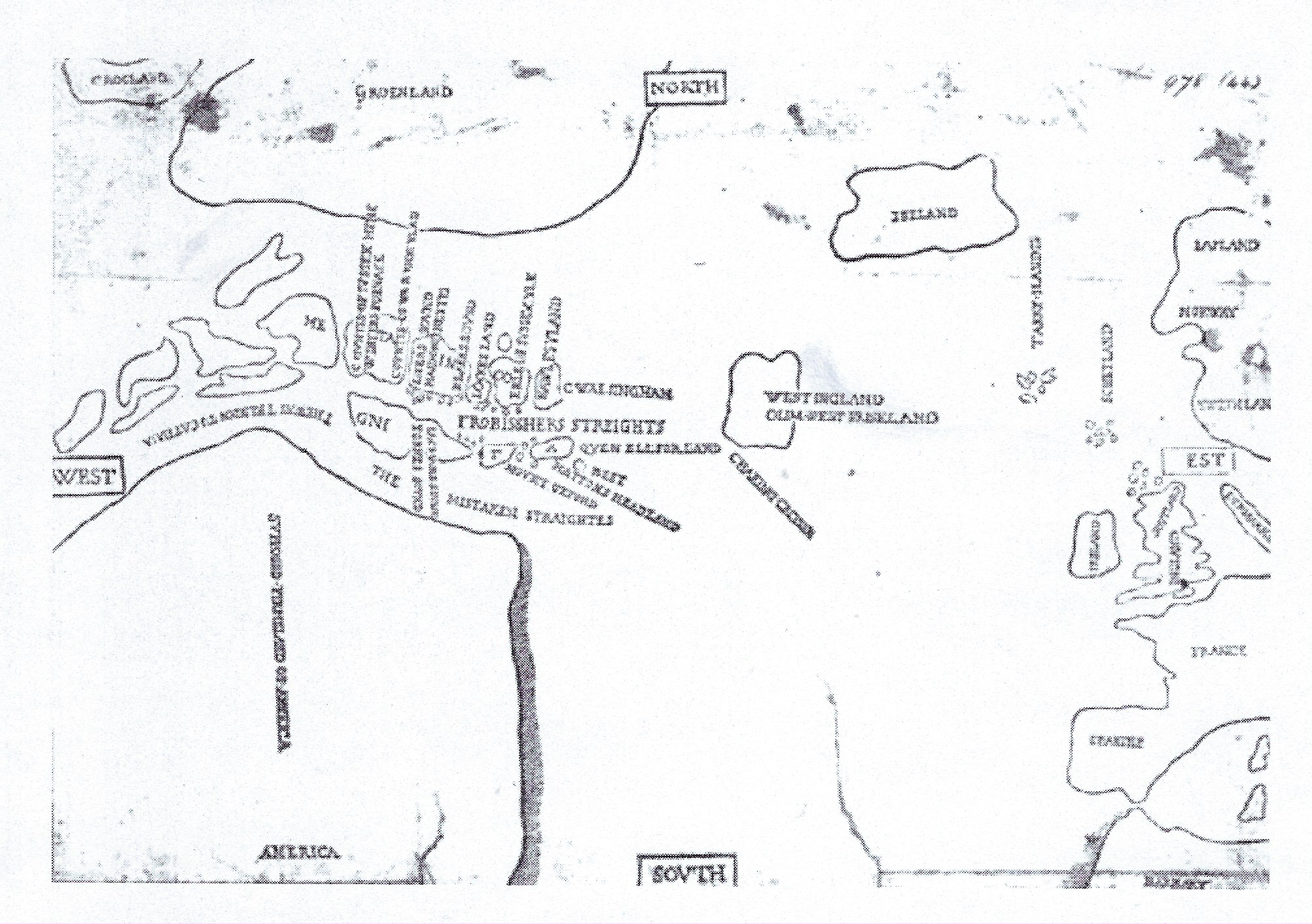
George Best's map showing the location of Mount Oxford, named after Edward de Vere, 17th Earl of Oxford, during the Frobisher voyages of 1576-1578
Huntington Library HM 715, ff. 1-3
List prepared by Michael Lok of moneys received from the venturers in the third Frobisher voyage, likely prepared soon after the ships' departure on 31 May 1578 as Oxford's name does not yet appear among the investors (see preceding document)
Oxford's indenture of 22 June 1578 for the sale of Castle Rising and related properties to Roger Townshend and Robert Buxton for £2396 13s 4d
Recognizance in the amount of £2000 which Oxford acknowledged in Chancery to Roger Townshend and Robert Buxton on 22 June 1578 in connection with Oxford's sale to them of Castle Rising, likely as trustees for Philip Arundel, Earl of Arundel
Northampton Record Office NPL 201
Oxford's indenture of 22 June 1578 for the sale of the manor of Easton Maudit to Christopher Yelverton for £1200
Recognizance in the amount of £2000 which Oxford acknowledged in Chancery to Christopher Yelverton on 22 June 1578 in connection with Oxford's sale to him of the manor of Easton Maudit
Letter dated 30 June 1578 from Edward Fitton to Lord Burghley concerning Oxford's manor of North Rode in Cheshire, part of the jointure of Oxford's wife, Anne
Letter dated 3 July 1578 from Edward Fitton to Lord Burghley mentioning Oxford's manor of North Rode in Cheshire, part of the jointure of Oxford's wife, Anne
Last will and testament, dated 10 July 1578, of Edward Sapcote, father-in-law of Thomas Burnaby, dedicatee of three works by Robert Greene: Greene’s Never Too Late (1590), Francesco’s Fortunes (1590) and A Quip for an Upstart Courtier (1592), and lessee of the Bear Garden in Southwark
Undated petition from Isabel Frobisher to Sir Francis Walsingham requesting financial relief until Martin Frobisher's return, likely from one of the voyages to the Canadian Arctic in which Oxford invested
Recognizance in the amount of £2000 which Oxford acknowledged in Chancery to John Pepys on 5 August 1578 in connection with Oxford's sale to John Pepys and his brother, Robert Pepys, of the manor of Gaywood
Section dedicated to Oxford in Book IV of Gabriel Harvey's Gratulationes Valdinenses, a work presented to the Queen on Harvey's behalf by Leicester on 30 July 1578, and again presented in printed form at Hadham Hall on 15 September 1578
ARCHIVO GENERAL DE SIMANCAS Leg. 834, f. 22S
Letter written on 14 August 1578 by the Spanish ambassador, Mendoza, to de Zayas describing the Queen's humiliation of the Earl of Sussex during the visit of a delegation sent by Alencon, and Oxford's refusal of the Queen's command to dance before the Frenchmen
Extract from a record stating that in 1578 Queen Elizabeth granted an augmentation of his coat of arms to the master of fence, Rocco Bonetti (d.1587), alluded to in Shakespeare's Romeo and Juliet as 'the very butcher of a silk button'
Extract from the Acts of the Privy Council stating that on 29 September 1578 the Council requested the mayor and aldermen to grant the freedom of the city to Rocco Bonetti (d.1587), alluded to in Shakespeare's Romeo and Juliet as 'the very butcher of a silk button'
Last will and testament, dated 6 October 1578, of the 16th Earl's former officer, John Turner, containing a bequest to Oxford
Last will and testament, dated 7 October 1578, of William Slywright, son-in-law of Humphrey Collett, whose daughter, Mercy Collett, son, John Collett, and grandson, Sir John Bodley of Streatham, were involved in the early operation of the Globe theatre
Lichfield Record Office 1579 B/C/11
Last will and testament, dated 12 October 1578, of Elizabeth Peyton Wigston, mother of Roger Wigston, at whose home, Wolston Priory, the last two Marprelate tracts, the Theses Matinianae and the Just Censure and Reproof of Martin Junior, were printed on a secret press in July 1589
Account prepared by Michael Lok circa October 1578 listing the amounts invested by himself and others in all three of the Frobisher voyages, and stating that of his total investment of £4270, Oxford had become a partner with him for £2000 worth of that sum
Last will and testament, dated 7 November 1578, of the personal property of John Mabbe (d.1582), whose son, John Mabbe the younger, purchased Oxford's manors of Gibcrack and Little Yeldham
Last will and testament, dated 20 November 1578, of the real property (including the Tabard Inn in Southwark) of John Mabbe (d.1582), whose son, John Mabbe the younger, purchased Oxford's manors of Gibcrack and Little Yeldham
List dated 30 November 1578 of those, including Oxford, who had not paid all or part of the sums subscribed for the Frobisher voyages, together with an account prepared by Michael Lok of moneys received and paid out, including £585 received from Oxford
Dedicatory epistle to Anne, Countess of Oxford, in John Brooke's A Christian Discourse Upon Certain Points of Religion, published in 1578, a translation from the French version dedicated to Henri de Bourbon, 2nd Prince of Conde
Order made by the Queen on 7 December 1578 directing that those, including Oxford, who had not paid all or part of the sums subscribed for the Frobisher voyages must pay half within 10 days and the other half within a month after
Licence dated 20 December 1578 authorizing Oxford to alienate the manor of Seynt Johns alias le Commandre in East Bergholt to Thomas Walton and Robert Derehaugh
Recognizance in the amount of £500 which Oxford acknowledged in Chancery to John Wood on 21 December 1578 in connection with a sale by Oxford to Wood on 18 December 1578
Recognizance in the amount of 2000 marks which Oxford acknowledged in Chancery on 21 December 1578 to John Cradocke, William Mawson and Thomas Martyn in connection with a sale by Oxford to them on 20 December 1578
Last will and testament, dated 30 December 1578, of Mary Leveson, aunt of William Leveson (d.1621), one of two trustees employed in the allocation of shares in the ground lease of the Globe Theatre in 1599
1579
Letter dated 14 January 1579 from Michael Lok to Sir Francis Walsingham stating that Oxford still owed £450 for his share of the amount assessed for freight in connection with the third voyage of Martin Frobisher in search of the Northwest Passage
TNA CP 25/2/130/1672/21ELIZIHIL, Item 10
Fine in the Court of Common Pleas dated 20 January 1579 by which Oxford transferred clear title to lands in Stansted Mountfitchet in Essex to Edward Hubberd for £480
TNA CP 25/2/130/1672/21ELIZIHIL, Item 25
Fine in the Court of Common Pleas dated 20 January 1579 by which Oxford transferred clear title to lands in Bowers Gifford in Essex to Hugh Beeston and Geoffrey Crome for £180
TNA CP 25/2/130/1673/21ELIZIEASTER, Item 16
Fine in the Court of Common Pleas dated 9 February and 6 May 1579 by which Oxford transferred clear title to the manor of Langdon Hills in Essex to Thomas Mildmay for £310
Last will and testament, dated 14 February 1579, of Roger Alford, at whose house in Hitcham Oxford may have resided for a time in 1564, and who acted as a trustee in Lord Burghley's purchase of the manor of Theobalds from Robert Burbage
Last will and testament, dated 26 February 1579, of Jasper Fisher, one of the Six Clerks of Chancery, whose London mansion of Fisher's Folly in St. Botolph's, Bishopsgate, Oxford owned from circa 1580 until 1588
Recognizance in the amount of £5000 which Oxford acknowledged in Chancery on 3 March 1579 in connection with a recognizance entered into by Edward Hubberd and others as security for repayment of Oxford's debt to Thomas Skinner of £2500
Letter dated 5 March 1579 from Gilbert Talbot to his father, George Talbot, 6th Earl of Shrewsbury, mentioning a device acted by Oxford and three of his young kinsmen before the Queen at Shrovetide
List compiled circa 25 March l 579 of those, including Oxford, who had not paid all or part of the sums subscribed by them for the third Frobisher voyage of 1578
Account prepared circa 25 March 1579 by Michael Lok alleging malfeasance by Martin Frobisher in connection with the three Frobisher voyages of 1576-8 in which investors, including Oxford, lost large sums of money
Account prepared circa 25 March 1579 by Michael Lok of expenses incurred by him in connection with the three Frobisher voyages in which Lok lists Oxford's investment in the voyages at £2430
Indictments stating that on 27 March 1579 Gregory Clover and Thomas Wixsted uttered scandalous words concernng Oxford, Warwick and Leicester
ARCHIVO GENERAL DE SIMANCAS Leg. 832, f. 23
Letter written on 8 April 1579 by the Spanish ambassador, Mendoza, to King Philip II, mentioning that Oxford, the Earl of Surrey and Lord Windsor were proposed as hostages for the Duke of Alencon's visit to England
Lists dated 25 April 1579 of those, including Oxford, who had not paid all or part of the sums subscribed by them for the second and third Frobisher voyages of 1577-8
Dedicatory epistle to Oxford in Geoffrey Gates' The Defence of Military Profession, published in 1579
Dedicatory epistle and English and Latin verses to Oxford in Anthony Munday's The Mirror of Mutability, or Principal Part of the Mirror for Magistrates, published in 1579
Dedicatory epistle to Oxford's father-in-law, Lord Burghley, in John Brooke's A Brief and Clear Confession of the Christian Faith, a translation from the French
Last will and testament, dated 10 June 1579, of Dorothy Gates Josselyn, mother of Jane Josselyn, whose second husband, Roger Harlakenden, defrauded Oxford in the sale of Colne Priory
TNA CP 25/2/131/1674/21ELIZITRIN, Item 22
Fine in the Court of Common Pleas dated 15 June 1579 by which Oxford transferred clear title to lands in Maldon and Woodham Mortimer in Essex to William Twedy for £280
Last will and testament, dated 22 June 1579, of Mary (nee Lake) Gifford, whose nephew, Richard Warren, was the first husband of Elizabeth Hayward, who later married Oxford's foe, Thomas Knyvet
TNA CP 25/2/131/1674/21ELIZITRIN, Item 12
Fine in the Court of Common Pleas dated 29 June 1579 by which Oxford's uncle, Robert Vere, transferred clear title to the manors of Kennington and Wennington in Essex to William Ayloffe for £680, manors in which Robert Vere held only a life estate while Oxford held the reversionary interest
TNA CP 25/2/157/2160/21ELIZITRIN, Item 11
Fine in the Court of Common Pleas dated 29 June 1579 by which Oxford transferred clear title to the manor of Hormead in Hertfordshire to Anthony Cage the elder for £640
Recognizance in the amount of £1000 which Oxford acknowledged in Chancery to Thomas Noke on 3 July 1579 in connection with Oxford's sale to him of the manor of Shottesbrook
TNA CP 25/2/131/1675/21/22ELIZITRIN, Item 10
Fine in the Court of Common Pleas dated 6 July and 6 October 1579 by which Oxford transferred clear title to lands in Rainham, Wennington and Aveley in Essex to William Ayloffe and his son, William Ayloffe, for £16
Extract from the Acts of the Privy Council dated 9 July 1579 directing the mayor and aldermen to inquire into violence by other fencers against the master of fence, Rocco Bonetti (d.1587), alluded to in Shakespeare's Romeo and Juliet as 'the very butcher of a silk button'
Last will and testament, dated 20 July 1579, of Margaret Forster Bassett Sulyard Ayloffe, sister-in-law of the wife of Oxford's maternal uncle, Henry Golding, and mother of Sir Edward Sulyard, to whom William Webbe dedicated A Discourse of English Poetry, in which Oxford is praised
Last will and testament, dated 31 July 1579, of Richard Cooke, the brother of Oxford's mother-in-law, Lady Burghley
Account by Michael Lok of the misconduct of Martin Frobisher in his three voyages to the Canadian Arctic near Baffin Island in the years 1576-8 which led to huge losses for the investors, including Oxford
Recognizance in the amount of £400 which Oxford acknowledged in Chancery to Edward Atslowe on 15 August 1579
Recognizance in the amount of £500 which Oxford acknowledged in Chancery on 15 August 1579 in connection with indentures between Oxford and Edward Atslowe of the same date
Recognizance in the amount of £1500 which Oxford acknowledged in Chancery to Thomas Ashfield on 17 August 1579 in connection with Oxford's sale to him of the manor of Chesham Bury
Recognizance in the amount of £800 which Oxford acknowledged in Chancery to Thomas Duncombe on 17 August 1579 in connection with Oxford's sale to him of the honour or manor of Whitchurch
Recognizance in the amount of £3000 which Oxford acknowledged in Chancery to Sir James Harington on 18 August 1579 in connection with Oxford's sale to him of the manor of Elmsthorpe
Copy of a letter dated 25 August 1579 from Philip Sidney to Sir Christopher Hatton in response to the latter's advice that the 'tennis-court quarrel' between Sidney and Oxford should be made up
Last will and testament, proved 2 November 1579, of Sir William Devereux, great-uncle of Robert Devereux, 2nd Earl of Essex, in which the testator appoints Thomas Trentham, father of Oxford's second wife, Elizabeth Trentham, as one of his executors
Last will and testament, dated 16 November 1579, of Anthony Bonner, whose daughter, Mary, was the mother of Thomas Combe to whom William Shakespeare of Stratford upon Avon left a sword
1580
Last will and testament, dated 16 January 1580, of Wistan Browne, who appears to be the Wistan Browne who, together with his father, George Browne, is mentioned in the IPM of Oxford's father, John de Vere
Last will and testament, dated 18 January 1580, of Oxford's paternal uncle, Aubrey de Vere
TNA CP 25/2/131/1676/22ELIZIHIL, Item 8
Fine in the Court of Common Pleas dated 20 January 1580 by which Oxford transferred clear title to lands in Doddinghurst in Essex to Richard Stonley for 130 marks
TNA CP 25/2/131/1676/22ELIZIHIL, Item 10
Fine in the Court of Common Pleas dated 20 January 1580 by which Oxford transferred clear title to the manor of Mountnessing in Essex to Sir John Petre for £480
TNA CP 25/2/131/1676/22ELIZIHIL, Item 12
Fine in the Court of Common Pleas dated 20 January 1580 by which Oxford transferred clear title to lands in Mundon and Purleigh to Thomas Wilson for 130 marks
Indenture dated 26 January 1580 by which Oxford granted a 21-year lease of Hall Meadow to Richard Simon of Birchanger
Last will and testament, dated 28 January 1580, of Henry Poole, part of whose former property in the Blackfriars was sold in 1610 to Richard and Cuthbert Burbage
Indenture of 11 February 1580 by which Jane Kelton transferred to her first cousin, Geoffrey Gates, the remainder of the 21-year lease of Colne Priory granted by Oxford to her late husband, Richard Kelton, Oxford's receiver
Indenture dated 26 February 1580 by which Frances Baynham Jerningham leased property in the Blackfriars which adjoined the premises which later became James Burbage's Blackfriars theatre to Sir George Carey for a term of twenty-one years
Licence dated 1 March 1580 authorizing Oxford to alienate his manor of Wakes Colne to his servant, Israel Amyce, and to William Tyffyn
Last will and testament, dated 3 March 1580, of John Lambert, uncle of Humphrey Martyn, addressee of the Langham Letter, which includes bequests to Humphrey Martyn and his brother, Edmund
Recognizance in the amount of £240 which Oxford acknowledged in Chancery to Robert Petre on 5 March 1580 in connection with Oxford's sale to Petre of lands in Gibcrack, Purleigh and Sandon
Recognizance in the amount of £1600 which Oxford acknowledged in Chancery to Richard Stonley on 5 March 1580 in connection with Oxford's sale to Stonley of the manor of Doddinghurst
Recognizance in the amount of 1000 marks which Oxford acknowledged in Chancery on 5 March 1580 to his servant, Hugh Beeston the younger, cancelled by a vacat on 27 June 1580
Recognizance in the amount of £800 which Oxford acknowledged in Chancery to Edward Hubberd on 11 March 1580 in connection with Oxford's sale to Hubberd of the manor of Bentfield Bury
Recognizance in the amount of £300 which Oxford acknowledged in Chancery on 23 March 1580 in connection with the sale to George Golding and his wife, Mary, of the manors of Waltons and Netherhall
Recognizance in the amount of £1000 which Oxford acknowledged in Chancery on 27 March 1580 in connection with the sale to George Knightley of the manor of Gutteridge
Recognizance in the amount of £1200 which Oxford acknowledged in Chancery on 30 March 1580 in connection with the sale to Sir Christopher Hatton of manors in Cheshire
Indenture of 1 April 1580 by which Oxford granted a lease for 21 years of a cottage and garden at Castle Hedingham to his servant, Nicholas Bleake
Satiric verses said to be connected to a fray on 10 April 1580 at the Theatre in Shoreditch involving Oxford's Men and gentlemen of the Inns of Court, occasioned by the former having forsaking Leicester's brother, the Earl of Warwick, and become followers of Oxford
Recognizance in the amount of £1000 which Oxford acknowledged in Chancery on 10 April 1580 in connection with the sale to George Golding and his wife, Mary, of the manors of Waltons and Netherhall
Recognizance in the amount of £1000 which Oxford acknowledged in Chancery on 12 April 1580 to John Byrd, brother of the composer, William Byrd, in connection with Oxford's sale to John Byrd of the manor of Battles Hall on 8 April 1580
Recognizance in the amount of 1000 marks which Oxford acknowledged in Chancery on 17 April 1580 to his servant, Hugh Beeston the younger, likely in connection with the sale to Hugh Beeston and Geoffrey Crome of lands in Bowers Gifford
Recognizance in the amount of 1000 marks which Oxford acknowledged in Chancery on 17 April 1580 in connection with sales to George Golding, Richard Brooke and Nicholas Lambert
Last will and testament, dated 14 April 1580, of Joan, second wife of William Saunders of Ewell, cofferer to Queen Mary I, whose first wife was the sister of Oxford’s step-grandmother, Ursula (nee Marston) Golding
TNA CP 25/2/131/1677/22ELIZIEASTER, Item 2
Fine in the Court of Common Pleas dated 18 April 1580 by which Oxford transferred clear title to lands in Gibcrack, Purleigh and Sandon in Essex to Robert Petre for £40
TNA CP 25/2/131/1677/22ELIZIEASTER, Item 3
Fine in the Court of Common Pleas dated 18 April 1580 by which Oxford transferred clear title to the manor of Maldon in Essex to William Twedy for 130 marks
TNA CP 25/2/131/1677/22ELIZIEASTER, Item 6
Fine in the Court of Common Pleas dated 18 April 1580 by which Oxford transferred clear title to the manor of Gutteridge in Essex to George Knightley for £220
TNA CP 25/2/131/1677/22ELIZIEASTER, Item 9
Fine in the Court of Common Pleas dated 18 April 1580 by which Oxford transferred clear title to the manor of Battles Hall in Essex to John Byrd for 400 marks
TNA CP 25/2/131/1677/22ELIZIEASTER, Item 17
Fine in the Court of Common Pleas dated 18 April 1580 by which Oxford transferred clear title to the manor of Bentfield Bury in Essex to Edward Hubberd for £400
TNA CP 25/2/131/1677/22ELIZIEASTER, Item 19
Fine in the Court of Common Pleas dated 18 April 1580 by which Oxford transferred clear title to the manor of Doddinghurst in Essex to Richard Stonley for £360
TNA CP 25/2/131/1677/22ELIZIEASTER, Item 28
Fine in the Court of Common Pleas dated 18 April 1580 by which Oxford transferred clear title to lands in sixteen villages in the area of Maldon in Essex to Richard Brooke and Nicholas Lambert for 130 marks
TNA CP 25/2/131/1677/22ELIZIEASTER, Item 34
Fine in the Court of Common Pleas dated 18 April 1580 by which Oxford transferred clear title to the manor of Gobions in Essex to Edward Lawrence for £600
TNA CP 25/2/131/1677/22ELIZIEASTER, Item 36
Fine in the Court of Common Pleas dated 18 April 1580 by which Oxford transferred clear title to the manors of Waltons and Netherhall in Essex to George Golding and his wife, Mary, for £320
Licence dated 20 April 1580 authorizing Oxford to alienate his manor of Weybourne in Norfolk to Sir Edward Clere
Indenture dated 20 April 1580 between Oxford and his servant William Walter in which Oxford granted William Walter a forty-year lease in reversion of Colne Park
TNA CP 25/2/131/1677/22ELIZIEASTER, Item 23
Fine in the Court of Common Pleas dated 2 May 1580 by which Leicester transferred clear title to the manors of Wanstead and Stonehall in Essex to Thomas Skinner for £40, a transaction related to Leicester's later purchase of the manors of Cranbrook and Rayhouse from Oxford on 9 June 1585
Last will and testament, dated 6 May 1580, of Sir John Thynne, builder of Longleat and friend of Oxford's father-in-law, Lord Burghley
Exemplification of a common recovery, dated 11 May 1580, between Oxford, on the one part, and Sir William Cordell and Edward Cordell, on the other part, of the manor of Barwicks in Toppesfield
Licence dated 12 May 1580 authorizing Oxford to alienate his manor of Bumpstead to William Stubbing
Recognizance in the amount of £1200 which Oxford acknowledged in Chancery on 12 May 1580 in connection with the sale to Israel Amyce and William Tyffyn of the manor of Wakes Colne
Recognizance in the amount of £2000 which Oxford acknowledged in Chancery on 12 May 1580 in connection with the sale to Sir Edward Clere of the manor of Weybourne in Norfolk
TNA CP 25/2/131/1678/22ELIZITRIN, Item 22
Fine in the Court of Common Pleas dated 13 and 30 May 1580 by which Oxford transferred clear title to the manor of Great Canfield in Essex to John Wiseman for 400 marks
Recognizance in the amount of £800 which Oxford acknowledged in Chancery on 19 May 1580 in connection with Oxford's sale to John Shuckburgh of the manor of Bilton
Recognizance in the amount of £2000 which Oxford acknowledged in Chancery on 19 May 1580 in connection with the sale to Nicholas West of the manors of Chesham Higham and Chesham Bury
Recognizance in the amount of £1200 which Oxford acknowledged in Chancery on 19 May 1580 in connection with the sale to William Stubbing of the manor of Bumpstead
TNA CP 25/2/131/1678/22ELIZITRIN, Item 20
Fine in the Court of Common Pleas dated 30 May 1580 by which Oxford transferred clear title to the manor of Fingrith in Essex to Richard Branthwayte for £200
TNA CP 25/2/131/1678/22ELIZITRIN, Item 26
Fine in the Court of Common Pleas dated 30 May 1580 by which Oxford transferred clear title to the manor of Wakes Colne in Essex to Israel Amyce and William Tiffin for 400 marks
TNA CP 25/2/131/1678/22ELIZITRIN, Item 28
Fine in the Court of Common Pleas dated 30 May 1580 by which Oxford transferred clear title to the manor of Bumpstead Hall in Essex to William Stubbing for an annuityof £30 payable to Oxford and his heirs
Last will and testament, dated 31 May 1580, of Francis Newdigate, the uncle of Anne Saunders, whose husband, George Saunders,was murdered on 25 March 1573 by Oxford's former servant, George Browne
Petition of Julio Borgarucci for commission on sale of Great Garden property at Aldgate to Oxford, and answer of Benedict Spinola
Last will and testament, dated 10 June 1580, of Henry Tyrrell, who was in the service of Henry Scrope, 9th Baron Scrope of Bolton, husband of Oxford's first cousin, Margaret Howard
Letter dated 14 June 1580 from John Hatcher, Vice-chancellor of the University of Cambridge, to Lord Burghley, denying Lord Burghley's request that Oxford's players be permitted to perform at the university
Indenture dated 14 June 1580 between Oxford and his trustees George Kirkham, Hugh Beeston and William Walter made in connection with Oxford's purchase from Benedict Spinola of the Great Garden property at Aldgate
Indenture dated 15 June 1580 between Oxford and Benedict Spinola in connection with Oxford's purchase from Spinola of the Great Garden property at Aldgate
Copy on the close rolls of the indenture dated 15 June 1580 above by which Benedict Spinola sold the Great Garden property at Aldgate to Oxford
Recognizance in the amount of £200 which William Stubbing acknowledged in Chancery on 21 June 1580 in connection with an annuity of £30 payable to Oxford in connection with the sale of the manor Bumpstead
Last will and testament, dated 6 July 1580, of Benedict Spinola, who forwarded funds to Oxford during his continental tour, and from whom Oxford purchased the Great Garden property at Aldgate
Recognizance in the amount of £1800 which Oxford acknowledged in Chancery to Philip Tilney on 8 July 1580 in connection with Oxford's sale to Tilney of the manor of Aldham
Epitaph on the death on 12 July 1580 of Benedict Spinola from whom Oxford purchased the Great Garden property at Aldgate
Recognizance in the amount of £2000 which Thomas Woodhouse acknowledged in Chancery on 14 August 1580 in connection with the sale to Oxford of the manor of Hickling in Norfolk
Recognizance in the amount of £7000 which Oxford acknowledged in Chancery on 16 September 1580 in connection with the sale to Thomas Skinner of the manors of Castle Camps and Fowlmere
Recognizance in the amount of 2000 marks which Oxford acknowledged in Chancery on 17 September 1580 in connection with indentures between Oxford and Thomas Skinner dated 16 September 1580
Oxford’s appointment of a council of six officers on 17 September 1580 consisting of William Daniel, Richard Branthwayte, Edward Hubberd, Israel Amyce, George Golding and John Mynors
Dedicatory epistle to Oxford in John Hester's A Short Discourse of the Excellent Doctor and Knight, Master Leonardo Fioravanti, Bolognese, Upon Surgery, a translation from Italian published in 1580
Dedicatory epistle to Oxford in John Lyly's Euphues and his England, published in 1580
Dedicatory epistle to Oxford in Anthony Munday's Zelauto, published in 1580
Dedicatory epistle to Anne, Countess of Oxford, in Abraham Fleming's The Epistle of the Blessed Apostle Saint Paul, published in 1580, a translation from the Latin of Neils Hemmingsen's Commentarius in epistolam Pauli ad Ephesios
Last will and testament, dated 20 October 1580, of Frances Thwaytes Gresham, whose executor, Sir Edward Neville, was the husband of Grisold Hughes, a second cousin of Oxford’s father, John de Vere, 16th Earl of Oxford
Copy of a warrant dated 4 November 1580 by which Oxford authorized the payment of £200 per annum to his estranged wife, Anne Cecil, by his receiver-general, Edward Hubberd
Recognizance in the amount of £900 which Lewis, 3rd Baron Mordaunt, acknowledged in Chancery on 26 November 1580 in connection with indentures between Lord Mordaunt and Oxford
Recognizance in the amount of £500 which Oxford acknowledged in Chancery on 28 November 1580 to Thomas Thomson and Thomas Kelton in connection with a six-year lease to them to cut down and carry away the timber in Chalkney Wood
Last will and testament, dated 30 November 1580, of Richard Farrant, whose widow sublet her late husband's lease of Sir William More's house in the Blackfriars to William Hunnis, who transferred his interest to Henry Evans, who sold it to Oxford, who gave it to John Lyly
Letter dated 25 December 1580 from Anne Farrant to Sir William More of Loseley requesting that More allow her to sublease the premises in the Blackfriars which More had leased to her late husband, Richard Farrant, site of the first Blackfriars playhouse
Notes of allegations against Oxford in Lord Henry Howard's hand, with additions and a lengthy personal note to Howard in the hand of Francis Southwell providing evidence of collusion between Howard and Southwell, likely compiled shortly after Southwell's examination by the authorities on or about 25 December 1580
Last will and testament, dated 26 and 30 December 1580, of Dr Julio Borgarucci, mentioned in an allegation of Oxford's with respect to Leicester's involvement in the poisoning of Walter Devereux, 1st Earl of Essex
Allegations against Oxford in Charles Arundel's hand with additions and corrections in the hand of Lord Henry Howard, perhaps compiled when Howard and Arundel were at the house of the Spanish ambassador, Mendoza, on 26 and 27 December 1580
Unsigned draft in the hand of Charles Arundel of a statement to the Privy Council concerning his secret meeting with Oxford at court on the night of 25 December 1580, likely written by Arundel on 28 December 1580 after he and Lord Henry Howard had given themselves up to the authorities
Revision of TNA SP 15/27/46, ff. 81-2 above, in the hand of and signed by Charles Arundel, concerning his secret meeting with Oxford at court on the night of 25 December 1580
Allegations against Leicester attributed to Oxford, written in the hand of Charles Arundel in late December 1580 or early January 1581
Letter dated 30 December 1580 in which Thomas Norton suggests to Sir Christopher Hatton that 'the gentleman in restraint' (likely Charles Arundel, who was in Hatton's custody) be examined concerning the authorship of treasonous books and other matters
1581
Dedicatory epistle dated 1 January [1581] to Philip Howard, Earl of Surrey, in Thomas Churchyard's A Light Bundle of Lively Discourses Called Churchyard's Chance, in which Churchyard promises to dedicate his next book to Oxford
Letter dated 1 January 1581 written to Count Philip Edward Fugger in Augsburg by a correspondent in Antwerp stating that Lord Henry Howard, Charles Arundel and Francis Southwell had been imprisoned for conspiring against the Queen
Letter from Lord Henry Howard to Queen Elizabeth containing allegations against Oxford, written by Howard at the Queen's commandment shortly after 30 December 1580
A second letter from Lord Henry Howard to Queen Elizabeth containing allegations against Oxford, in particular an allegation that Oxford had vaunted of receiving sexual favours from the Queen, written by Howard at the Queen's commandment
ARCHIVO GENERAL DE SIMANCAS Leg. 835, f. 6
Letter written on 9 January l 581 by the Spanish ambassador, Mendoza, to King Philip II, reporting the arrests of Lord Henry Howard, Charles Arundel and Francis Southwell, and stating that Leicester was inflaming the people against them and against the French
TNA SP 12/147/4, 4. I, ff. 5-6
Excerpt from a letter from Thomas Norton to Sir Francis Walsingham endorsed 10 January 1581, enclosing interrogatories which had already been administered to Lord Henry Howard by the Lord Chancellor, Sir Thomas Bromley
Letter from Michel de Castelnau, Sieur de Mauvissiere, to King Henri III dated 11 January 1581 mentioning Oxford's allegations against Lord Henry Howard and Charles Arundel
Transcript by M. Armand Baschet of part of BN 15973, ff. 387v-392v above
Transcript by J. H. Pollen and W. MacMahon, and translation by B.M. Ward, of part of BN 15973, ff. 387v-392v above
Letter from Michel de Castelnau, Sieur de Mauvissiere, to Queen Catherine de Medici of 11 January 1581 mentioning Oxford's allegations against Lord Henry Howard and Charles Arundel
Letter endorsed 12 January 1581 in which Lord Henry Howard requests Sir Francis Walsingham to speak favourably for him to the Queen, and states that Oxford's message that he would be revenged on Howard was brought to him by Charles Arundel on 16 December 1580
Interrogatories for Charles Arundel concerning treasonous activities, likely administered shortly after Howard and Arundel had turned themselves in to the authorities after their flight to the house of the Spanish ambassador Mendoza on the night of 25 December 1580
Answers by Charles Arundel to interrogatories in TNA SP 12/151/47, ff. 105-6
Interrogatories in Oxford's hand to be administered to Lord Henry Howard and Charles Arundel
Interrogatories in Oxford's hand to be administered to Lord Henry Howard and Charles Arundel
Answers in Charles Arundel's hand to interrogatories in Oxford's hand in SP 12/151/42, f. 96 and SP 15/28/2, f. 3
Allegations against Oxford in Charles Arundel's hand, intended as a letter to the Queen, likely written in January 1581 after Arundel had been examined on interrogatories prepared from Oxford's notes
Extensive allegations against Oxford in Charles Arundel's hand, compiled for the stated purpose of discrediting Oxford's credibility as a witness against Howard, Arundel and Southwell
Account in Sir William Segar's The Book of Honor and Armes (1590) of two tournaments in which Oxford participated, the first on 1-3 May 1571, and the second on 22 January 1581
Speech spoken by Oxford's page at a tournament at Whitehall on 22 January 1581 in which Oxford took part as the Knight of the Tree of the Sun
BL MS Lansdowne 99, ff. 259a-64b
Oxford’s response as the Knight of the Tree of the Sun to Philip Howard's challenge as Callophisus, issued in the form of a printed broadside
Recognizance in the amount of £1000 which Oxford acknowledged in Chancery to John Waterhouse on 31 January 1581 in connection with Oxford's sale to Waterhouse of the manor of Whitchurch
Last will and testament, dated 3 February 1581, of Oxford's first cousin, John Darcy, 2nd Baron Darcy of Chiche, one of the guarantors of Oxford's debt to the Court of Wards
Last will and testament, dated 6 February 1581, of Sir Robert Throckmorton, who was the uncle of Oxford's friend, Arthur Throckmorton, and whose grandson, William Norwood, was the brother-in-law of Margaret Lygon, mother of Thomas Russell, overseer of the will of William Shakespeare of Stratford
Fine in the Court of Common Pleas dated 9 February and 12 April 1581 by which clear title to the castle of Camps and the manors of Castle Camps and Fowlmere passed from Oxford to Thomas Skinner for £1200
Recognizance in the amount of 2000 marks which Oxford acknowledged in Chancery to John Mabbe the younger on 16 February 1581 in connection with the sale of the manor of Gibcrack
Recognizance in the amount of £500 which Oxford acknowledged in Chancery on 19 March 1581 to Humphrey Drywood and Robert Drywood in connection with Oxford's sale to them of the manor of Earls Fee
NORFOLK RECORD OFFICE NRS 10865 25 D4
Release, dated 20 March 1581, by Robert Christmas to Sir Edward Clere of his interest in the manor of Weybourne in Norfolk acquired under the 16th Earl's will
Letter of 23 March 1581 in which Sir Francis Walsingham advises the Earl of Huntingdon of Anne Vavasour's imprisonment in the Tower after the birth of her illegitmate son by Oxford on the night of 21 March 1581, and of attempts to apprehend Oxford
TNA SP 12/151/51, ff. 111v, 112
Copies of six letters written by Charles Arundel in late March or early April 1581 concerning Oxford's imprisonment and Leicester's assistance to Oxford in preventing the release of Arundel and Lord Henry Howard from house arrest
Undated letter from Sir Christopher Hatton to the Queen in which Hatton may have referred to Oxford as 'your Turk'
Letter dated 1 April 1581 written to Count Philip Edward Fugger in Augsburg by a correspondent in Paris stating that Lord Henry Howard, Charles Arundel and Francis Southwell had been imprisoned for a Catholic plot, and that Oxford, having renounced Catholicism, had been set free
Last will and testament, dated 4 April 1581, of Vincent Guicciardini, apparently a nephew of the historian Francesco Guicciardini, author of Historia d'Italia, of which Oxford owned a copy in the original Italian, now in the Folger Shakespeare Library
Letter written by Charles Arundel in late March or early April 1581 to an unidentified highly-placed personage concerning his removal to a 'wilderness', likely Sutton in West Sussex, where he remained under house arrest until August 1581
Letter dated 14 April 1581 written from Orleans by Henry Percy to Lord Burghley containing commendations to Oxford's wife, Anne Cecil
Last will and testament, dated 15 April 1581, of Anne Pickering Weston Knyvet Vaughan, grandmother of Oxford's mistress, Anne Vavasour, and mother of Oxford's foe, Sir Thomas Knyvet
Last will and testament, dated 18 April 1581, of Sir William Cordell, one of five trustees appointed by Oxford in an indenture of 30 January 1575 prior to his departure on his continental tour
Letter dated 29 April 1581 written to Count Philip Edward Fugger in Augsburg by a correspondent in England stating that Lord Henry Howard, Charles Arundel and Francis Southwell had been in prison for four months, and that Oxford and Anne Vavasour were now in the Tower as a result of the birth of their illegitimate son
Dedicatory epistle of 6 May 1581 to Oxford in Thomas Stocker's Divers Sermons of Master John Calvin, a translation from the French of Plusieurs sermons touchant la divinite humanite et nativite de nostre Seigneur Jesus Christ
Last will and testament, dated 9 May 1581, of John Freke, co-purchaser with Matthew Bragge of Oxford's manor of Thorncombe in Devonshire (now Dorset)
TNA CP 25/2/131/1682/23ELIZITRIN, Item 31
Fine in the Court of Common Pleas dated 22 May 1581 by which Oxford transferred clear title to the manors of Waltons and Netherhall in Essex to George Golding and his wife, Mary, for £320
TNA CP 25/2/131/1683/23/24ELIZIMICH, Item 54
Fine in the Court of Common Pleas dated 22 May 1581 by which Oxford transferred clear title to the manor of Gibcrack in Essex to John Mabbe the younger for £400
Last will and testament, dated 24 May 1581, of Thomas Howard, 1st Viscount Bindon, brother of Oxford's uncle, Henry Howard, Earl of Surrey, who appointed as executor Bartholomew Clerke, translator of The Courtier, to which Oxford contributed a Latin epistle
Petition dated 16 June 1581 by Michael Lok to the Privy Council requesting release from the Fleet prison, and setting out, among other things, the circumstances of Oxford's earlier purchase of a half share in Lok's investment in the Frobisher voyages
Letter dated 18 June 1581 from Thomas, Lord Wentworth, to Lord Burghley concerning the marriage of Oxford's sister-in-law, Elizabeth Cecil, and William Wentworth
Letter dated 20 June 1581 from Thomas, Lord Wentworth, to Lord Burghley concerning the marriage of Oxford's sister-in-law, Elizabeth Cecil, and William Wentworth
Entries, beginning 24 June 1581, providing evidence of the residence in London and place and date of death of Rocco Bonetti (d.1587), alluded to in Shakespeare's Romeo and Juliet as 'the very butcher of a silk button'
Last will and testament, dated 29 June 1581, of Henry Wriothesley, 2nd Earl of Southampton, father of Henry Wriothesley, 3rd Earl of Southampton, to whom Shakespeare dedicated Venus and Adonis and The Rape of Lucrece
Letter dated 12 July 1581 from Sir Francis Walsingham to Lord Burghley advising that the Queen has decided 'upon some persuasion' that Oxford must reconcile with his wife, Anne Cecil, before the Queen will restore his full liberty
Copy of a letter of 13 July 1581 in which Lord Burghley thanks Sir Christopher Hatton for his intervention with the Queen, and urges that Oxford not be forced to reconcile with his wife as a condition of being granted his full liberty
BL MS Lansdowne 33/6, ff. 12-13
Letter written circa 13 July 1581 in which Oxford urges Lord Burghley to remind the Queen of her promise that he is to be restored to full liberty
Letter of 14 July 1581 in which Sir Francis Walsingham advises Lord Burghley of his efforts to secure Oxford's liberty, and of the Queen's insistance that Oxford publicly accuse Lord Henry Howard and Charles Arundel
Copy of a letter endorsed 20 July 1581 in which Lord Henry Howard requests assistance in securing his liberty, and mentions that whenever the subject is broached to the Queen, she demands a face to face confrontation between himself and Oxford
Copy of an undated letter written circa July 1581 by Charles Arundel to an unidentified highly-placed personage requesting assistance in securing his liberty after he had been imprisoned 7 months, in which Arundel makes reference to efforts being made by others to secure Oxford's liberty
Copy of an undated letter written circa July 1581 by Charles Arundel to an unidentified highly-placed personage while he was still under house arrest, mentioning a libel which he alleges Oxford has accused him of writing against the unidentified personage in question
Letter dated 12 August 1581 from the Spanish ambassador, Mendoza, to King Philip II stating that the Queen has sent Lord Henry Howard on an embassy to her suitor, the Duke of Alencon and Anjou
Copy of an undated unsigned letter allegedly written in 1581 by Charles Arundel to an unidentified gentleman in which Arundel agrees to work with the gentleman in question to further their joint purpose
Copy of an undated unsigned letter allegedly written in 1581 to Charles Arundel seeking his involvement in conveying money overseas, perhaps to Catholic exiles on the continent
Copy of an undated unsigned letter allegedly written in 1581 by Charles Arundel to Mr Dorsey, apparently in reply to TNA SP 12/151/56, f. 116 above, in which Arundel acknowledges having conveyed money overseas, perhaps to Catholic exiles on the continent
Answers by Charles Arundel to accusations allegedly made against him by Oxford, allegations by Arundel against Oxford, and a letter by Arundel to an unnamed friend all dating from July and August 1581 while Arundel was under house arrest
Last will and testament, dated 24 August 1581, of Anthony Cage, who purchased Oxford's manor of Hormead, and whose son competed with Oxford for the right to serve as chamberlain to Queen Anne at the coronation of James I
ARCHIVO GENERAL DE SIMANCAS Leg. 835, f. 149
Letter dated 11 September 1581 from the Spanish ambassador, Mendoza, to King Philip II which states that Oxford has been deputed to accompany Don Antonio on his departure from England
TNA SP 12/155/44, ff. 84-84bis
Letter dated 14 September 1581 from Lord Henry Howard to Sir Francis Walsingham requesting Walsingham to further his suit for reinstatement in the Queen's favour, and accusing Leicester of having caused Oxford to make an allegation against Howard concerning a prophecy
Letter dated 19 September 1581 from Leicester to Sir William More of Loseley advising that Anne Farrant had sold her lease of premises in the Blackfriars to William Hunnis, Master of the Children of the Chapel
Letter dated 27 September 1581 from the Spanish ambassador, Mendoza, to King Philip II stating that Lord Henry Howard has returned from his embassy to the Queen's suitor, the Duke of Alencon and Anjou
Last will and testament, dated 6 October 1581, of Francis Southwell, whose son, Miles Southwell, married the sister of Oxford's mistress, Anne Vavasour, and who made his nephew, Francis Southwell, who was involved in allegations against Oxford in 1581, his residuary legatee
Last will and testament, dated 6 October 1581, of Elizabeth Martyn (d.1583), stepmother of Humphrey Martyn, addressee of the Langham Letter, and investor in the Frobisher voyages in which Oxford also invested, and suffered heavy losses
Letter dated 19 October 1581 from Thomas Radcliffe, 3rd Earl of Sussex, to his kinsman, Charles Arundel, concerning the Queen's suspicions about Arundel's recent visit to the home of Henry Percy, 8th Earl of Northumberland, at Petworth in Sussex
Letter of 27 October 1581 written by Lord Henry Howard to Leicester from Highgate, asking to be reconciled to him, and currying favour by claiming he had stayed Oxford's hand against Leicester in the past
TNA CP 25/2/131/1683/23/24ELIZIMICH, Item 10
Fine in the Court of Common Pleas dated 27 October 1581 by which Oxford transferred clear title to the manor of Earls Fee in Essex to Humphrey Drywood and Robert Drywood for £180
Oxford’s lawsuit in Chancery of 11 November 1581 as guardian of 4-year-old Henry Bullock to put a stop to fraud by Bullock’s uncle, Richard Wiseman
Letter of 3 December 1581 written by Lord Henry Howard after his release from house arrest to Sir Francis Walsingham at court, indicting that rumours have reached him of a fresh attempt to shake and undermine his liberty
BL MS Lansdowne 104/63, ff. 164-165
Copy in Lord Burghley's hand of a letter dated 7 December 1581 to Oxford from his estranged wife Anne, expressing her love for him and hope to be returned to his favour
Recognizance in the amount of £200 which Oxford acknowledged in Chancery on 10 December 1581 to William Drury in connection with Oxford's sale to him of a yearly rent of £12 from the manors of Tendring Hall and Garnons
BL MS Lansdowne 104/64, ff. 166-167
Copy in Lord Burghley's hand of a letter dated 12 December 1581 to Oxford from his estranged wife Anne, expressing her willingness to bear his adverse fortune, and alluding to Oxford's warning about Lady Drury
Recognizance in the amount of £800 which Oxford acknowledged in Chancery on 16 December 1581 to William Lewin in connection with Oxford's sale to Lewin, Anthony Luther and Thomas Gooche of the manor of Flanderswick
Recognizance in the amount of £400 which Oxford acknowledged in Chancery on 16 December 1581 to John Baet, citizen and cloth-worker of London, in connection with a sale of property
Recognizance in the amount of £1200 which Oxford acknowledged in Chancery on 16 December 1581 to William Brewster, Robert Plombe, William Bigg and William Adams alias Butcher in connection with a sale of property
Dedicatory epistle to Anne, Countess of Oxford, in An Exposition Upon the Epistle of St. Paul to the Ephesians, a translation of Expositio super Epistolam Sancti Pauli ad Epheseos, published on 24 December 1581
ARCHIVO GENERAL DE SIMANCAS Leg. 835, ff. 121-4
Letter from the Spanish ambassador, Mendoza, to King Philip II written on 25 December 1581 describing the flight of Lord Henry Howard and Charles Arundel to his house a year earlier on 25 December 1580, and Lord Henry Howard's service as a spy for Spain since that time
1582
Last will and testament, dated 2 January 1582, of Thomas Chapman, father of the poet and playwright, George Chapman, who described Oxford in The Revenge of Bussy D'Ambois as 'valiant and learned and liberal as the sun'
TNA CP 25/2/131/1684/24ELIZIHIL, Item 6
Fine in the Court of Common Pleas dated 20 January 1582 by which Oxford transferred clear title to a yearly rent of £12 from the manors of Tendring Hall and Garnons to William Drury for £240
TNA CP 25/2/131/1684/24ELIZIHIL, Item 13
Fine in the Court of Common Pleas dated 20 January 1582 by which Oxford transferred clear title to the manor of Flanderswick to William Lewin, Anthony Luther and Thomas Gooche for 400 marks
Last will and testament, dated 28 January 1582, of Mary Denny Gates, whose husband, Sir John Gates, was named as an executor in the 1552 will of the 16th Earl of Oxford
BL MS Cotton Appendix 47, f. 5
Entry dated 3 February 1582 in the diary of Richard Madox mentioning that Oxford and his wife Anne had been reconciled
Last will and testament, dated 14 February 1582, of Elizabeth Lyster Blount, whose nephew, Richard Lyster, married Mary Wriothesley, aunt of Henry Wriothesley, 3rd Earl of Southampton, to whom Shakespeare dedicated Venus and Adonis and The Rape of Lucrece
Extract from a memorandum dated 14 February 1582 from Cardinal de Granvelle to King Philip II recommending that the King praise the Spanish ambassador in England, Mendoza, for having saved Lord Henry Howard, and encourage Mendoza to retain Howard as a spy
Entry from the parish register of St. Botolph's, Bishopsgate, recording the burial of Oxford's man, Robert Breninges, who was slain in the fray between Oxford and Anne Vavasour's uncle, Thomas Knyvet, on 21 February 1582
BL MS Cotton Appendix 47, f. 7v
Entry dated 3 March 1582 in the diary of Richard Madox mentioning the fray on 21 February 1582 between Oxford and Anne Vavasour's uncle, Thomas Knyvet, in which both Oxford and Knyvet were hurt, and Oxford's man Robert Breninges was slain
Recognizance in the amount of £1200 which Oxford acknowledged in Chancery on 24 February 1582 to Richard Shepham, Merchant Tailor of London, in connection with a loan of £960
Last will and testament, dated 25 February 1582, of Anne Browne Tyrrell Petre, whose son-in-law, John Talbot, was the executor of the wills of Oxford’s brother-in-law, Edward Windsor, 3rd Baron Windsor, and Oxford’s half-sister, Katherine de Vere Windsor
ARCHIVO GENERAL DE SIMANCAS Leg. 836, ff. 65-6
Letter dated 6 March 1582 from Don Bernardino de Mendoza to King Philip II referring to information passed on to Mendoza by his 'second confidant', Lord Henry Howard
ARCHIVO GENERAL DE SIMANCAS Leg. 836, ff. 75-7
Letter dated 6 March 1582 from Don Bernardino de Mendoza to King Philip II recommending that the King pay Lord Henry Howard a pension for his services as a spy for Spain, and mentioning Leicester's attempt to drive Howard from court by 'false accusations'
Excerpt from a letter dated 17 March 1582 from Walsingham's secretary, Nicholas Faunt, to Anthony Bacon, mentioning the fray of 21 February 1582 in which Oxford and Anne Vavasour's uncle, Thomas Knyvet, had both been hurt, Oxford 'more dangerously'
Dedicatory epistle to Oxford and poem mentioning Oxford in Thomas Watson's The EKATOMPATHIA or Passionate Century of Love (Hekatompathia) published in 1582
Letter dated 5 April 1582 from John Farnham to Roger Manners, mentioning the beauty of Oxford's future second wife, Elizabeth Trentham, then one of the Queen's Maids of Honour
Letter dated 9 April 1582 from Roger Manners to Edward Manners, 3rd Earl of Rutland, mentioning Oxford's daughter, Elizabeth de Vere
Letter dated 23 April 1582 from King Philip II to Don Bernardino de Mendoza agreeing to the payment of Lord Henry Howard for his services as a spy for Spain
Letter dated 26 April 1582 from Don Bernardino de Mendoza to King Philip II confirming that Lord Henry Howard continues to act as a spy for Spain, and that Mendoza has prevailed upon Howard to refuse an embassy to Germany
Last will and testament, dated 17 May 1582, of Stephen Boyle, whose daughter Elizabeth Boyle married the poet Edmund Spenser in 1594 [I]
Letter dated 20 May 1582 from King Philip II to Don Bernardino de Mendoza authorizing payment to Lord Henry Howard for his services as a spy for Spain
Recognizance in the amount of £1000 which Oxford acknowledged in Chancery on 29 May 1582 to Thomas Barfoot, Thomas Luther and Anthony Luther in connection with a sale of property
Recognizance in the amount of 1000 marks which Oxford acknowledged in Chancery on 1 June 1582 to Thomas Gent in connection with a sale of property
TNA CP 25/2/170/2949/24ELIZITRIN, Item 5
Fine in the Court of Common Pleas dated 11 June 1582 by which Rowland Broughton and his wife Elizabeth transferred to Oxford clear title to the Great Garden property at Aldgate for £200
TNA CP 25/2/170/2949/24ELIZITRIN, Item 14
Fine in the Court of Common Pleas dated 11 June 1582 by which Richard Wolriche and his wife Anne transferred to Oxford clear title to thirty messuages and other property in St Botolph's without Bishopsgate for £600
TNA CP 25/2/131/1686/24ELIZITRIN, Item 26
Fine in the Court of Common Pleas dated 11 June 1582 by which Oxford transferred clear title to lands in Essex to John Mayer for £43
TNA CP 25/2/131/1686/24ELIZITRIN, Item 36
Fine in the Court of Common Pleas dated 11 June 1582 by which Oxford transferred clear title to lands in Essex to Edward Glascock for £428
TNA CP 25/2/131/1686/24ELIZITRIN, Item 41
Fine in the Court of Common Pleas dated 11 June 1582 by which Thomas Skinner and his wife, Blanche, transferred clear title to the manors of Wanstead and Stonehall to Leicester for £80, a transaction related to Leicester's purchase of Cranbrook and Rayhouse from Oxford on 9 June 1585
Statement by Roger Townshend of events on Monday, 18 June 1582, leading up to a fray, deliberately provoked by false rumours, between Gastrell and Horsley, purporting to be Oxford's men, and Thomas Knyvet and his men
Statements taken on 22 and 24 June 1582 from four witnesses to an affray at the Blackfriars on Monday, 18 June 1582, referred to in TNA SP 12/154/13, ff. 23-4 above
Statements taken on 24 and 26 June 1582 from two witnesses to an affray on Friday, 22 June 1582, between one Gastrell, purporting to be one of Oxford's men, and Thomas Knyvet's men
Indenture dated 28 June 1582 by which the Queen leased her 'thirds' in the lands of her ward, Southampton, to Lord Howard, which provides a standard against which to measure the favouritism which tainted the Queen's lease of her 'thirds' in Oxford's lands to Leicester
Last will and testament, dated 4 July 1582, of Jane (nee Heckington) Cecil, mother of Oxford's father-in-law, William Cecil, Lord Burghley
Last will and testament, dated 7 July 1582, of William Saunders, a first cousin of George Saunders, murdered on 25 March 1573 by Oxford's former servant, George Browne
ARCHIVO GENERAL DE SIMANCAS Leg. 836, f. 168
Letter dated 25 July 1582 from Don Bernardino de Mendoza to King Philip II stating that he has given Lord Henry Howard 500 crowns and promised him a pension of 1000 crowns a year for his services as a spy for Spain
Letter written 27 July 1582 by Sir Christopher Hatton to Lord Chancellor Thomas Bromley conveying the Queen's request for Bromley's reasons for actions taken in connection with Thomas Knyvet's trial for the killing of Oxford's man Robert Breninges
Letter written 28 July 1582 by Lord Chancellor Thomas Bromley responding to the Queen's request that Bromley provide reasons for actions he had taken in connection with Thomas Knyvet's trial for the killing of Oxford's man Robert Breninges
Last will and testament, dated 1 August 1582, of Sir John Brewes, nephew of Elizabeth de Vere (d.1537), Countess of Oxford, wife of the 13th Earl
Letter written 2 August 1582 by Sir Christopher Hatton indicating the Queen's pleasure at Lord Chancellor Bromley's reply to her request for reasons for his actions taken in connection with Thomas Knyvet's trial for the killing of Oxford's man Robert Breninges
Last will and testament, dated 20 August 1582, of Frances Jerningham, who was in the service of Elizabeth de Vere (d.1537), Countess of Oxford, wife of John de Vere, 13th Earl of Oxford; whose niece married Nicholas Brend, who held the ground lease of the Glob;, and whose son sold the Jerningham mansion in the Blackfriars, which adjoined James Burbage's Blackfriars theatre, to George Carey, 2nd Baron Hunsdon
Last will and testament, dated 16 October 1582, of Humphrey Peyto, nephew of Francis Peyto, who wished to meet with Oxford when he passed through Milan in 1576 and was the source of genealogical information used in A Conference About the Next Succession to the Crown of England (1594)
Letter dated 1 November 1582 from Don Bernardino de Mendoza to King Philip II confirming that he has given Lord Henry Howard 500 crowns and promised him a pension of 1000 crowns for spying for Spain, and that Howard is providing him with twice weekly reports
Letter dated 10 November 1582 from Lord Wentworth to Lord Burghley regarding the death of William Wentworth, Lord Wentworth's eldest son and heir, and Oxford's brother-in-law
Copy of indenture of 13 November 1582 between Oxford and Thomas Skinner granting Oxford the right to repurchase the manors of Castle Camps and Fowlmere from Skinner on or before 30 November 1584
Letter dated 13 December 1582 from Don Bernardino de Mendoza to King Philip II reporting that Lord Henry Howard has been offered a pension of 1000 crowns by the French, but has refused it on the ground that he is already pledged to French interests
BL MS Lansdowne 36/76, ff. 192-3
Letter from Oxford’s servant, John Lyly, to Lord Burghley concerning Oxford’s displeasure with him
Last will and testament, dated 16 November 1582, of Lucy (nee Somerset) Neville, Lady Latimer, mother of Oxford's sister-in-law, Dorothy Cecil, and grandmother of 'Anne Corwaleys' of the Cornwallis-Lysons manuscript
1583
Recognizance in the amount of £2000 which Oxford acknowledged in Chancery on 1 January 1583 to John Southall in connection with the sale of the manors of Stansted Mountfitchet and Burnells
Fine in the Court of Common Pleas dated 20 January 1583 by which Oxford transferred clear title to the manors of Overhall and Netherhall in Suffolk to Richard Peacock and Rowland Martin for £800 in preparation for the eventual transfer of these manors to the use of the heirs of Thomas Skinner
TNA CP 25/2/131/1688/25ELIZIHIL, Item 2
Fine in the Court of Common Pleas dated 20 January 1583 by which Oxford transferred clear title to two mills and lands in Essex to Robert Pinder for £120
TNA CP 25/2/131/1688/25ELIZIHIL, Item 25
Fine in the Court of Common Pleas dated 20 January 1583 by which Oxford transferred clear title to the manors of Stansted Mountfitchet and Burnells in Essex to John Southall, father-in-law of Oxford's receiver-general Edward Hubberd, for £480
Last will and testament, dated 24 January 1583, of Elizabeth Shakerley Elkyn Marler Nicholas, whose third husband, Sir Ambrose Nicholas, Lord Mayor of London, purchased Oxford's mansion at London Stone, and whose stepson was a witness in the Belott v Mountjoy lawsuit in which he is stated to have had a personal conversation with William Shakespeare
Recognizance in the amount of £800 which Oxford acknowledged in Chancery on 2 February 1583 to John Gardiner, Anthony Watson and Michael Gardiner in connection with the sale of the manor of Easton Hall
TNA CP 25/2/131/1688/25ELIZIHIL, Item 29
Fine in the Court of Common Pleas dated 3 February 1583 by which Oxford transferred clear title to the manor of Easton Hall in Essex to John Gardiner, Anthony Watson and Michael Gardiner for 400 marks
Letter dated 12 February 1583 from King James of Scotland to Queen Elizabeth on behalf of Rocco Bonetti (d.1587), who had connections to Oxford through the lease of rooms in the Blackfriars
ERO D/DPr 302
Indenture dated 16 February 1583 by which Oxford granted a 21-year lease of certain parcels in Earls Colne to his servant, John Phynye
Recognizance in the amount of £2000 which Oxford acknowledged in Chancery on 19 February 1583 to Sir William Spring in connection with the sale of the manor of Earls Hall
Letter dated 28 February 1583 from Mary, Queen of Scots, to the Spanish ambassador, Mendoza, stating that Mendoza's letters to her could be safely conveyed via Lord Henry Howard
Letter written by Lord Burghley on 12 March 1583 to Sir Christopher Hatton acquainting him with the facts concerning the false allegations made to the Queen against Oxford by Thomas Knyvet and his men
Copy of a letter written by Lord Burghley on 18 March 1583 to Sir Christopher Hatton intimating that he has heard from Leicester that Oxford is not to be reinstated in the Queen's favour
Letter written by Sir Christopher Hatton on 19 March 1583 in which he advises Lord Burghley that he sees some hope of Oxford reinstatement in the Queen's favour
Last will and testament, dated 19 March 1583, of Francis Cave, whose two nephews, Roger Cave and Erasmus Smith, were successively the brothers-in-law of Oxford's father-in-law, Lord Burghley
Letter dated 28 March 1583 from Robert Bowes to Sir Francis Walsingham concerning espionage activities of the master of fence, Rocco Bonetti (d.1587), who had connections to Oxford through the lease of rooms in the Blackfriars
Last will and testament, dated 1 April 1583, of Sir John Huband, who held the lease of the Stratford tithes later purchased by William Shakespeare of Stratford upon Avon, and whose ward was the grandson of Sir Richard Verney, accused by the author of Leicester's Commonwealth of the murder of Leicester's first wife, Amy Robsart
Letter dated 26 April 1583 from Mauvissiere to Sir Francis Walsingham on behalf of the master of fence, Rocco Bonetti (d.1587) stating that since Bonetti's return from Scotland he has been ‘threatened by the people of the Earl of Oxford'
Report dated circa 6 May 1583 by the auditors of the accounts of Michael Lok showing the amounts paid by the investors in the Frobisher voyages and the amounts still owing by them, showing that Oxford had invested £2520 and still owed £540
Entry in the parish register of St. Nicholas church, Castle Hedingham, recording the burial of Oxford's infant son on 9 May 1583
Letter written by Sir Walter Raleigh dated 10 May 1583 in which he advises Lord Burghley of his efforts to have Oxford reinstated to the Queen's favour, and of the fact that someone has 'strangely' persuaded the Queen otherwise
Last will and testament, dated 24 May 1583, of Walter Corbet, first cousin of Sir Richard Newport, the owner of a copy of Hall's Chronicle, formerly Loan 61 in the British Library, containing annotations thought to be by Shakespeare
Letter dated 27 May 1583 from Roger Manners to Edward Manners, 3rd Earl of Rutland, advising of the likelihood that Oxford was to be reinstated in the Queen's favour
HMC Rutland, Vol. 1, pp. 150-1
Letter dated 2 June 1583 from Roger Manners to Edward Manners, 3rd Earl of Rutland, advising that Oxford has been reinstated in the Queen's favour, principally through the efforts of Sir Walter Raleigh
BL MS Lansdowne 38/62, ff. 158-9
Letter said to have been written on 20 June 1583 from Oxford requesting Lord Burghley to intercede in the matter of John, Lord Lumley's payment to the Queen
Last will and testament, dated 20 July 1583, of John Danyell, nephew of Oxford's uncle, William Golding, brother of Oxford's mother, Margery Golding
Letter dated 9 August 1583 from the master of fence, Rocco Bonetti (d.1587), who had connections to Oxford through the lease of rooms in the Blackfriars, to Sir Francis Walsingham
Last will and testament, dated 9 August 1583, of Robert Newport of Sandon and Rushden, Hertfordshire
Last will and testament, dated 16 August 1583, of Sir Henry Bedingfield, whose second son, the Gentleman Pensioner Thomas Bedingfield, dedicated his translation of Cardanus' Comfort to Oxford, praising Oxford's skill in arms and philosophy
Nuncupative will, dated 16 August 1583, of Anthony Crane, whose wife, Elizabeth, was the 'Mistress Crane' at whose manor of East Molesey the first of the Marprelate tracts was printed by Robert Waldegrave on a secret press in October 1588
Licence dated 2 September 1583 authorizing Oxford to alienate his manors of Tilbury-juxta-Clare, Northtofts and Skaths to his servant, Israel Amyce
TNA CP 25/2/132/1691/25/26ELIZIMICH, Item 39
Fine in the Court of Common Pleas dated 6 October 1583 by which Thomas Skinner and his wife, Blanche, transferred clear title to the manors of Wanstead and Stonehall to Leicester for £80, a transaction related to Leicester's purchase of Cranbrook and Rayhouse from Oxford on 9 June 1585
Excerpt from Camden's Annales Rerum Anglicarum et Hibernicarum Regnante Elizabetha, published in 1615, mentioning the flight from England of Oxford's foe Charles Arundel shortly after the arrest of Francis Throckmorton on 13 November 1583
Indenture dated 17 November 1583 by which Oxford sold Colne Park to Roger Harlakenden for £2000
TNA CP 25/2/132/1691/25/26ELIZIMICH, Item 31
Fine in the Court of Common Pleas dated 18 November 1583 by which Oxford transferred clear title to twelve knights' fees in Essex and Hertfordshire to Peter Palmer
Petition dating from November 1583 from Anne Farrant to Sir Francis Walsingham regarding Sir William More's re-entry into premises in the Blackfriars which More had leased to her late husband, Richard Farrant, site of the first Blackfriars playhouse
Oxford's acknowledgement, dated 30 November 1583, of the receipt of £13,400 for the sale of Castle Camps and Fowlmere in Cambridge and Overhall and Netherhall and the park of Lavenham in Suffolk to Richard Peacock, Rowland Martin and Thomas Skinner
Oxford's deed of 9 December 1583 in fulfilment of indentures entered into on 30 November 1583 for the sale of his manors of Overhall and Netherhall in Lavenham in Suffolk to Richard Peacock, Rowland Martin and Thomas Skinner
Last will and testament, dated 10 December 1583, of Joan Bodley, the niece of Dionyse Leveson, grandmother of William Leveson, one of the trustees used by William Shakespeare of Stratford upon Avon in the transfer of shares in the Globe Theatre in 1599
Letter written on 22 December 1583 by Juan Bautista de Tassis, the Spanish ambassador to France, to King Philip II of Spain describing the arrival in Paris of Charles Arundel and Thomas, Lord Paget, who had fled England for fear of arrest
Interrogatories administered to Philip Howard, Earl of Arundel, on 24 December 1583 after the flight to Paris of Charles Arundel and Thomas, Lord Paget
Answers by Philip Howard to the above interrogatories administered to him on 24 December 1583 after the flight to Paris of Charles Arundel and Thomas, Lord Paget
Document dating from December 1583 entitled 'Account of Events in England ' reporting that Lord Henry Howard had also been imprisoned
1584
Bill of complaint filed 20 January 1584 by John Newman and William Hunnis against Anne Farrant with respect to a lease which had been sold by Newman and Hunnis to Henry Evans, who sold it to Oxford, who gave it to his servant, John Lyly
TNA CP 25/2/132/1692/26ELIZIHIL, Item 1
Fine in the Court of Common Pleas dated 20 January 1584 by which Oxford transferred clear title to the manors of Tilbury-juxta-Clare, Nortofts and Skaths in Essex to Israel Amyce for £640
TNA CP 25/2/132/1692/26ELIZIHIL, Item 13
Fine in the Court of Common Pleas dated 20 January 1584 by which Oxford transferred clear title to Colne Park in Essex to Roger Harlakenden for £800
TNA CP 25/2/132/1692/26ELIZIHIL, Item 35
Fine in the Court of Common Pleas dated 20 January 1584 by which Sir Thomas Heneage and his wife, Anne, transferred clear title to the manor of Bretts in Essex to Roger Townshend, who sold it two months later to Oxford
TNA CP 25/2/132/1692/26ELIZIHIL, Item 43
Fine in the Court of Common Pleas dated 20 January 1584 by which Oxford transferred clear title to the manor of Great Yeldham in Essex to Thomas Plome and Edmund Plome for £600
Letter thought to date from 1584 from the master of fence, Rocco Bonetti (d.1587), who had connections to Oxford through the lease of rooms in the Blackfriars, to Sir Francis Walsingham, requesting Walsingham's intervention in matters involving Hugh Hare and William Dool
Last will and testament, dated 1 February 1584, of William Playters of Sotterley, Suffolk, who married Thomasine Tyrrell, the daughter of Edmund Tyrrell
Licence dated 6 February 1584 authorizing Adrian Gilbert to search for the Northwest Passage, and incorporating Gilbert and his associates, including Oxford, as the Colleagues for the Fellowship for the Discovery of the Northwest Passage
Licence dated 2 March 1584 authorizing Oxford to alienate his manor of Vaux to his servant, Israel Amyce
Licence dated 2 March 1584 authorizing Oxford's servant Israel Amyce and his wife Martha to alienate their manor of Rayhouse to Oxford
Licence dated 2 March 1584 authorizing Roger Townshend to alienate the manor of Bretts in West Ham to Oxford
Letter from Mary, Queen of Scots, to Queen Elizabeth recounting gossip relayed to Mary by Elizabeth Talbot, Countess of Shrewsbury
Copy enrolled in Chancery on 2 May 1584 of the indenture of 6 February 1584 between Oxford and Thomas Skinner by which Oxford relinquished his right to repurchase the manors of Castle Camps and Fowlmere on or before 30 November 1584
TNA CP 25/2/132/1693/26ELIZIEASTER, Item 39
Fine in the Court of Common Pleas dated 6 May 1584 by which Israel Amyce and his wife Martha transferred clear title to the manors of Cranbrook and Rayhouse in Essex to Oxford for £300
TNA CP 25/2/132/1693/26ELIZIEASTER, Item 43
Fine in the Court of Common Pleas dated 6 May 1584 by which Oxford transferred clear title to the manor of Vaux in Essex to Israel Amyce for £300
TNA CP 25/2/132/1693/26ELIZIEASTER, Item 51
Fine in the Court of Common Pleas dated 6 May 1584 by which Oxford transferred clear title to the manors of Wivenhoe, Battleswick and Great Bentley in Essex to Roger Townshend for £2513
TNA CP 25/2/132/1693/26ELIZIEASTER, Item 46
Fine in the Court of Common Pleas dated 18 May 1584 by which Thomas Skinner and his wife Blanche transferred clear title to Wanstead and Stonehall in Essex to Leicester for £80, a transaction related to Leicester's later purchase of Cranbrook and Rayhouse from Oxford on 9 June 1585
TNA CP 25/2/132/1694/26ELIZITRIN, Item 19
Fine in the Court of Common Pleas dated 29 May and 15 June 1584 by which Oxford transferred clear title to the manor of Hayes in Essex to Thomas Willows and John Pratt for 400 marks
Last will and testament, dated 5 June 1584, of Sir Robert Wingfield, nephew of John de Vere, 14th Earl of Oxford
TNA CP 25/2/132/1694/26ELIZITRIN, Item 26
Fine in the Court of Common Pleas dated 15 June 1584 by which Oxford transferred clear title to the manor of Little Yeldham in Essex to John Mabbe for £300
Nuncupative last will and testament, dated 20 June 1584, of Ambrose Smith, whose granddaughter married Sir Francis Bacon, first cousin of Oxford's wife, Anne Cecil
Indenture of bargain and sale dated 26 June 1584 by which Oxford sold the manor of Sheriffs in Essex to Richard Bowser for £400
TNA CP 25/2/132/1694/26ELIZITRIN, Item 24
Fine in the Court of Common Pleas dated 29 June 1584 by which Oxford transferred clear title to the manor of Sheriffs in Essex to Richard Bowser for £180
Account dated 1 July 1584 estimating expenses at court for Oxford's wife, Anne Cecil, and her two daughters at £232 17s 8d for one year
Ode to Oxford in John Southern's Pandora, The Music of the Beauty of His Mistress Diana, published on 20 June 1584, extolling Oxford’s skill in astronomy, classical languages, music and horsemanship
Epitaphs by Anne, Countess of Oxford, on the death of her infant son, Lord Bulbeck, who was buried at Castle Hedingham on 9 May 1583, published in 1584 John Southern's Pandora, The Music of the Beauty of His Mistress Diana
Surrey History Centre LM/COR/3/372
Letter dated July 1584 from Oxford's brother-in-law, Lord Willoughby, to Sir William More on behalf of the Italian master of fence, Rocco Bonetti (d.1587), requesting More to extend a lease in the Blackfriars which Bonetti had purchased from Oxford's servant, John Lyly
Letter dating from c.1584 from Sir Walter Raleigh to Sir William More on behalf of the Italian fencing master, Rocco Bonetti (d.1587), requesting More to extend a lease in the Blackfriars which Bonetti had purchased from Oxford's servant, John Lyly
Dedicatory epistle to Oxford in Robert Greene's Gwydonius, The Card of Fancy, published in 1584
Last will and testament, dated 20 August 1584, of Lettice Ireland Worsop Wayte, whose second husband, Anthony Wayte, appears to have been related to the William Wayte who obtained a writ requesting sureties of the peace against William Shakespeare of Stratford upon Avon and the theatre owner, Francis Langley
Last will and testament, dated 24 August 1584, of Thomas Cooper of Thurgarton, whose brother and heir, William Cooper, married Oxford's sister-in-law, Dorothy Trentham
Notes made by Sir William More of Loseley after Easter term 1584 concerning a sublease of his house in the Blackfriars which Oxford had purchased from Henry Evans and granted to John Lyly
Licence dated 1 September 1584 authorizing Oxford to alienate his manor of Earls Colne to Roger Harlakenden
Last will and testament, dated 5 September 1584, of Richard Lygon, brother-in-law and uncle of Thomas Russell, overseer of the will of William Shakespeare of Stratford upon Avon
Last will and testament, dated 23 September 1584, of Philippa Tyrrell, whose father, Richard Tyrrell, included Oxford's stepfather, Charles Tyrrell, in an entail in his will
TNA CP 25/2/132/1695/26/27ELIZIMICH, Item 1
Fine in the Court of Common Pleas dated 13 October 1584 by which Oxford transferred clear title to the manor of Earls Colne to Roger Harlakenden for £400
Recognizance in the amount of £3000 which Oxford acknowledged in Chancery on 15 October 1584 to William Bigg in connection with the sale of the manors of Barwicks and Scotneys
Last will and testament, dated 26 October 1584, of Francis Saunders, the brother of George Saunders, murdered on 25 March 1573 by Oxford's former servant, George Browne
Recognizance in the amount of £3000 which Oxford acknowledged in Chancery on 30 October 1584 to Henry Atslowe in connection with the sale of the manor of Downham
BL MS Lansdowne 42/39, ff. 97-8
Letter dated 30 October 1584 from Oxford to Lord Burghley advising that purchasers of his lands, fearful that the Queen might extend against the lands for his debt to the Court of Wards, have requested that they be permitted to repay the debt
Indenture dated 9 November 1584 by which Thomas Kelton transferred to Roger Harlakenden his interest in a 21-year lease of Colne Priory granted by Oxford to his then-receiver, Richard Kelton
TNA CP 25/2/132/1695/26/27ELIZIMICH, Item 9
Fine in the Court of Common Pleas dated 12 November 1584 by which Oxford transferred clear title to the manors of Barwicks and Scotneys to William Bigg for £733
Recognizance in the amount of £1000 which Oxford acknowledged in Chancery on 16 November 1584 to Roger Harlakenden in connection with indentures dated 15 September 1584 for the sale of the manor of Earls Colne
Recognizance in the amount of £1000 which Oxford acknowledged in Chancery on 16 November 1584 to Roger Harlakenden in connection with indentures dated 15 September 1584 for the lease of Colne Priory
Recognizance in the amount of £400 which Oxford acknowledged in Chancery on 16 November 1584 to his servant, Nicholas Bleake, in connection with the sale of a messuage and other property in Sible Hedingham and Gosfield
TNA CP 25/2/132/1695/26/27ELIZIMICH, Item 41
Fine in the Court of Common Pleas dated 18 November 1584 by which Oxford transferred clear title to a messuage and other property in Sible Hedingham and Gosfield to his servant, Nicholas Bleake for 100 marks
Last will and testament, dated 18 November 1584, of Justice William Ayloffe, who knew Oxford personally, was related by marriage to Oxford's maternal uncle, Henry Golding, and purchased Oxford's manors of Kennington and Wennington
Indenture of 24 November 1584 by which Oxford granted to his servant, John Lyly, gentleman, a perpetual yearly rent of £30 13s 4d which he had received from the sale on 2 March 1584 of his manor of Bentfield Bury to his receiver-general, Edward Hubberd
TNA CP 25/2/132/1696/27ELIZIHIL, Item 30
Fine in the Court of Common Pleas dated 25 November 1584 and 20 January 1585 by which Oxford transferred clear title to the manors of Lamarsh and Crepping Hall in Essex to Christian Turner
Recognizance in the amount of £3000 which Oxford acknowledged in Chancery on 9 December 1584 to Christian Turner in connection with the sale of the manors of Lamarsh and Crepping Hall
Last will and testament, dated 1584/5, of Thomas Cornwallis, whose first cousin, Sir Thomas Cornwallis of Brome, was the father of Sir William Cornwallis, who purchased Oxford's interest in Fisher's Folly
1585
Indenture dated 4 January 1585 providing that Richard Peacock and Rowland Martin will enter into a recovery as a result of which Roger Townshend and Thomas Owen will be seised of Oxford's former manors in Lavenham to the use of the heirs of Thomas Skinner
BL MS Lansdowne 99/93, ff. 252-3
Letter endorsed 19 January 1585 from Anne Vavasour's only brother, Thomas Vavasour, challenging Oxford to a duel
Interrogatories and depositions of 19 and 20 January 1585 in the Key v. Masterson lawsuit concerning the lawfulness of the marriage of the 16th Earl and Margery Golding
Indenture dated 2 February 1585 by which Oxford granted privileges to fifteen of his copyhold tenants of the manor of Grays in Sible Hedingham
Last will and testament, dated 2 February 1585, of Mary Clopton, who married Sir William Cordell, one of the trustees appointed by Oxford in an indenture of 30 January 1575 prior to his departure on his continental tour
Excerpt from the translator's additions to the French edition of Leicester's Commonwealth, published in early 1585, in which mention is made of Leicester's attempt to nourish discord between Oxford and his wife Anne
Letter written on 4 March 1585 by Don Bernardino de Mendoza to King Philip II mentioning a possible visit by King James to England, and the rumour that the Earls of Oxford, Arundel and Bedford would go to Scotland as hostages for the King's safety
Last will and testament, dated 19 March 1585, of Edmund Bedingfield, brother of Thomas Bedingfield, who dedicated his translation of Cardanus' Comfort to Oxford, and brother-in-law of Francis Southwell, involved in 1581 in allegations against Oxford
Indenture dated 20 March 1585 between Sir William More of Loseley and the Italian master of fencer, Rocco Bonetti (d.1587), concerning an extension of two leases held by Bonetti, one from Margaret Poole and the other from Oxford's servant, John Lyly
Last will and testament, dated 1 April 1585, of Francis Southwell, who was involved with Oxford’s first cousin, Lord Henry Howard, and Charles Arundel in allegations against Oxford in late 1580 and 1581
Recovery in the Court of Queen's Bench dated 19 May 1585 by which legal title to Oxford's manor of Earls Colne was transferred to Roger Harlakenden
Last will and testament, dated 26 May 1585, of Alice Cloville Tyrrell Forster Golding, widow of Oxford's maternal uncle, Henry Golding
Letter written on 1 June 1585 by Don Bernardino de Mendoza to King Philip II confirming the capture of the Earl of Arundel and the arrest of Lord Henry Howard, and the Queen's attempt to prohibit the sale of the French edition of Leicester's Commonwealth
TNA CP 25/2/133/1698/27ELIZITRIN, Item 16
Fine in the Court of Common Pleas dated 7 June 1585 by which Oxford transferred clear title to lands in Sible Hedingham and other towns in Essex to Hugh Towse and Richard Syday for £500
Last will and testament, dated 13 June 1585, of Richard Bowser, who purchased Oxford's manor of Sheriffs
Entry of 16 June 1585 in an account book of Robert, Earl of Leicester, for £50 in part payment for the manor of Cranbrook which Leicester had purchased from Oxford on 9 June 1585
Last will and testament, dated 28 June 1585, of Cecily Gage Baynham Herbert, stepmother of Frances Baynham Jerningham, who leased the Jerningham mansion in the Blackfriars in 1580 to George Carey, 2nd Baron Hunsdon
TNA CP 25/2/133/1699/27/28ELIZIHIL, Item 37
Fine in the Court of Common Pleas dated 28 June 1585 and 6 October 1585 by which Oxford transferred clear title to the manors of Cranbrook and Rayhouse to Leicester
Indenture dated 6 July 1585 by which Leicester released Israel Amyce from any obligation for a statute Staple in the amount of £8000 entered into by Amyce in connection with Oxford's sale to Leicester of the manors of Cranbrook and Rayhouse
Letter written on 11 July 1585 by King Philip II of Spain to Don Bernardino de Mendoza indicating that the King had bestowed a pension of 80 crowns on Charles Arundel
Last will and testament, dated 6 and 11 August 1585, of Ambrose Saunders, first cousin of George Saunders, murdered on 25 March 1573 by Oxford's former servant, George Browne
Last will and testament, dated 3 September 1585, of Sir Lionel Duckett, uncle of Humphrey Martyn, addressee of the Langham Letter
Letter written on 11 September 1585 by Don Bernardino de Mendoza to King Philip II stating that a force of 4000 men was being raised which Oxford would lead in Zeeland, and that Oxford had left for Zeeland on the night of 29 August
Document dated 19 September 1585 indicating that Oxford and Sir John Norris had arrived in Flanders with 5 or 6000 soldiers, and that Charles Arundel had been declared guilty of high treason
Extract from a letter dated 9 October 1585 from Don Bernardino de Mendoza to King Philip II stating that Charles Arundel and other exiles have complained that the pensions granted them a year earlier by the King have not been paid
Surrey History Centre LM/COR/3/382
Letter dated 10 October 1585 from Sir John North to Sir William More on behalf of the Italian fencing master, Rocco Bonetti (d.1587), requesting More to extend a lease in the Blackfriars which Bonetti had purchased from Oxford's servant, John Lyly
Surrey History Centre LM/COR/3/383
Letter dated 6 November 1585 from Sir John North to Sir William More on behalf of the Italian fencing master, Rocco Bonetti (d.1587), requesting More to extend a lease in the Blackfriars which Bonetti had purchased from Oxford's secretary, John Lyly
BL MS Cotton Galba C VIII, ff. 206-7
Letter dated 12 November 1585 from Thomas Doyley to Leicester describing the capture by Spanish privateers of a ship on which he was travelling in the company of two of Oxford's men carrying letters and provisions for Oxford, who was then in command of a company of horsemen in the Low Countries
Surrey History Centre LM/COR/3/384
Letter dated 23 November 1585 from Robert Sothebie to Sir William More concerning the request that More extend a lease in the Blackfriars which the Italian fencing master, Rocco Bonetti (d.1587), had purchased from Oxford's secretary, John Lyly
Surrey History Centre LM/COR/3/386
Letter dated 30 November 1585 from three arbitrators on behalf of the Italian fencing master, Rocco Bonetti (d.1587), requesting Sir William More to either extend a lease in the Blackfriars which Bonetti had purchased from Oxford's secretary, John Lyly, or to recompense Bonetti for his improvements to the property
Last will and testament, dated 2 December 1585, of Oxford's nephew, Frederick Windsor, 4th Baron Windsor, who presented a device before the Queen with Oxford at Shrovetide 1579, and jousted with Oxford in a tournament on 22 January 1581
Surrey History Centre LM/COR/3/387
Letter dated 2 December 1585 from Sir John North to Sir William More on behalf of the Italian fencing master, Rocco Bonetti (d.1587), requesting More to extend a lease in the Blackfriars which Bonetti had purchased from Oxford's secretary, John Lyly
Last will and testament, dated 7 December 1585, of Edmund Yorke, brother of Oxford's friend, Edward Yorke, and first cousin of Oxford's friend, Martin Frobisher, whose will was witnessed by Hugh Vere, likely Oxford's first cousin of that name
1586
Excerpt commending Oxford as the best of the court poets from William Webbe’s Discourse of English Poetry
Surrey History Centre LM/COR/3/388
Letter dated 27 January 1586 from Sir John North to Sir William More on behalf of the Italian fencing master, Rocco Bonetti (d.1587), requesting More to extend a lease in the Blackfriars which Bonetti had purchased from Oxford's secretary, John Lyly
Pardon of alienation, dated 3 February 1586, to Leicester for his purchase from Oxford and Israel Amyce of the manor of Rayhouse by indenture dated 9 June 1585 without prior licence from the Queen
Last will and testament, dated 1 March 1586, of Frances Kitson, whose brother was closely associated with Oxford's friends, Lord Henry Howard and Charles Arundel, and whose sister was the mother of three daughters praised by the poet, Edmund Spenser
Publication on 2 May 1586 of William Camden's Britannia, which went through six editions from 1586 to 1610 in Camden's lifetime, but which fails to mention William Shakespeare in its description of Stratford upon Avon
Pardon of alienation, dated 4 May 1586, to Leicester for his purchase from Oxford of the manors of Cranbrook and Rayhouse without prior licence from the Queen
Extract from a letter dated 11 May 1586 from Don Bernardino de Mendoza to King Philip II reporting on Charles Arundel's presence at the house of the English ambassador, Sir Edward Stafford, and the possibility that Arundel might be spying for England at the Spanish court
Letter dated 11 May 1586 from Don Bernardino de Mendoza to King Philip reiterating his suspicion that Charles Arundel might be spying for England at the Spanish court, and urging the King to send him away
Last will and testament, dated 14 and 15 May 1586, of Margaret (nee Campion) Blackwell, whose husband, William Blackwell, and daughter, Anne (nee Blackwell) Bacon, are both mentioned in the indenture by which William Shakspeare of Stratford upon Avon purchased the Blackfriars Gatehouse on 10 March 1613
BL MS Lansdowne 50/22, ff. 49-50
Lettter written by Oxford on 25 June 1586 requesting Lord Burghley to lend him £200 so that he can pursue a suit to the Queen, likely the suit by purchasers of his lands to repay his debt to the Court of Wards for fear of extents by the Queen
Copy of writ of privy seal dormant dated 26 June 1586 by which Queen Elizabeth granted Oxford an annuity of £1000 ‘until such time as he shall be by us otherwise provided for to be in some manner relieved’
Letter dated 2 July 1586 from Mary, Queen of Scots, to Don Bernardino de Mendoza, reminding Mendoza that moneys which were advanced on her behalf by Charles Arundel and others have not been reimbursed by the Pope and King Philip II as had been agreed
Last will and testament, dated 20 July 1586, of Francis Smith, brother-in-law of Elizabeth Skinner, to whose father, Thomas Skinner, Oxford sold his manor of Castle Camps
Letter dated 13 August 1586 from Don Bernardino de Mendoza to King Philip II outlining details of the Babington plot and identifying Lord Henry Howard as one of the principals who would be involved in it
Last will and testament, dated 1 September 1586, of Thomas Darcy, brother-in-law of Sir Edward Sulyard to whom William Webbe dedicated A Discourse of English Poetry, in which Oxford is praised as 'most excellent among the rest' for poetry
Last will and testament, proved 2 September 1586, of Roger Cave, brother-in-law of William Cecil, Lord Burghley, whose first cousin, Sir John Huband, held a share in the Stratford tithes purchased in 1605 by William Shakespeare of Stratford upon Avon
Last will and testament, dated 3 September 1586, of Mary Throckmorton, who purchased property from Oxford's friend, Thomas Bedingfield, and whose uncle, George Puttenham, in The Arte of English Poesie, named Oxford among court poets who have written 'excellently well'
Last will and testament, dated 6 September 1586, of Charles Hussey 'the younger', whose sister, Elizabeth, was the 'Mistress Crane' at whose manor of East Molesey the first of the Marprelate tracts was printed by Robert Waldegrave on a secret press in October 1588
Excerpt from Camden's Annales Rerum Anglicarum et Hibernicarum Regnante Elizabetha, published in 1615, mentioning Oxford as present at the trial of Mary, Queen of Scots, on 14 and 15 October 1586 at Fotheringay, and on 25 October in the Star Chamber at Westminster
Last will and testament, dated 19 October 1586, of Thomas Trentham, father of Oxford's second wife, Elizabeth Trentham, containing a clause providing for her marriage portion of £1000 payable at 500 marks per year for three years
Letter dated 8 November 1586 from Don Bernardino de Mendoza to King Philip II describing Charles Arundel's dealings with Sir Edward Stafford, the English ambassador to France, who was furthering the interests of Mary, Queen of Scots and acting as a spy for Spain
Account dated December 1586 stating amounts owing to Charles Arundel and other English exiles with respect to their pensions from King Philip II
Dedicatory epistle to Oxford in Angel Day's The English Secretary, wherein is contained a perfect method for the inditing of all manner of epistles and familiar letters, published in 1586, the first letter-writing manual written in English
Nuncupative last will and testament, dated 25 December 1586, of Henry Mackwilliam, who jousted against Oxford in a tournament at Westminster on 1-3 May 1571
1587
Letter dated 25 January 1587 from Maliverny Catlyn to Sir Francis Walsingham mentioning Oxford's players and calling it a 'woeful sight to see two hundred proud players jet in their silks'
Last will and testament, dated 13 February 1587, of Hugh Newport, brother of Sir Richard Newport, the owner of a copy of Hall's Chronicle, formerly Loan 61 in the British Library, now in the hands of a trustee, Lady Hesketh, containing annotations thought to be by Shakespeare
Last will and testament, dated 10 April 1587, of Anne Tyrrell, which establishes that the Charles Tyrrell who married Oxford's mother, Margery Golding, was not the testatrix' brother, Charles Tyrrell, as erroneously stated in The Complete Peerage
Last will and testament, dated 24 April 1587, of Sir John Russell, whose wife, Elizabeth Sheldon, was the sister of Katherine (nee Sheldon) Trentham, wife of Oxford's brother-in-law, Francis Trentham, and whose brother, Thomas Russell, was the overseer of the will of William Shakespeare of Stratford
Letter from Lord Burghley dated 5 May 1587 requesting Sir Francis Walsingham to obtain a firm answer from the Queen with respect to her grant to Oxford of the lands of Edward Jones
Indenture of 10 May 1587 by which John Lyly sold his grant from Oxford of £30 13s 4d yearly rent to Edward and Jane Hubberd for £250
Letter dated 13 May1587 from Sir Francis Walsingham to Lord Burghley concerning the Queen's grant to Oxford of the escheated lands of Edward Jones, executed for his part in the Babington plot
Reply dated 13 May 1587 by Lord Burghley to the above letter from Sir Francis Walsingham concerning the Queen's grant to Oxford of the escheated lands of Edward Jones, executed for his part in the Babington plot
Indenture dated 16 May 1587 by which Oxford granted a 1000-year lease of Swetney wood to Thomas Harrington, yeoman, of Sible Hedingham
Documents comparing Oxford’s suit to be appointed gauger of vessels for beer and ale, and Dr Julius Caesar’s suit to be appointed surveyor of the gauges of vessels for beer and ale and surveyor of the filling thereof, including Sir Thomas North’s itemization of objections to Dr Caesar's suit which establish personal communication between Oxford and Sir Thomas North, the translator of Plutarch's Lives, one of Shakespeare's principal sources
1587 suit to Lord Burghley by purchasers of Oxford's lands requesting that leaseholders be required to repay a proportionate share of Oxford’s £3300 debt to the Court of Wards
Answer of William Combe, who in 1602 sold 107 acres of land to William Shakespeare of Stratford upon Avon, to a bill of complaint of Edmund Tilney, Master of the Revels, and Philip Tilney, who purchased Oxford's manor of Aldham
Recognizance by John Lyly of 20 May 1587 to guarantee performance of TNA C 54/1275 above
Bill of complaint filed by Israel Amyce in Chancery against Dorothy Breamer concerning payment for velvets and silks received by Amyce on Oxford's behalf in 1582
Last will and testament, dated 9 June 1587, of Hercules Meautys, husband of Philippa Cooke, niece of Oxford's mother-in-law, Lady Burghley, whose great-grandfather, John Meautys, is mentioned in the anonymous play, The Book of Sir Thomas More
Letter from Lord Burghley dated 14 June 1587 to Thomas Fanshawe requesting delivery of evidences concerning the grant to Oxford of the lands of Edward Jones
Letters patent dated 1 July 1587 by which the Queen granted the lands of the Babington conspirator Edward Jones to Oxford's brother-in-law Robert Cecil and Oxford's servant Hugh Beeston for Oxford’s benefit
Last will and testament, dated 1 July 1587, of Sir William Drury, who was one of Oxford's associates at court circa 1578-81, and jousted against Oxford in a tournament on 22 January 1581
Oxford’s deed dated 3 July 1587 granting Castle Hedingham to the Queen on condition that she regrant it to him and his heirs by his wife, Anne Cecil, Oxford’s bond of the same date for £4000, and the fine of 6 October 1587 by which clear title passed to the Queen
Extract from Leicester's will dated 1 August 1587 mentioning thirteen parcels of land formerly belonging to the manor of Cranbrook which Leicester had purchased from Oxford in 1585
Last will and testament, dated 20 August 1587, of Walsingham Saunders, whose aunt, Anne Saunders, married Richard Browne, uncle of Sir Thomas Browne, who signed Lady Russell's petition against James Burbage's Blackfriars playhouse, and whose sister, Margaret Saunders, was a friend of the poet Michael Drayton
Last will and testament, dated 27 September 1587, of Margaret (nee West) Danyell, sister-in-law of William Golding, brother of Oxford's mother, Margery Golding
Last will and testament, dated 30 September 1587, of William Sheldon, whose niece, Katherine Sheldon, married Oxford's brother-in-law, Francis Trentham
TNA CP 25/2/133/1707/29/30ELIZIMICH, Item 45
Fine in the Court of Common Pleas dated 6 October 1587 by which Oxford transferred clear title to Castle Hedingham in Essex to the Queen in accordance with the terms of his deed of 3 July 1587
Copy on the patent rolls of the grant dated 18 November 1587 by which the Queen reconveyed Castle Hedingham, including her reversionary interest, to Oxford and the heirs of his body by his first wife, Anne Cecil
Bill of complaint and other documents in a lawsuit filed by Oxford in the Court of Star Chamber circa November 1587 alleging that Richard Payne and others had tampered with a writ of exigent by which John Elyott had been outlawed for debt, thus invalidating Oxford's lease of Aveley
Interrogatories pertaining to STAC 5/O3/35 (see above), a lawsuit filed by Oxford in the Court of Star Chamber circa November 1587 alleging that Richard Payne and others had tampered with a writ of exigent by which John Elyott had been outlawed for debt, thus invalidating Oxford's lease of Aveley
Schedule of recognizances and statutes acknowledged by Oxford in the Court of Chancery from 1571 to 1587 amounting in total to almost £150,000
Unsigned note circa 1587 with respect to recognizances encumbering lands in Cheshire sold by Oxford to Sir Christopher Hatton
Unsigned note circa 1587 in Lord Burghley's hand with respect to a problem in the drafting of the letters patent authorizing the purchasers of Oxford's lands to repay his debt to the Queen in the Court of Wards
Draft proviso intended to resolve the problem mentioned in Lord Burghley's note above
Unsigned letter on Oxford's behalf to Sir Christopher Hatton answering certain objections to the draft letters patent by which purchasers of Oxford's lands would repay his debt to the Queen in the Court of Wards
Draft bond to be entered into by purchasers of Oxford's lands with respect to rights of execution assigned to them by the Queen under letters patents in 1589/90
Last will and testament, dated 4 December 1587, of Sir Roger Townshend, who purchased Oxford's manors of Wivenhoe, Battleswick and Great Bentley, was related to Oxford by marriage, and was the father of Ben Jonson's patron, Sir Robert Townshend
Copy in Lord Burghley's hand of his letter written to Oxford on 15 December 1587 in reply to Oxford's letter alleging that Lord Burghley had done nothing to prefer him to advancement
Memorandum, likely dating from late 1587, from Roger Harlakenden to Lord Burghley concerning properties which Harlakenden had purchased from Oxford, and referring to the Queen's extent against Oxford's lands in the Court of Wards
Indenture dated 31 December 1587 by which Geoffrey Gates transferred to Roger Harlakenden his interest in the remainder of the 21-year lease of Colne Priory granted by Oxford to his then-receiver, Richard Kelton
1588
Indenture dated 2 January 1588 by which Oxford granted a 21-year lease of Colne Priory to Roger Harlakenden
Undated last will and testament, proved 18 January 1588, of Nicholas Saunders of Ewell, whose mother was the sister of Oxford’s step-grandmother, Ursula (nee Marston) Golding, and whose son was the dedicatee of Greene's Vision (1592), said to have been written 'at the instant' of Robert Greene's death
Last will and testament, dated 27 January 1588, of John Wentworth, Oxford's first cousin (of the half blood)
Nuncupative will, dated 8 February 1588, of Oxford's maternal uncle, William Golding of Belchamp St Paul, brother of Oxford's mother, Margery Golding
Letter from Lord Burghley dated 8 March 1588 to Thomas Fanshawe directing that Castle Hedingham be extended for a debt owed to the Crown by the 16th Earl in order to preserve it from ‘utter spoil’
Last will and testament, dated 6 March 1588, of William Cooke, brother of Oxford's mother-in-law, Lady Burghley, whose father-in-law, Lord John Grey, was the uncle of Lady Jane Grey, the 'nine days Queen', and whose son married the granddaughter of Thomas Lucy of Charlecote, from whose park William Shakespeare of Stratford upon Avon allegedly poached deer
Last will and testament, dated 2 May 1588, of Richard Wingfield, whose son, Sir John Wingfield, married Susan Bertie, the sister of Oxford's brother-in-law, Peregrine Bertie, Lord Willoughby d'Eresby
TNA CP 25/2/261/30ELIZIEASTER, Item 5
Fine in the Court of Common Pleas dated 6 May 1588 by which Oxford transferred clear title to Colne Priory to the Queen
Lease dated 16 May 1588 by which Oxford granted the manor of Aveley to the Queen for two years in satisfaction of a debt of £200
Letters patent dated 24 May 1588 by which Queen Elizabeth granted the manor of Hinxton in Cambridge to John Machell at Oxford's suit, Oxford having previously surrendered the manor to the Queen for that purpose
Letter to Lord Burghley from Wilfride Samonde accompanying an elegy by Samonde on the death of Oxford's first wife, Anne Cecil, who died 5 June 1588
Latin epitaph by John Hoskyns written after the death of Oxford's first wife, Anne Cecil, on 5 June 1588
Letters patent dated 8 June 1588 by which Queen Elizabeth regranted Colne Priory to Oxford
Copy on the patent rolls of the letters patent dated 8 June 1588 by which Queen Elizabeth regranted Colne Priory to Oxford
Last will and testament, dated 10 June 1588, of Dorothy (nee Cave) Smith Poole, whose nephew, Roger Cave, and whose son, Erasmus Smith, were married successively to Lord Burghley's sister, Margaret Cecil, and whose great-granddaughter, Alice Barnham, married Sir Francis Bacon, first cousin of Oxford's wife, Anne Cecil
Postscript to a letter written 13 June 1588 by Philip Gawdy to his brother, Bassingbourne Gawdy, mentioning the death of Oxford's first wife, Anne Cecil
Last will and testament, dated 21 July 1588, of John Audley, whose nephew married Katherine Windsor, the daughter of Oxford's half sister, Katherine de Vere
Last will and testament, dated 16 September 1588, of Eleanor Elliott, whose husband, John Elliott, was outlawed for debt, causing the forfeiture of Oxford's lease of Aveley, and who with her husband was involved in Lord Burghley's purchase of the manor of Theobalds
Excerpt from Camden's Annales Rerum Anglicarum et Hibernicarum Regnante Elizabetha, published in 1615, mentioning Oxford as among those who hired ships at their own expense to fight the Spanish Armada
Dedicatory epistle to Oxford in Anthony Munday's Palmerin D' Oliva, a translation from Spanish, Italian, and French published in 1588
Last will and testament, dated 12 November 1588, of William Carew, father of Thomasine (nee Carew) Amyce Vere, who married firstly Oxford's servant, Israel Amyce, and secondly Oxford's first cousin, John Vere of Kirby Hall
Last will and testament, dated 20 December 1588, of Sir Henry Gates, whose brother, Sir John Gates, was an executor of the 1552 will of the 16th Earl
1589
Excerpts from The Arte of English Poesie in which Oxford is named among court poets, is said to deserve ‘the highest prize’ for comedy and interlude, and is referred to as the dedicatee of Southern's Pandora ('a great nobleman in England')
Last will and testament, dated 1 and 10 February 1589, of Sir William Winter, whose granddaughter married William Throckmorton, a first cousin of Mary Tracy Vere, wife of Oxford’s first cousin, Horatio Vere, Baron of Tilbury
Last will and testament, dated 15 March 1589, of Sir James Hales, whose step-grandmother, Margaret, initiated the lawsuit Hales v Petit, alluded to in the gravedigger's speech in Shakespeare's Hamlet, and whose wife was the dedicatee of Robert Greene's Menaphon
Last will and testament, dated 3 April 1589, of Denzel Holles, whose wife was Oxford's first cousin, Eleanor Sheffield, and who appointed as his overseer Oxford's brother-in-law, Peregrine Bertie
Last will and testament, dated 25 April 1589, of Bartholomew Clerke, to whose Latin translation of The Courtier Oxford contributed a Latin epistle
Last will and testament, dated 17 May 1589, of Henry Compton, 1st Baron Compton, dedicatee of The Paradise of Dainty Devises, which contains eight songs by Oxford
HMC Rutland, Vol. 1, pp. 273-4
Letter dated 26 July 1589 from the Countess of Rutland to the Countess of Bedford, mentioning that Oxford's daughter, Elizabeth de Vere, had recently been taken into the Queen's service as a Maid of Honour
Last will and testament, dated 29 August 1589, of Grace Wolley Tyrrell Calton, whose first husband, Richard Tyrrell, included in an entail in his will Charles Tyrrell, second husband of Oxford's mother, Margery Golding
Last will and testament, dated 1 September 1589, of Henry Prannell, who purchased Oxford's manor of Newsells, and whose son inherited Newsells, and left it to his wife, Frances Howard, daughter of Thomas Howard, 1st Viscount Bindon
Last will and testament, dated 8 September 1589, of Jane Pakington Baskerville Duckett, aunt of Humphrey Martyn, addressee of the Langham Letter
Last will and testament, dated 25 September 1589, of John Stubbe, second husband of Oxford's first cousin, Anne de Vere
Last will and testament, dated 25 September 1589, of Ellen Beverley Pounde, great-aunt of Henry Wriothesley, 3rd Earl of Southampton, to whom Shakespeare dedicated Venus and Adonis and The Rape of Lucrece
Last will and testament, dated 25 September 1589, of William Hervey, stepfather of Henry Wriothesley, 3rd Earl of Southampton, to whom Shakespeare dedicated Venus and Adonis and The Rape of Lucrece
Last will and testament, dated 12 December 1589, of Sir John Arundel of Lanherne, formerly surveyor of Oxford's lands in Cornwall and Devon, and purchaser of Oxford's manors in Cornwall, who died on 17 November 1590
1590
Last will and testament, dated 1 January 1590, of George Carleton, whose third wife, Elizabeth, was the 'Mistress Crane' at whose manor of East Molesey the first of the Marprelate tracts was printed by Robert Waldegrave on a secret press in October 1588
Bill of complaint and answer filed in Chancery against William Cardinall, the purchaser of Oxford's former manor of East Bergholt, by his copyhold tenants
Indenture of 24 March 1590 by which Oxford and John Herdson granted the Queen a one hundredth part interest in lands in Aveley for a three year term
Last will and testament, dated 3 April 1590, of Thomas Bedingfield, whose uncle, the Gentleman Pensioner Thomas Bedingfield (d.1613), dedicated his translation of Cardanus' Comfort to Oxford, praising Oxford's skill in arms and philosophy
Lease of Lavenham made 13 April 1590 by the Queen to Oxford’s servant, Arthur Milles
Letter from John Herdson to Lord Burghley concerning Oxford's lease of Aveley, likely dating from early 1590
Interrogatories administered to Wilfred Luty in Easter term 1590 in Queen Elizabeth's lawsuit against Richard Payne concerning Oxford's lease of the manor of Aveley mentioning Henry Saxey and Richard Heywood
Last will and testament, dated 21 June 1589, of Queen Elizabeth's gentlewoman, Blanche Parry, cousin of Oxford's father-in-law, Lord Burghley, and cousin of Eleanor Bull, in whose house in Deptford the playwright Christopher Marlowe was slain in 1593
Copy of grant dated 11 July 1590 by which Frances Jerningham and Henry Jerningham (who later sold the Jerningham mansion in the Blackfriars to Sir George Carey), granted an annuity to Sir Henry Brooke and John Brooke for the benefit of Frances' mother, Catherine Brooke Jerningham
Last will and testament, dated 30 July 1590, of Bryan Cave, whose two nephews, Roger Cave and Erasmus Smith, were successively the brothers-in-law of Oxford's father-in-law, Lord Burghley
Dedicatory sonnet to Oxford in the first edition of Edmund Spenser's The Faerie Queen, published in 1590
Letter written by Oxford on 5 August 1590 in which he requests permission from Lord Burghley to dispose of his lease of Aveley in order to redeem leases at Castle Hedingham
Last will and testament, dated 9 August 1590, of Wistan Browne, who appears to be the grandson of George Browne mentioned in the IPM of Oxford's father, John de Vere
Last will and testament, dated 7 September 1590, of Walter Blount, whose wife, Margaret, was the aunt of Thomas Russell, overseer of the will of William Shakespeare of Stratford upon Avon
BL MS Lansdowne 63/76, ff. 191-2
Letter written by Oxford on 8 September 1590 in which he advises Lord Burghley of difficulties with one Bellingham, and mentions that Thomas Skinner has attempted to obtain a composition to settle matters resulting from his fraud against Oxford
Last will and testament, dated 11 October 1590, of Richard Burnaby, father of Thomas Burnaby, dedicatee of three works by Robert Greene: Greene’s Never Too Late (1590), Francesco’s Fortunes (1590) and A Quip for an Upstart Courtier (1592), and lessee of the Bear Garden in Southwark
Judgment granted to Thomas Skinner on 20 October 1590 against Oxford for 2000 marks pursuant to a recognizance acknowledged by Oxford in Chancery on 17 September 1580
Another copy of TNA C 43/10/340, i.e. judgment granted to Thomas Skinner on 20 October 1590 against Oxford for 2000 marks
Letter dated 6 November 1590 written by Henry Lok to Lord Burghley from Edinburgh explaining his reasons for leaving Oxford’s service after 20 years, and criticizing Israel Amyce and other of Oxford's servants as 'greedy horse-leeches'
Chancery petition of Christopher Marshall dated 10 November 1590 against Thomas Skinner and Nicholas Mynne re Queen’s extents against manor of Castle Camps
Last will and testament, dated 7 December 1590, of Edward Cordell, brother of Sir William Cordell, one of five trustees appointed by Oxford in an indenture of 30 January 1575 prior to his departure on his continental tour
Chancery petition of Sir Roger Townshend and others against Sir William Waldegrave and Thomas, Lord Darcy of Chiche, to restrict the latter’s use of statutes for £6000 from Oxford
1591
BL Lansdowne 68/113, ff. 252-4
Letter dated 6 January 1591 from Thomas Churchyard to Julian Penn concerning rooms rented for Oxford's men at Julian Penn's house on St Peter's Hill, together with Churchyard's bond to Julian Penn in the amount of £50
Letter dated 6 March 1591 from Roger Manners to Lord Burghley mentioning a proposed marriage between Oxford's daughter, Elizabeth Vere, and Edward Russell, 3rd Earl of Bedford
Undated letter from Thomas Churchyard to Julian Penn concerning non-payment of rent due 25 March 1591 for rooms rented for Oxford's men
BL Lansdowne 68/114, ff. 255-6
Undated letter from Julian Penn to Oxford concerning non-payment of rent due 25 March 1591 for rooms rented for Oxford's men
Queen's letters patent dated 3 May 1591 granting John Drawater and John Holmes goods and chattels forfeited to the Queen on 20 April 1584 by the outlawry for debt of Oxford's former servant, Israel Amyce, including recognizances of Oxford's in the amount of £7000 and a 31-year lease from Oxford to Amyce of the profits of the Office of Lord Great Chamberlain
Lawsuit filed in Chancery by Anthony Caldwell on 8 May 1591 mentioning extents against Oxford's former manor of Gibcrack by Edmund Style, Thomas Skinner, and the Queen
BL MS Lansdowne 68/6, ff. 12-13
Letter dated 18 May 1591 in which Oxford thanks Lord Burghley for punishing Thomas Hampton for his part in the fraud of Thomas Skinner, and proposes to purchase the demesnes of Denbigh which the Queen intends to sell to Richard Carmarden and Thomas Middleton
Last will and testament, dated 1 June 1591, of William Leveson, uncle of William Leveson (d.1621), who acted as trustee to William Shakespeare of Stratford upon Avon in the allocation of shares in the ground lease of the Globe Theatre in 1599
Last will and testament, dated 10 June 1591, of Thomas Digges, whose widow married Thomas Russell, the overseer of the will of William Shakespeare of Stratford upon Avon
Certificate dated 20 June 1591 concerning payments to the Court of Wards by and on behalf of Thomas Skinner which indicates how the fraud by Skinner came about which caused Oxford to forfeit bonds in the amount of £20,000
BL Lansdowne 68/11, ff. 22-3, 28
Letter dated 30 June 1591 from Oxford to Lord Burghley requesting the latter's assistance in remedying the consequences of the fraud by which Thomas Skinner, with the connivance of Thomas Hampton, had caused Oxford to forfeit bonds amounting to £20,000
Notes in Lord Burghley’s hand at top left of Oxford’s letter of 30 June 1591 stating that Oxford's original debt to the Court of Wards for his wardship, marriage and livery was £3306, and that for non-payment of this debt Oxford forfeited bonds totalling £11,446, bringing his total debt to the Court of Wards to £14,752
Notes in Lord Burghley’s hand at bottom left of Oxford’s letter of 30 June 1591 stating that Oxford's original debt to the Court of Wards for his wardship, marriage and livery was £3306, and that for non-payment of this debt Oxford forfeited bonds totalling £11,446, bringing his total debt to the Court of Wards to £14,752
Dedicatory epistle to Oxford in John Farmer's Divers & Sundry Ways of Two Parts in One, to the Number of Forty, upon one Plainsong, published in 1591
Copy on the Close Rolls of the indenture dated 4 July 1591 by which Oxford sold his Great Garden property to John Wolley and Francis Trentham on condition that he receive the profits for life and that after his death it be disposed for the benefit of Elizabeth Trentham
Indenture tripartite dated 18 July 1591 by which, after John Drawater and John Holmes had extended against Colne Priory by force of a grant to them by the Queen via letters patent dated 3 May 1591, Oxford, Israel Amyce, Drawater and Holmes granted Roger Harlakenden a 17-year lease of Colne Priory and other rights
Indenture tripartite dated 20 July 1591 by which, after Colne Priory had been extended under the Queen's letters patent of 3 May 1591, Oxford, Israel Amyce, John Drawater and John Holmes granted Roger Harlakenden the timber in Chalkney Wood for 21 years for £300
Last will and testament, dated 27 July 1591, of Mary Fitton Leveson, whose great-niece, Mary Fitton, is thought by some scholars to have been the Dark Lady of Shakespeare's Sonnets
Last will and testament, dated 29 July 1591, of George Winter, who purchased property from John Combe of Stratford upon Avon, and who was the first cousin of both Oxford's friend, Sir Arthur Throckmorton, and Job Throckmorton, who assisted with the printing of the Marprelate tracts
Last will and testament, dated 20 August 1591, of Rowland Maylard, keeper of the gardens at Hampton Court, whose brother-in-law, Nicholas Brend, leased the ground on which the Globe playhouse was built to William Shakespeare of Stratford upon Avon and others
Last will and testament, dated 9 September 1591, of Margery Throckmorton, who purchased property from Oxford's friend, Thomas Bedingfield, and whose brother, George Puttenham, in The Arte of English Poesie, named Oxford among court poets who have written 'excellently well'
Last will and testament, dated 4 October 1591, of Elizabeth Golding, wife of Oxford's maternal uncle, Sir Thomas Golding, whose sister-in-law was the mother of Job Throckmorton, who assisted with the printing of the Marprelate tracts in 1589
Last will and testament, dated November 1591, of Sebastian Bryskett, whose brother, Thomas Bryskett, appears to have taken over the lease of property in the Blackfriars held by the master of fence, Rocco Bonetti (d.1587)
TNA CP 25/2/135/1723/33/34ELIZIMICH, Item 74
Fine in the Court of Common Pleas dated 25 November 1591 by which Oxford transferred title to the honour and castle of Hedingham and the manors of Hedingham, Shetleford and Parkes in Essex to Lord Burghley and his heirs
Exemplification, dated 29 November 1591, of fine of 25 November 1591 by which Oxford transferred title to the honour and castle of Hedingham and the manors of Hedingham, Shetleford and Parkes in Essex to Lord Burghley and his heirs
Licence dated 2 December 1591 authorizing Oxford to alienate the manors of Castle Hedingham and Gosfield to Lord Burghley and Oxford's three daughters Elizabeth, Bridget, and Susan Vere
Indenture dated 2 December 1591 by which Roger Harlakenden sold to William Hampton a half interest in Chalkney Wood, apparently as the quid pro quo for Thomas Hampton's participation in fraud against Oxford
Record dated 27 December 1591 of Queen Elizabeth's gift of a jewelled gold carcanet to Elizabeth Trentham, one of her Maids of Honour, on the occasion of her marriage to Oxford
1592
Oxford's commission, dated 9 January 1592, authorizing his then servant, Roger Harlakenden, to sell Colne Priory
Pardon of alienation to Lord Burghley, dated 27 January 1592, for his purchase from Oxford of the honour and castle of Hedingham and the manors of Hedingham, Shetleford and Parkes in Michaelmas term 1591 without licence
Licence dated 1 February 1592 authorizing Oxford and his second wife, Elizabeth Trentham, to alienate lands in Wickham and the rectory of Wickham to Edmund Stubbing
Licence dated 1 February 1592 authorizing Oxford and his second wife, Elizabeth Trentham, to alienate Colne Priory to Richard Harlakenden
Licence dated 1 February 1592 authorizing Oxford and his second wife, Elizabeth Trentham, to alienate the rectory of Messing to George Maxey
Indenture dated 7 February 1592 by which Oxford sold Colne Priory to Richard Harlakenden, eldest son and heir of Roger Harlakenden
Licence dated 7 February 1592 authorizing Oxford to alienate the manor of Inglesthorpe to Thomas Albery and John Newett
Last will and testament, dated 8 February 1592, of William Arundell, whose uncle, Charles Arundel, was Oxford's close friend and later bitter enemy, and whose brother married Mary Wriothesley, the sister of Henry Wriothesley, 3rd Earl of Southampton, to whom Shakespeare dedicated Venus and Adonis and The Rape of Lucrece
Indenture dated 8 February 1592 by which Oxford appointed William Tiffin and William Adams as his attorneys to deliver seisin of Colne Priory to Richard Harlakenden
Licence dated 2 March 1592 authorizing Oxford and his second wife, Elizabeth Trentham, to alienate the rectory of Walter Belchamp to Elizabeth Trentham's brother, Francis Trentham, and maternal uncle, Ralph Sneyd
TNA CP 25/2/135/1725/34ELIZIEASTER, Item 44
Fine in the Court of Common Pleas dated 12 April 1592 by which Oxford and his second wife, Elizabeth Trentham, transferred clear title to the manors of Castle Hedingham and Gosfield to Lord Burghley and Oxford's three daughters Elizabeth, Bridget, and Susan
Letters patent dated 14 April 1592 by which Queen Elizabeth, at the petition of Sir John Norris, granted her reversionary interest in Colne Priory to Theophilus Adams and Thomas Butler
Copy of letters patent dated 14 April 1592 by which Queen Elizabeth, at the petition of Sir John Norris, granted her reversionary interest in Colne Priory to Theophilus Adams and Thomas Butler
TNA CP 25/2/135/1725/34ELIZIEASTER, Item 46
Fine in the Court of Common Pleas dated 5 May 1592 by which Oxford and his second wife, Elizabeth Trentham, transferred clear title to Colne Priory to Richard Harlakenden for £200
Oxford's warrant dated 8 May 1592 authorizing Israel Amyce, John Drawater and John Holmes to convey Colne Priory to Roger Harlakenden's eldest son and heir, Richard Harlakenden
TNA CP 25/2/135/1725/34ELIZIEASTER, Item 43
Fine in the Court of Common Pleas dated 5 May 1592 by which Oxford and his second wife, Elizabeth Trentham, transferred clear title to the rectory of Messing in Essex to George Maxey for 160 marks
Record in the Court of King's Bench in Hilary and Easter terms 1600 of a lawsuit brought by William Shakespeare against John Clayton for a debt of £7 on a bond acknowledged by Clayton to Shakespeare in London on 22 May 1592
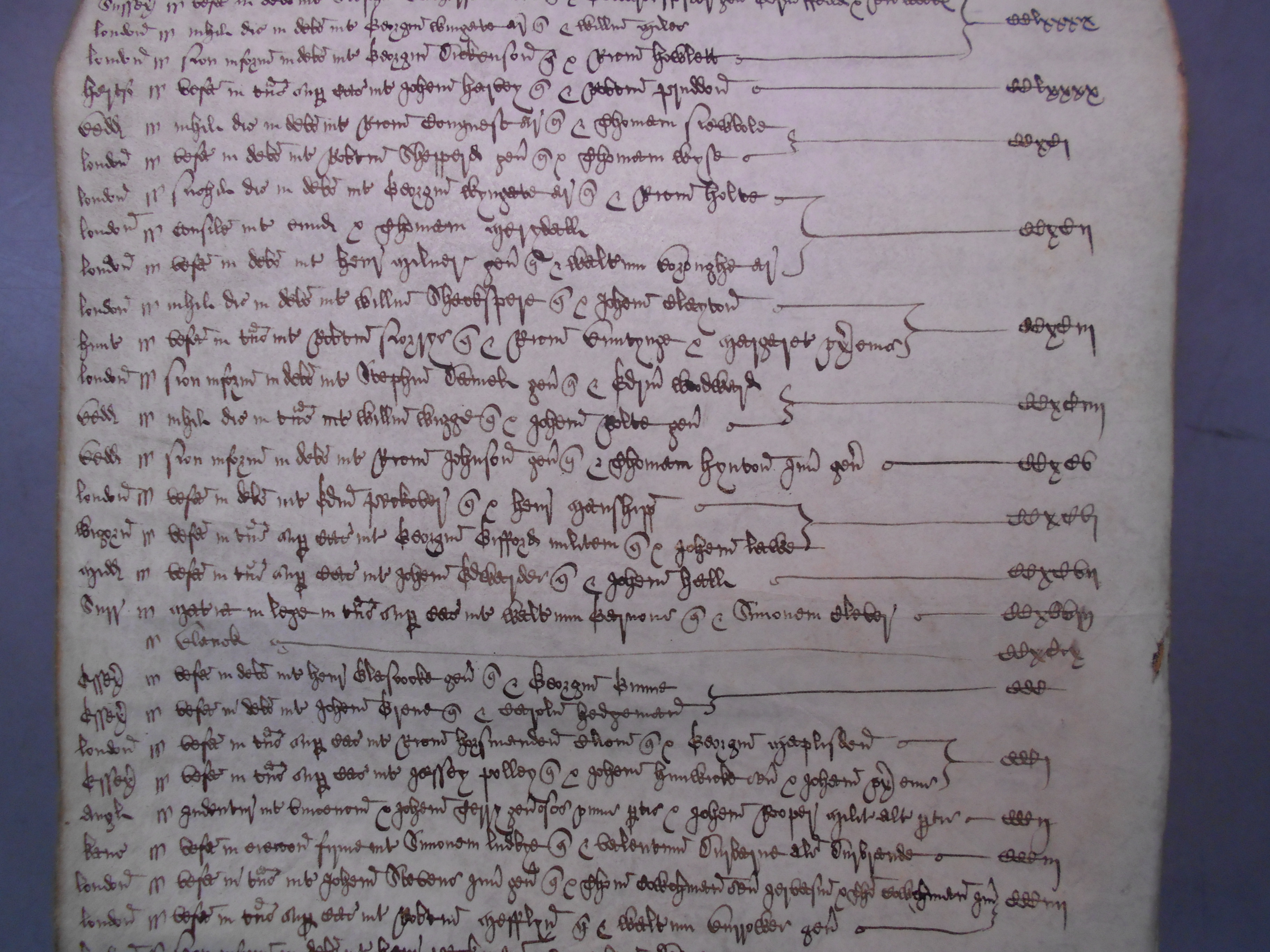
Excerpt from the docket roll for civil pleas from Michaelmas term 1599 to Trinity term 1601 containing an entry for TNA KB 27/1361/1, rot. 293 above, an action for debt brought in London by William Shackspere, querent, against John Clayton
TNA CP 25/2/135/1726/34ELIZITRIN, Item 31
Fine in the Court of Common Pleas dated 22 May 1592 by which Oxford and his second wife, Elizabeth Trentham, transferred clear title to the rectory of Walter Belchamp to Francis Trentham and Ralph Sneyd for £160
TNA CP 25/2/135/1726/34ELIZITRIN, Item 17
Fine in the Court of Common Pleas dated 22 May 1592 by which Oxford transferred clear title to the manor of Inglesthorpe in Essex to Thomas Albery and John Newett for 200 marks
Copy on the patent rolls of the Queen's grant dated 8 June 1592 to John Drawater and John Holmes of a 100-year lease of Oxford's former properties which had been seised into the Queen's hands for Oxford's debt to the Court of Wards
Indenture dated 16 June 1592 by which John Drawater and John Holmes sold to Roger Harlakenden for £200 their interest in a 100-year lease of Oxford's former properties of Colne Priory and the manor and park of Earls Colne granted to them by the Queen on 8 June 1592
Last will and testament, dated 18 June 1592, of Henry Vernon of Hilton, Staffordshire [I]
Last will and testament, dated 20 June 1592, of Edmund Hakluyt, whose father, Richard Hakluyt, was the stepson of Katherine Trentham, the sister of Richard Trentham, grandfather of Oxford's second wife, Elizabeth Trentham
Memorandum, partly in Oxford's hand, concerning his 1592 suit to the Queen for licence to import oils, fruits and wools, in return for which Oxford offered to pay the Queen £450 per annum more than she currently received in customs fees
Copy, addressed directly to the Queen, of Oxford's 1592 suit for licence to import oils, fruits and wools
Letter dated 14 July 1592 from Lord Burghley to Alderman Henry Billingsley in furtherance of Oxford’s suit for licence to import oils, fruits and wools
Alderman Henry Billingsley's certificate, in response of Lord Burghley's letter above, itemizing the customs fees paid to the Queen for oils, wools and fruits imported into England during the years 1589-1592
Licence dated 12 August 1592 authorizing Oxford to alienate the rectory of Great Bentley to Henry Smith and John Glascock
Map prepared by Israel Amyce, taken from Louis Thorn Golding's An Elizabethan Puritan
Letter dated 1 September 1592 from Ralph Bowes to Lord Burghley concerning a lease sought by Bowes to his benefit and that of his mistress, Oxford's daughter, Elizabeth Vere
TNA CP 25/2/135/1727/34/35ELIZIMICH, Item 23
Fine in the Court of Common Pleas dated 2 November 1592 by which Oxford transferred clear title to the rectory of Great Bentley to Henry Smith and John Glascock for £180
Last will and testament, dated 6 November 1592, of Henry Hugford, Town Clerk of Stratford upon Avon, who in 1573 sued John Shakespeare for debt
Indenture dated 15 November 1592 by which William Hampton sold back to Roger Harlakenden a half interest in Chalkney Wood, apparently as the quid pro quo for Thomas Hampton's participation in fraud against Oxford
Last will and testament, dated 17 November 1592, of Sir Rowland Hayward, whose mansion of King's Place, Hackney, was purchased by Oxford's second wife, Elizabeth Trentham, and whose sister-in-law married the uncle and guardian of Francis Langley, builder of the Swan Theatre, against whom in 1596 William Wayte sought a peace bond together with William Shakespeare of Stratford upon Avon
Privy Seal warrant dated 23 November 1592 authorizing payment from the Exchequer of £24 3s 1d to the Queen's goldsmith, Sir Richard Martyn, for a gilt bowl with a cover given by the Queen to Oxford at his marriage to his second wife, Elizabeth Trentham
Last will and testament, dated 26 November 1592, of Robert Spring, whose first wife, Joan Forster, was the stepdaughter of Oxford's uncle, Henry Golding
1593
Interrogatories and depositions in Oxford's suit in Chancery against Roger Harlakenden and Richard Harlakenden for fraud in the sale of Colne Priory
Last will and testament, dated 13 February 1593, of Robert Heywood, erroneously claimed to be the father of the dramatist, Thomas Heywood
Last will and testament, dated 13 March 1593, of Anne Prannell, whose husband purchased Oxford's manor of Newsells, and whose son inherited Newsells, and left it to his wife, Frances Howard, daughter of Thomas Howard, 1st Viscount Bindon
Last will and testament, dated 20 March 1593, of Margaret Bromley Newport, wife of Sir Richard Newport, the owner of a copy of Hall's Chronicle, formerly Loan 61 in the British Library, now in the hands of a trustee, Lord Hesketh, containing annotations thought to be by Shakespeare
Last will and testament, dated 22 March 1593, of Robert Sandford, whose wife, Isabel Egerton, was a half sister of Sir Thomas Bromley, one of the trustees appointed under Oxford's indenture of 20 January 1575, and a second cousin of Margaret Bromley, wife of Sir Richard Newport, owner of a copy of Hall's Chronicle thought to contain annotations by Shakespeare
Record of the religious ceremony at which Queen Elizabeth received Holy Communion on Easter Sunday, 15 April 1593, a ceremony at which Oxford was one of the four Earls who laid the communion cloth on the Queen's cushion
Last will and testament, dated 20 July 1593, of Sir Warham St Leger, whose daughter, Anne St Leger, married Thomas Russell, the overseer of the will of William Shakespeare of Stratford upon Avon
Last will and testament, dated 14 November 1593, of Thomas Darcy, whose wife, Camilla Guicciardini, was related to the historian Francesco Guicciardini, whose Historia d'Italia Oxford owned a copy of in the original Italian, now at the Folger Shakespeare Library
Oxford's revocation on 3 December 1593 of his earlier commission to Lewin, Harlakenden, & Tiffin re Earls Colne grammar school, & his reappointment of Adams as schoolmaster
Oxford’s replication in his Chancery suit against Roger and Richard Harlakenden for either reconveyance of Colne Priory or for compensation for fraud and breach of trust in the sale
1594
Last will and testament, dated 8 February 1594, of John Brooke, whose brother, William Brooke, Lord Cobham, was patron of the Lord Chamberlain's Men in 1596-7, and whose brother, Thomas Brooke the younger, wrote verses commemorating the death of Arthur Brooke, author of Romeus and Juliet
Last will and testament, dated 16 February 1594, of Jane Newton, whose niece, Elizabeth Brooke, was the wife of Oxford's brother-in-law, Sir Robert Cecil
Interrogatories in Oxford's lawsuit against Roger and Richard Harlakenden for fraud in the sale of Colne Priory, together with depositions given in April and May 1594 by Oxford's servants Barnaby Worthy, Nicholas Bleake, David Wilkins, Simon Ive and Thomas Hampton
Last will and testament, dated 12 April 1594, of Ferdinando Stanley, 5th Earl of Derby, brother of Oxford's son-in-law, William Stanley, 6th Earl of Derby
Chancery suit commenced on 19 April 1594 by Roger Harlakenden against John Bowser in which Harlakenden's bill of complaint contains his admission that he had documents in his possession pertaining to properties of Oxford's which he, Harlakenden, had not purchased
Last will and testament, dated 23 April 1594, of Anne Blount, whose brother-in-law, John Felton, was executed for nailing to the door of the Bishop of London's palace the papal bull excommunicating Queen Elizabeth
Chancery suit commenced on 6 May 1594 by Oxford's paternal uncle, Robert Vere, and his third wife, Joan (nee Hubberd) against Edward Hubberd, alleging fraud in the sale of Oxford's manors of Kennington, Wennington and Shottesbrook
Sworn statement dated 7 May 1594 by Oxford's servant, Barnaby Worthy, in connection with his attempt to amend his deposition given in Oxford's lawsuit in Chancery commenced in 1593 against Roger Harlakenden and Richard Harlakenden for fraud in the sale of Colne Priory
Referral by the Lord Keeper, dated 15 May 1594, to the Master of the Rolls of Oxford's servant Barnaby Worthy's attempt to amend his deposition given in Oxford's lawsuit in Chancery commenced in 1593 against Roger Harlakenden and Richard Harlakenden for fraud in the sale of Colne Priory
Deposition of Thomas Swift sworn 3 June 1594 in a Star Chamber suit brought against him for actions taken by him in the years 1589-92 while he was in the service of Sir William Cornwallis in Oxford's former mansion of Fisher's Folly in Bishopsgate
Letter dated 7 July 1594 from Oxford to Lord Burghley requesting assistance in rectifying certain abuses in his office of Lord Great Chamberlain which had 'greatly hindered' both himself and the Queen
Letter dated 19 July 1594 from Lord Burghley to Sir Robert Cecil requesting that the next time he comes privately to London, he bring Oxford's daughter, Lady Elizabeth Vere, with him
Last will and testament, proved 23 July 1594, of Eleanor Haselrigge Clerke, wife of Bartholomew Clerke, to whose Latin translation of The Courtier Oxford contributed a Latin epistle
Last will and testament, dated 24 August 1594, of Richard Branthwayte, serjeant at law, to whom Oxford transferred his manor of Fingrith by a fine of 30 March 1580 and whom Oxford appointed as one of his officers on 17 September 1580
Letter dated 13 September 1594 from William Stanley to Lord Burghley concerning negotiations for his marriage to Oxford's daughter, Elizabeth Vere
Letter dated 9 November 1594 from Oxford requesting that Lord Burghley have his Remembrancer set down in writing his objections to reviving the law under which the Queen and Lord Great Chamberlain received fees for homage when tenants were admitted to their lands
Memorandum said to date from 1594 concerning Oxford's claim to rights in Waltham Forest and Havering
Letter in secretary hand dated December 1594 from Sir William Dethick to Lord Burghley which, when compared with the three draft grants of arms to John Shakespeare of 1596 and 1599, establishes that the latter are also in Dethick's secretary hand
1595
Last will and testament, dated 1 February 1595, of Oxford's paternal uncle Robert Vere (d.1598), brother of John de Vere, 16th Earl of Oxford
TNA C 24/244/35
Interrogatories and depositions from a lawsuit in Chancery in 1595 concerning a grant made by Oxford in 1574/5 to his then receiver, Richard Kelton, of the right to the presentation of the church of Nether Yeldham
Memorandum dated 9 March 1595 from Oxford to Lord Burghley proposing that the Queen take the monopoly of tin into her own hands, thereby increasing her profit by £7000 a year, and requesting a licence to transport tin and lead, for which he offers the Queen £500 a year
Last will and testament, dated 15 March 1595, of John Worsop, whose brother, Edward Worsop, was bound, together with Robert Burbage, to Sir William Cecil in connection with the latter's purchase of Theobalds
Audit Office entry recording payment, authorized by a Privy Council warrant dated 15 March 1595, to William Kempe, William Shakespeare and Richard Burbage, servants to the Lord Chamberlain, for two comedies or interludes performed at court before the Queen on 26 and 28 December 1594
Pipe Office entry recording payment, authorized by a Privy Council warrant dated 15 March 1595, to William Kempe, William Shakespeare and Richard Burbage, servants to the Lord Chamberlain, for two comedies or interludes performed at court before the Queen on 26 and 28 December 1594
Letter dated 20 March 1595 from Oxford to Lord Burghley outlining a plan to equal the artficially high offer to the Queen of £10,000 by which his competitors, including Lord Buckhurst, had earlier driven him out of the bidding for the tin monopoly
Letter dated 23 March 1595 from Oxford to Lord Burghley responding to objections to his proposal regarding the tin monopoly which appear to have been made by Lord Buckhurst
Memorandum dated 25 March 1595 comparing Oxford's offer to increase the Queen's profits from the tin mines with the offer of Lord Buckhurst
Letter dated 25 March 1595 from Oxford to Lord Burghley responding to further questions as to how his offer for the tin monopoly compares to that made by Lord Buckhurst, and accusing Lord Buckhurst of attempting to cheat the Queen
Letter dated 28 March 1595 from Oxford to Lord Burghley citing Richard Carmarden as his source for figures concerning the quantity of tin, and stating that Lord Buckhurst now claims that his offer was only intended to be £4000 over the Queen's current £3000 revenues
BL MS Lansdowne 86/66, ff. 169-70
Memorandum by Oxford, likely dating from late March 1595, stating that Lord Buckhurst now claims that his offer for the tin monopoly of £7000 was intended as £4000 over and above the £3000 of revenues currently received by the Queen
Letter dated 28 March 1595 from Oxford to Lord Burghley's secretary, Michael Hicks, concerning the annual production of tin in Devonshire and Cornwall
Letter dated 1 April 1595 from Oxford to Lord Burghley containing Oxford's firm offer to increase the Queen's revenues from tin from £3000 to £10,000, and the names of the merchants associated with him in the venture
Letter dated 9 April 1595 from Oxford to Lord Burghley advising that the merchants named in his letter of 1 April 1595 have backed out, having been dissuaded by members of the Turkey Company which transported most of England's export tin
Letter dated 13 April 1595 from Oxford to Lord Burghley after both his and Lord Buckhurst's backers for the tin monopoly had deserted them because of the Queen's vaccillation, proposing a new plan for the tin monopoly for the consideration of the Queen, Lord Burghley and Lord Buckhurst
Letter dated 17 April 1595 from Oxford to Lord Burghley mentioning deceptive practices by Richard Carmarden, the distinction between the suit for the tin monopoly and the suit for the licence to transport tin, and that Lord Buckhurst has abandoned his suit for the tin monopoly
Letter dated 24 April 1595 from Oxford to Sir Robert Cecil concerning the allowance promised byWilliam Stanley, 6th Earl of Derby, to his wife, Oxford's daughter Elizabeth de Vere
Letter dated 20 May 1595 from Anthony Standen concerning the Queen's displeasure at learning that the Earl of Essex had fathered an illegitimate son in 1591, for whose paternity Thomas Vavasour had earlier taken responsibility, and her displeasure at something concerning Essex and the 'newly-coined Countess'
Last will and testament, dated 14 May 1595, of Thomas Hampton, who purchased lands from Oxford, and who appears to have been related to the Thomas Hampton who was involved in the frauds against Oxford of Thomas Skinner and Roger Harlakenden
Memorandum dated 4 June 1595 comparing Lord Buckhurst's offer for the tin monopoly, which was in competition with Oxford's, with the alternative solution of an imposition or tax of 6s 8d on every hundred weight of tin
Memorandum dated 4 June 1595 from Oxford to Lord Burghley in which he refutes Richard Carmarden's reasons why the Queen should accept Lord Buckhurst's offer of £4600 for both the pre-emption and transportation of tin
Letter dated 7 June 1595 from Oxford to Lord Burghley advising of the dishonesty of Richard Carmarden and suggesting a means by which the Queen can obtain an accurate estimate of the annual production of tin in Cornwall
Letter dated 13 June 1595 from Oxford to Lord Burghley requesting that Alderman John Catcher be sent down to Cornwall to work with Middleton in obtaining an accurate estimate of the annual production of tin in Cornwall
Letter dated 14 June 1595 from Oxford to Lord Burghley reiterating his request that an order be sent by the Queen to Sir Francis Godolphin directing that no tin be bought or sold till the midsummer coinage, and that agents be appointed for Cornwall and London
Letter dated 15 June 1595 from Oxford to Lord Burghley reiterating his request that an order be sent by the Queen directing that no tin be bought or sold till the midsummer coinage, and that the tin be sold by agents, realizing a profit of £20,000
Letter 16 June 1595 from Lord Burghley to Oxford explaining that he had been sharply reproved by the Queen for advancing Oxford's proposal that delivery of tin be stayed so that it could be bought for the Queen's profit
Certificate dated 1 July 1595 stating that by 2 February 1594 the purchasers of Oxford's lands had repaid all but £800 of his original debt to the Court of Wards of £3300 and stating that on 23 July 1590 Lord Burghley had authorized further extents on behalf of the Queen for repayment of £7000 worth of penal bonds forfeited by Oxford to the Court of Wards
Bill of complaint filed by Oxford in Chancery on 1 July 1595 against Thomas Coe and his sons, Roger Coe and Edward Coe, concerning a lease of the rectory of Walter Belchamp, and answer of Thomas Coe
Letter dated 5 August 1595 from Oxford to Lord Burghley concerning Thomas Middleton's return from Cornwall and the bribes offered by Lord Buckhurst to Oxford's agents for the tin monopoly to persuade them to abandon him, thus hindering the Queen's service
Letter dated 5 October 1595 from King Henri IV of France to Oxford expressing gratitude for services performed with Queen Elizabeth on the King's behalf
Letter dated 20 October 1595 from Oxford to Sir Robert Cecil recounting the actions taken by the Queen with respect to Oxford's suit concerning Waltham Forest
Letter dated 21 October 1595 from Oxford to Sir Robert Cecil occasioned by the death of Sir Thomas Heneage, who had held the keepership of Waltham Forest
Last will and testament, dated 7 November 1595, of Thomas Castelyn, brother-in-law of Humphrey Martyn, addressee of the Langham Letter
Complaint in 1595 against any 'innovations' in the tin trade, perhaps instigated by those who had originally offered Queen Elizabeth 1000 marks for the tin monopoly in 1594 and had been forced to raise their offer to a point at which it had become unprofitable
Memorandum by Oxford which appears to date from the end of 1595, listing the prices paid by the tin merchants per 1000 pounds of tin from 1571 to midsummer 1595, and discussing the Queen's attempt to exercise her pre-emption in 1595
1596
Indenture dated 2 February 1596 by which Henry Jerningham sold to Sir George Carey the Jerningham mansion in the Blackfriars which adjoined the premises which became James Burbage's Blackfriars theatre
Indenture dated 4 February 1596 between Sir William More and James Burbage by which More sold Burbage for £600 premises in the Blackfriars partly consisting of the fence-school of William Joyner on which Oxford and Lyly had held a lease
TNA CP 25/2/170/3003/38ELIZIHIL, No. 11
Fine in the Court of Common Pleas dated 9 Feruary 1596 by which Henry Jerningham and Frances Jerningham transferred title to Sir George Careyof the Jerningham mansion in the Blackfriars which adjoined the premises which became James Burbage's Blackfriars theatre
Last will and testament, dated 26 February 1596, of Sir John Wolley, the son-in-law of Sir William More who sold property in the Blackfriars to James Burbage, and one of Oxford's trustees in connection with legal agreements for the benefit of Oxford's second wife, Elizabeth Trentham
Letter dated 14 March 1596 from Oxford to Lord Burghley concerning further information required by Lord Burghley on points recently made by Oxford in notes on the pre-emption of tin
Letter dated 20 March 1596 from Oxford's son-in-law, William Stanley, 6th Earl of Derby, to Sir Robert Cecil concerning payment of a debt owed by Derby to Cecil, apparently the same debt referred to in CP 40/94 below
Last will and testament, dated 4 April 1596, of Anthony Marler, whose aunt resided in Oxford's former mansion of London Stone, and who may have been related to the playwright, Christopher Marlowe
Letter dated 17 May 1596 from Oxford's son-in-law, William Stanley, 6th Earl of Derby, to Sir Robert Cecil concerning payment of a debt of £100 owed by Derby to Cecil
Pardon of alienation dated 18 May 1596 to Edmund Felton for his purchase of lands from Oxford by indenture dated 13 August 1592 without licence having been granted beforehand by the Queen
Last will and testament, dated 13 June 1596, of Edmund Martyn, brother of Humphrey Martyn, addressee of the Langham Letter
Judgment in the Court of Chancery dated 14 June 1596 against Roger Harlakenden in a lawsuit involving Oxford's former manor of Sheriffs
Agreement dated 16 June 1596 between the Company of Pewterers and Henry Jackman that Jackman would be the Company's agent for a period of one year to pursue the Company's suit to the Queen that no tin should be exported from England in blocks
Letter dated 10 July 1596 from the Archbishop and Council of York to the Privy Council concerning one Richard Atkinson of Ripon, with an endorsement concerning Oxford which appears to relate to matters concerning a different person, Anthony Atkinson of Hull
Last will and testament, dated 26 July 1596, of Henry Jerningham, who sold the Jerningham mansion in the Blackfriars to George Carey, 2nd Baron Hunsdon
Undated memorandum by Oxford re the revival of the 'suit of bars' on behalf of the Pewterers
Letter dated 6 September 1596 from Oxford to Sir Robert Cecil apparently concerning the allowance promised by William Stanley, 6th Earl of Derby, to his wife, Oxford’s daughter Elizabeth de Vere
Letter dated 17 September 1596 from Oxford to Sir Robert Cecil concerning the allowance promised by William Stanley, 6th Earl of Derby, to his wife, Oxford’s daughter Elizabeth de Vere
Last will and testament, dated 17 October 1596, of Richard Southwell, whose sister, Dorothy Southwell, married Oxford's first cousin, John Wentworth
Copy said to date from about 1631 of a petition in November 1596 from residents of the Blackfriars to the Privy Council objecting to James Burbage's plans to erect an indoor playhouse there, signed by Lady Russell, Lord Hunsdon, Richard Field and others
Entry on the King’s Bench controlment roll in which William Wayte requests sureties of the peace against William Shakespeare of Stratford upon Avon, Francis Langley, Dorothy Soer and Anne Lee by writ directed to the sheriff of Surrey returnable 29 November 1596
LAMBETH PALACE MS 660, ff. 149-50
Letter dated 1 December 1596 from Lady Anne Bacon to the Earl of Essex, admonishing him for having compromised the reputation of her great-niece, Oxford's daughter Elizabeth Vere
Letter dated 1 December 1596 from the Earl of Essex to Lady Anne Bacon in reply to her letter above, partly refuting her allegation
Letter dated 4 December 1596 from Lady Anne Bacon to the Earl of Essex in reply to his letter above
Last will and testament, dated 6 December 1596, of Lord Burghley's servant, Bernard Dewhurst, whose letter to Lord Burghley dated 2 September 1573 contains important details of Oxford's financial affairs
Last will and testament, dated 28 December 1596, of Thomas Skinner, with whom Oxford had extensive financial dealings throughout his life, and whose fraud caused Oxford to forfeit bonds to the value of £20,000
Last will and testament, dated 31 December 1596, of Sir John Wotton, appointing Oxford as his executor and making Oxford and his son, Henry de Vere, residuary legatees
1597
Letter dated 11 January 1597 from Oxford to Sir Robert Cecil thanking him for advising the Countess of Oxford of Thomas Gurley's petition against her to the Privy Council
Schedule to CP 37/67 above, explaining the background to Thomas Gurley's petition
Letter dated 30 January 1597 from Thomas Gurlyn to Sir Robert Cecil concerning the petition he had preferred to the Privy Council against the Countess of Oxford
Last will and testament, dated 20 February 1597, of Mary (nee Matthew) Wolley Langton Judde Altham, whose granddaughter married William Throckmorton, a first cousin of Mary Tracy Vere, wife of Oxford’s first cousin, Horatio Vere, Baron of Tilbury
Last will and testament dated 24 February 1597 of William Brooke, 10th Baron Cobham, patron of the Lord Chamberlain's Men, whose first wife, Dorothy Neville, was the sister of Ursula Neville, mother of Anne St Leger, wife of Thomas Russell, overseer of the will of William Shakespeare of Stratford upon Avon
Copy of above will of William Brooke, 10th Baron Cobham
Sonnet to Oxford in Henry Lok's Ecclesiastes, Otherwise Called The Preacher . . . whereunto are annexed sundry sonnets of Christian passions, published by Richard Field in 1597
Sonnet to Oxford's daughter Elizabeth Vere, Countess of Derby, in Henry Lok's Ecclesiastes, Otherwise Called The Preacher . . . whereunto are annexed sundry sonnets of Christian passions, published by Richard Field in 1597
Last will and testament, dated 22 March 1597, of Richard Warren, the first husband of Elizabeth Hayward, who later married Oxford's foe, Thomas Knyvet
Last will and testament, dated 7 April 1597, of George Sneyd, maternal uncle of Oxford's second wife, Elizabeth Trentham
Undated memorandum from Oxford to an unnamed lord re the Queen's right to purchase by pre-emption all the tin available at a coinage and sell it to the tin merchants herself, thereby greatly increasing her revenues
Exemplification dated 4 May 1597 of the fine by which title to New Place passed from William Underhill (d.1597) to William Shakespeare of Stratford upon Avon
Last will and testament, dated 30 May 1597, of Isabel Mabbe, owner of the Tabard Inn in Southwark, and mother of John Mabbe the younger, who purchased Oxford's manors of Gibcrack and Little Yeldham
Last will and testament, dated 5 June 1597, of Sir John North, who in 1585 and 1586 wrote letters requesting Sir William More of Loseley to extend a lease in the Blackfriars which Bonetti had purchased from Oxford's servant, John Lyly
Last will and testament, dated 10 June 1597, of Henry Prannell, whose father purchased Oxford's former manor of Newsells, and who himself owned Newsells, and left it to his wife, Frances Howard, daughter of Thomas Howard, 1st Viscount Bindon
Last will and testament, dated 15 June 1597, of Thomas Brend, whose son, Nicholas Brend, leased the ground on which the Globe was built to William Shakespeare of Stratford upon Avon and others
Last will and testament, dated 6 July 1597, of William Underhill, who sold New Place to William Shakespeare of Stratford upon Avon
Letter dating from 29-31 July 1597 from Sir Edward Fitton to Sir Robert Cecil concerning the arrival of William Stanley, 6th Earl of Derby, and his wife, Oxford's daughter Elizabeth de Vere, at Knowsley, and mentioning both the jointure and the allowance of £1000 promised by the Earl to his wife
Letter dated 9 August 1597 from Sir Edward Fitton to Sir Robert Cecil advising that officers of William Stanley, 6th Earl of Derby, had refused to serve the Earl if he continued his ill treatment of his wife, Oxford's daughter Elizabeth de Vere
Letter dated 11 August 1597 from Sir Edward Fitton to Sir Robert Cecil advising of improved relations between William Stanley, 6th Earl of Derby, and his wife, Oxford's daughter Elizabeth de Vere
Letter dated 16 August 1597 from Henry Herbert, 2nd Earl of Pembroke, to Lord Burghley mentioning a proposed marriage between Oxford's daughter, Bridget Vere, and William Herbert, 3rd Earl of Pembroke
Letter endorsed 16 August 1597 from Mary (nee Sidney), Countess of Pembroke, to Lord Burghley concerning a proposed marriage between Oxford's daughter, Bridget Vere, and William Herbert, 3rd Earl of Pembroke
Statement dated 20 August and said to date from the year 1597 by William Stanley, 6th Earl of Derby, retracting allegations which he had apparently made concerning his wife, Oxford's daughter, Elizabeth de Vere
Licence of 2 September 1597 authorizing the executors of Sir Rowland Hayward to alienate the manor of King's Place in Hackney to Oxford's second wife, Elizabeth Trentham, Francis Trentham, Ralph Sneyd, and Giles Yonge
Letter dated 3 September 1597 from Henry Herbert, 2nd Earl of Pembroke, to Lord Burghley concerning a proposed marriage between Oxford's daughter, Bridget Vere, and the 2nd Earl of Pembroke's eldest son and heir, William Herbert, 3rd Earl of Pembroke
Letter dated 8 September 1597 from Oxford to Lord Burghley mentioning a proposed marriage between Oxford's daughter, Bridget Vere, and William Herbert, 3rd Earl of Pembroke
Petition filed in Chancery in fall of 1597 concerning lands belonging to Oxford's manor of Thorncombe in Devonshire
Last will and testament, dated 28 September 1597, of Elizabeth Ramsey Clerke Alford, at whose house in Hitcham Oxford may have resided for a time in 1564, whose grandson was suggested as a husband for Oxford's daughter, Susan Vere, and whose granddaughter was the dedicatee of Robert Greene's Lady Fitzwater’s Nightingale
Last will and testament, dated 3 and 7 November 1597, of John Drawater, assisted Roger Harlakenden in his fraud against Oxford in the sale of Colne Priory
Last will and testament, dated 15 November 1597, of William Lewin, who accompanied Oxford on the first part of his continental tour in 1575, and who left Oxford a bequest of 100 ounces of gilt plate in his will
Chancery petition of Roger Harlakenden dated 25 November 1597 against Samuel Cockerell for documents relating to Colne Priory, and answer of Samuel Cockerell
1598
Letter dated 9 January 1598 from Bridget, Countess of Bedford, to Sir Robert Cecil requesting that her grandson, Francis Norris, who in 1599 married Oxford's daughter, Bridget Vere, be permitted to accompany Cecil on an embassy to France
Letter dated 29 January 1598 from Bridget, Countess of Bedford, to Sir Robert Cecil expressing gratitude that Cecil has agreed to her request (see CP 48/83 above)
Excerpt from Francis Meres’ Palladis Tamia, published in 1598, in which Oxford is named among those English poets who are ‘best for tragedy’
Last will and testament, dated 14 February 1598, of Oxford's half-sister, Katherine de Vere, wife of Edward Windsor, 3rd Baron Windsor, nephew of Roger Corbet, a ward of the 13th Earl of Oxford, and uncle of Sir Richard Newport, the owner of a copy of Hall’s Chronicle containing annotations thought to have been made by Shakespeare
Last will and testament, dated 20 February 1598, of Sir Charles Morison, whose mother had the care of Oxford's daughters, Bridget and Susan, and whose nephew, Francis Norris, 2nd Baron Norris of Rycote, married Oxford's daughter, Bridget Vere
Last will and testament, dated 1 March 1598, of Oxford's father-in-law, William Cecil, Lord Burghley, containing generous bequests to Oxford's three daughters
Letter written by Sir Robert Cecil to Michael Hickes after Lord Burghley's death expressing his determination that Oxford should not be given custody of his daughters
Memorandum dating from 1598 of lands purchased by Lord Burghley for the maintenance of Oxford’s three daughters, Elizabeth, Bridget and Susan Vere, after Lord Burghley's death
Last will and testament, dated 15 March 1598, of Anthony Kempe, who bequeathed to his niece, Anne Kempe Shirley, and her husband, Sir Thomas Shirley, the right to live rent-free for a year at his mansion in the Blackfriars
Queen Elizabeth's letter of privy seal of 15 April 1598 which granted to the Company of Pewterers privileges which Oxford considered very disadvantageous to the Queen's financial interests, as indicated in several of his tin mine letters and memoranda
Letter by Oxford, likely written on 16 April 1598 to Sir Edmund Anderson, Chief Justice of the Common Pleas, explaining the origins of competing suits for the tin monopoly, one by a group including the Company of Pewterers, and the other by himself
Memorandum by Oxford, likely written on 16 or 17 April 1598 to Sir Edmund Anderson, concerning the profits to be made by the Queen from the tin monopoly
Memorandum by Oxford, likely written on 16 or 17 April 1598 to Sir Edmund Anderson, a day or two after the Queen's grant of privileges to the Company of Pewterers on 15 April 1598
Bill of complaint, answer and replication in Chancery suit of 21 May 1598 by Judith Ruswell against Oxford for an alleged debt of £1000 allegedly owed to her late husband, the tailor William Ruswell (dismissed at trial)
Letter dated 30 August 1598 from John Chamberlain to Dudley Carleton mentioning that Lord Burghley has left £6000 and £800 or £900 in land to Oxford's two younger daughters, Bridget and Susan Vere
Last will and testament, dated 24 September 1598, of Henry Henslowe, whose sister, Ellen Henslowe, married John Fortescue, mentioned in the indenture by which William Shakespeare of Stratford upon Avon and others purchased the Blackfriars gatehouse on 10 March 1613
Letter dated 12 October 1598 from Oxford's daughter, Bridget Vere, to her uncle, Sir Robert Cecil, written from Theobalds
Letter dated 28 October 1598 from Richard Quiney to William Shakespeare of Stratford upon Avon requesting help with arranging a loan of £30 to pay debts incurred while Quiney was pursuing a suit at court on behalf of the Corporation of Stratford
Letter dated 4 November 1598 from Abraham Sturley to Richard Quiney mentioning William Shakespeare of Stratford upon Avon
Last will and testament, dated 14 December 1598, of Sir Matthew Arundell, whose younger brother, Charles Arundel, was Oxford's close friend and later bitter enemy, and whose daughter-in-law was the sister of Henry Wriothesley, 3rd Earl of Southampton, to whom Shakespeare dedicated Venus and Adonis and The Rape of Lucrece
Letter dating from late 1598 or early 1599 from Adrian Quiney to Richard Quiney mentioning William Shakespeare of Stratford upon Avon
Undated memorandum from Oxford to Queen Elizabeth explaining why she should impose a tax of 32 shillings per 100 lbs. of tin as well as an export tax of 2d per 100 lbs. of tin in order to realize a profit of £34,500
1599
Last will and testament, dated 4 January 1599, of Anne Carew, mother of Thomasine (nee Carew) Amyce Vere, who married firstly Oxford's servant, Israel Amyce, and secondly Oxford's first cousin, John Vere of Kirby Hall
Letter dated 17 January 1599 from Thomas Gurlyn to Robert Devereux, 2nd Earl of Essex, concerning a suit to the Queen [I]
Letter said to date from 28 January 1599 from William Stanley, 6th Earl of Derby, to Sir Robert Cecil concerning the reprieve of a young man at the request of Derby's wife, Oxford's daughter Elizabeth de Vere
Chancery petition of Henry Atslowe concerning the manor of Downham sold by Oxford to Edward Atslowe, and answers of Frances Atslowe and Edward Francis
Judgment rendered by the Court of Chancery on 10 February 1599 in Oxford’s suit against Roger and Richard Harlakenden for reconveyance of Colne Priory and for compensation for fraud and breach of trust in the sale
Copy of order made in the Court of Chancery on 10 February 1599 in Oxford’s suit against Roger and Richard Harlakenden for reconveyance of Colne Priory and for compensation for fraud and breach of trust in the sale
Last will and testament, dated 16 February 1599, of William Colles, uncle of Humphrey Martyn, addressee of the Langham Letter
Letter dated 1 March 1599 from John Chamberlain to Dudley Carleton mentioning that a contract has been concluded for the marriage of Oxford's daughter, Bridget de Vere, to Francis Norris
Letter to Oxford dated 3 March 1599 from Robert Bertie, son of Oxford's sister, Mary, and her husband Peregrine Bertie, Lord Willoughby d'Eresby
Last will and testament, dated 6 March 1599, of Dorothy Vernon, aunt of Elizabeth Vernon, wife of Henry Wriothesley, 3rd Earl of Southampton, to whom Shakespeare dedicated Venus and Adonis and The Rape of Lucrece
Depositions of 13 witnesses taken in 1599 in case of Ruswell v Oxford (see TNA C 2/Eliz/R8/29 above)
Letter dated 16 April 1599 written by Oxford's daughter, Bridget Vere, to Sir Henry Maynard on behalf of Mr Arnold, chaplain of the Dowager Countess of Bedford
Last will and testament, dated 20 April 1599, of Judith Brend, whose half-brother, Nicholas Brend, leased the ground on which the Globe was built to William Shakespeare of Stratford upon Avon and others
Letter dated 21 April 1599 from the Dowager Countess of Bedford to Sir Robert Cecil concerning the marriage of Oxford's daughter, Bridget Vere, to the Dowager Countess' grandson, Francis Norris
Memorandum of 21 April 1599 giving figures for the coinages in Devon and Cornwall for the years 1595 to 1598, and discussing the Queen's right to purchase all the tin by pre-emption, a course Oxford had recommended to her since 1595
Memorandum by Bevis Bulmer of 23 April 1599 consisting of statements taken from Oxford's memorandum to an unnamed lord (EL2344) and Bulmer's responses
Letter dated 28 April 1599 from the Dowager Countess of Bedford to Sir Robert Cecil concerning the marriage of Oxford's daughter, Bridget Vere, to the Dowager Countess' grandson, Francis Norris
Dedicatory epistle to Oxford in John Farmer's The First Set of English Madrigals to Four Voices, published in 1599
Dedicatory epistle to Oxford in George Baker's The Practice of the New and Old Physic, a second edition of Baker's earlier 1576 publication The New Jewel of Health, which he had dedicated to Anne, Countess of Oxford
Letter dated 9 May 1599 from John Tyndall to Sir Robert Cecil advising that Oxford's daughter, Elizabeth, and her husband, William Stanley, 6th Earl of Derby, had been at Castle Hedingham
Last will and testament, dated 10 and 14 May 1599, of George Carey, 2nd Baron Hunsdon, who leased, then purchased, the Jerningham mansion in the Blackfriars, and to whose son-in-law, Sir Thomas Berkeley, Oxford gave an Italian translation of Herodotus
Inquisition post mortem, dated 17 May 1599, of Thomas Brend, whose son, Nicholas Brend, leased the land on which the Globe was built to William Shakespeare of Stratford upon Avon
Oxford's bill of complaint filed in Chancery circa 1599 alleging that Roger Harlakenden had in his possession evidences belonging to Oxford concerning various properties and Oxford's office of Lord Great Chamberlain
Roger Harlakenden's answer to Oxford's bill of complaint (see ERO D/DPr/425 above)
Letter written by Oxford to the Queen in June 1599, explaining the circumstances by which she has been deceived as to the money the merchants had ready for her to exercise the pre-emption of tin
Notice of a failed attempt on 10 June 1599 to serve a writ of outlawry on Robert Mabbe, whose brother, John Mabbe, purchased Oxford's manors of Gibcrack and Little Yeldham, and whose nephew, James Mabbe, wrote commendatory verses for the First Folio of Shakespeare's plays
Letter written by Oxford to Sir Robert Cecil in June 1599, a few days after he had written his letter to the Queen explaining the circumstances by which she had been deceived as to the money the merchants had ready for her to exercise the pre-emption of tin
Bill of complaint dated 27 June 1599 of Robert Mabbe, whose brother, John Mabbe, purchased Oxford's manors of Gibcrack and Little Yeldham, concerning the Tabard Inn of Chaucer's Canterbury Tales
Letter dated July 1599 written by Sir Charles Danvers to Henry Wriothesley, 3rd Earl of Southampton, mentioning the death of Henry Mackwilliam, who is named in Charles Arundel's 1581 libels against Oxford
Last will and testament, dated 6 and 7 August 1599, of Oxford's brother-in-law, Peregrine Bertie, Lord Willoughby de Eresby
Letter written in August 1599 from the Dowager Countess of Bedford to Sir Robert Cecil requesting that he deliver Oxford's daughter, Susan Vere, from 'this solitary imprisonment'
Letter dated 23 August 1599 from John Chamberlain to Dudley Carleton mentioning that Oxford’s second wife, Elizabeth Trentham, Countess of Oxford, stood godmother, as the Queen's deputy, to Elizabeth Coke
Dedicatory epistle to Oxford in the second edition of Angel Day's The English Secretary, published in 1599
Offer of £10,000 for the tin monopoly made by Bevis Bulmer on 16 October 1599; by letter dated 31 October 1599, Sir John Popham informed Sir Robert Cecil that Queen Elizabeth had directed that Oxford be made aware of Bulmer's offer
TNA C 24/277, Part 1, Piece 35
Interrogatories and depositions of Hugh Beeston, Edward Hubberd, Thomas Hampton, Israel Amyce and Roger Harlakenden in connection with Oxford's bill of complaint in Chancery (see ERO D/D/Pr/425 above)
Letter dated 30 November 1599 from William Stanley, 6th Earl of Derby, to Sir Robert Cecil, mentioning that he has visited his wife, Oxford's daughter, Elizabeth de Vere, at Hackney
1600
Letter dated 28 January 1600 from Oxford's son-in-law, William Stanley, 6th Earl of Derby, to Sir Robert Cecil, written from Hackney, where Oxford was then living
Interrogatories drawn up on behalf on Oxford in his suit against Roger and Richard Harlakenden for fraud in the sale of Colne Priory, together with answers by six witnesses, including Walter Cope, taken in November 1599 and February 1600
Interrogatories and depositions of witnesses in 1600 and 1603 on Oxford's behalf in furtherance of his lawsuit against Roger and Richard Harlakenden for fraud in the sale of Colne Priory
Last will and testament of Brian Annesley (d.1604), one of the defenders against Oxford in a tournament at Westminster on 1-3 May 1571, whose daughter, Christian Annesley, married the nephew of Oxford's brother-in-law, Edward Windsor, 3rd Baron Windsor
Lawsuit commenced 25 April 1600 concerning lands, parcel of Oxford's former manor of Thorncombe, mentioning Oxford's four commissioners, Luke Atslowe, Roger Baynes, John Floyde and Richard Temple, who held courts of survey of Oxford's lands in 1572
Letter dated 14 May1600 from Oxford's son-in-law, Francis Norris, to Sir Robert Cecil, concerning wrongs done to his mother, Elizabeth Morison, by her second husband, Henry Clinton, 2nd Earl of Lincoln
Letter dated 30 May1600 from Oxford's daughter, Bridget Vere, to Sir Robert Cecil, concerning wrongs done to her mother-in-law, Elizabeth Morison, by her second husband, Henry Clinton, 2nd Earl of Lincoln (see CP 79/48 above)
Last will and testament, dated 2 June 1600, of Bridget (nee Hussey), Dowager Countess of Bedford, with whom Oxford's daughters, Bridget Vere and Susan Vere, were placed after the death of Lord Burghley, and who was a first cousin of 'Mistress Crane' of the Marprelate tracts
Bodenham's Belvedere, or The Garden of the Muses
Epistle 'To the Reader' from the 1600 edition, mentioning Oxford as one of the poets whose works are included in Belevedere
Letter written by Oxford in July 1600 to Sir Robert Cecil requesting his assistance in Oxford's suit to obtain the governorship of the Isle of Jersey
Letter dated 6 September 1600 from Henry Clinton, 2nd Earl of Lincoln, to Sir Robert Cecil concerning payment of his debts and the possible sale to Oxford's son-in-law, William Stanley, 6th Earl of Derby, of his house in Cannon Row
Letter dated 4 November 1600 from Sir Walter Raleigh to Lord Buckhurst and Sir Robert Cecil concerning the Queen’s exercise of the pre-emption, a right discussed in Oxford’s letters and memoranda on the tin monopoly
Last will and testament, dated 17 November 1600, of Oxford's servant and officer, Nicholas Bleake
Last will and testament, dated 14 December 1600, of Edmund Newport, brother of Sir Richard Newport, the owner of a copy of Hall's Chronicle, formerly Loan 61 in the British Library, now in the hands of a trustee, Lady Hesketh, containing annotations thought to be by Shakespeare
1601
Excerpt from the Exchequer Pipe Roll of 1600-1601 indicating that Oxford was listed on the subsidy roll as owing £20, but that the amount had been paid in the county of Essex
Letter dated 2 February 1601 from Oxford to Sir Robert Cecil requesting his assistance in Oxford's suit to obtain the office of Lord President of Wales
Letter dated 3 February 1601 from John Chamberlain to Dudley Carleton mentioning that Bridget, Dowager Duchess of Bedford, has 'bequeathed the greatest part of her wealth' to Oxford's son-in-law, Francis Norris
Letter dating from circa March 1601 from Oxford to Sir Robert Cecil expressing gratitude for his assistance in Oxford's suit to obtain the office of Lord President of Wales
Last will and testament, dated 13 March 1601, of William Hoby, whose daughter-in-law married Oxford's first cousin, Horatio Vere, and whose half brother, Sir Thomas Hoby, married Lady Burghley's sister, Elizabeth Cooke
Last will and testament, dated 16 March 1601, of Oxford's onetime receiver-general, Edward Hubberd, whose sister Joan married Oxford's uncle, Robert Vere
Last will and testament, dated 21 April 1601, of Joan (nee Coe) Smith, whose son married the daughter of Thomas Skinner, with whom Oxford had extensive financial dealings
Letter dated 11 May 1601 from Oxford to Sir Robert Cecil with respect to an unspecified suit to the Queen, likely Oxford's suit to recover for the Queen lands which had escheated to her on the attainder of Sir Charles Danvers
Petition dating from 1601 from Arthur Milles, likely directed to Sir Robert Cecil, concerning his trial and acquittal after having been accused by Oxford's second wife, Elizabeth Trentham, of stealing a casket
Memorandum dating from June 1601 prepared for Oxford concerning the lands of Sir Charles Danvers which had escheated to the Crown, including lands which were his mother's Latimer inheritance and had been put in trust for him by his mother
Memorandum dating from 1601 prepared for Oxford concerning the fraudulent attempts by Lady Danvers, her husband, Sir Edmund Carey, and others to defeat the Queen's interest in the lands of Sir Charles Danvers which had escheated to the Crown at his attainder
Indenture dated 26 June 1601 between Sir George More and Cuthbert Burbage and Richard Burbage by which More sold to the Burbages property in the Blackfriars in which Margaret Poole held a life estate and which had formerly been leased to the Italian master of fence, Rocco Bonetti (d.1587)
Memorandum drawn up for Lord Buckhurst with a note by him endorsed 30 June 1601 concerning Oxford's suit to recover for the Queen the lands which had escheated to her on the attainder of Sir Charles Danvers
Letter dated 8 July 1601 from John Chamberlain to Dudley Carleton mentioning the death of Oxford's brother-in-law, Lord Willoughby, and that the presidency of Wales, for which Oxford had petitioned, has been awarded to the Earl of Shrewsbury
Letter dated 7 August 1601 from Lord Buckhurst and Sir John Fortescue to Sir Edward Coke concerning Oxford's suit to recover for the Queen the lands which had escheated to her on the attainder of Sir Charles Danvers
Last will and testament, dated 18 August 1601, of Ellen Harding Knyvet Browne, whose second husband, Sir Thomas Browne, signed Lady Russell's petition against James Burbage's Blackfriars theatre, and whose stepson, Sir Matthew Browne, was a trustee of Nicholas Brend, who leased the ground on which the Globe theatre was built to the Lord Chamberlain's Men
Excerpt from 'The State of England Anno Dom. 1600', an unpublished manuscript by Sir Thomas Wilson, in which it is erroneously claimed that Oxford's income in 1575 was 'rated' at £12,000 per year and that he had sold all his lands by 1577
Letter dated 3 October 1601 from William Waad to Sir Robert Cecil mentioning his cousin, William Leveson (d.1621), one of the trustees used by William Shakespeare of Stratford upon Avon in the allocation of shares in the ground lease of the Globe Theatre in 1599
Indenture dated 7 October 1601 by which Nicholas Brend mortgaged certain properties in Southwark, including the Globe playhouse, to Sir Matthew Browne and John Collett, specifically mentioning Richard Burbage and William Shakespeare of Stratford upon Avon, gentlemen, as lessees
Letter dated 7 October 1601 from Oxford to Sir Robert Cecil thanking him for his assistance in Oxford's suit to recover for the Queen the lands which had escheated to her on the attainder of Sir Charles Danvers
Recognizance in the amount of £2500 acknowledged by Nicholas Brend on 8 October 1601 in connection with the indenture, TNA C 54/1722, mm. 5-7 above, by which he had mortgaged certain properties in Southwark, including the Globe playhouse, to Sir Matthew Browne and John Collett, specifically mentioning Richard Burbage and William Shakespeare of Stratford upon Avon, gentlemen, as lessees
Indenture dated 10 October 1601 by which Nicholas Brend sold certain properties in London and Southwark, including the Globe playhouse, to Sir Matthew Browne and John Collett, specifically mentioning Richard Burbage and William Shakespeare of Stratford upon Avon, gentlemen, as lessees
Last will and testament, dated 10 October 1601, of Nicholas Brend, who leased the ground on which the Globe was built to William Shakespeare of Stratford upon Avon and others
Account of debate on monopolies in House of Commons on 20 November 1601, including Raleigh’s defence of his patent concerning tin
Letter dated 22 November 1601 from Oxford to Sir Robert Cecil concerning Oxford's suit to recover for the Queen the lands which had escheated to her on the attainder of Sir Charles Danvers
Inquisition post mortem, dated 3 December 1601, of Nicholas Brend, who leased the ground on which the Globe was built to William Shakespeare of Stratford upon Avon and others
Letter dated 4 December 1601 from Oxford to Sir Robert Cecil expressing amazement at Cecil's change of attitude with respect to Oxford's suit to recover for the Queen the lands which had escheated to her on the attainder of Sir Charles Danvers
Petition from Thomas Raynton to Sir Robert Cecil dating from about 1601 in which Raynton describes himself as a servant of Oxford's youngest daughter, Susan de Vere
Memorandum dating from 1601 or 1602 by Oxford describing Sir Edmund Carey's actions in the Danvers escheat case, concerning which Oxford says he has written to the Queen
1602
Letter dating from January 1602 from Oxford to Sir Robert Cecil expressing disappointment at Cecil's change of attitude and the delays which have hindered Oxford's suit to recover for the Queen the lands which had escheated to her on the attainder of Sir Charles Danvers
Letter dating from early 1602 from Oxford's youngest daughter, Susan Vere, to her uncle, Sir Robert Cecil, in which she assures him she would not marry without his consent (see CP 85/8 below)
Letter dated 3 February 1602 from Dorothy Clerke Long Morison to Sir Robert Cecil concerning a proposed marriage between her son, Charles Morison, and Oxford's youngest daughter, Susan Vere (see CP 183/123 above)
Bill of complaint dated 9 February 1602 in a lawsuit in Chancery brought by Thomas Skinner against Anne (nee Blackwell) Bacon, Robert Bacon and George Ruggle concerning certain leases granted by Oxford and his father, the 16th Earl
Last will and testament, dated 23 February 1602, of William Carew, brother of Thomasine (nee Carew) Amyce Vere, who married firstly Oxford's servant, Israel Amyce, and secondly Oxford's first cousin, John Vere of Kirby Hall
Letter dated 22 March 1602 from Oxford to Sir Robert Cecil concerning the impediments which have frustrated Oxford's suit to recover for the Queen the lands which had escheated to her on the attainder of Sir Charles Danvers, including the Queen's failure to grant him her rights de bene esse in quantum est
Letter dated 28 March 1602 from Anthony Atkinson to Sir Robert Cecil stating that Oxford is 'honourable' and 'hath a good heart', and indicating that Oxford had instructed Atkinson to reveal certain matters to Lord Buckhurst which resulted in proceedings against Atkinson and others in the Star Chamber
Copy of a memorandum likely prepared by Oxford's first cousin, Sir Francis Vere, describing from his point of view events in April 1602 when he received a challenged from Henry Percy, 9th Earl of Northumberland
Last will and testament, dated 30 April 1602, of Lord Burghley's brother-in-law, Sir Henry Killigrew, whose nephew, Sir Maurice Berkeley, was the half brother of Thomas Russell, overseer of the will of William Shakespeare of Stratford upon Avon
Two documents concerning the Danvers escheat case: (1) a memorandum concerning Sir Edmund Carey's harassment of Oxford’s secretary, Michael Cawley, and (2) a draft letter from Oxford to the Queen
Indenture dated 1 May 1602 by which William Shakespeare of Stratford upon Avon purchased 107 acres of arable land in Old Stratford from William Combe of Warwick and John Combe of Old Stratford for £320
Letter dated 17 May 1602 from Roger Wilbraham and George Carew to Sir Thomas Egerton and Sir Robert Cecil concerning speeches by Stephen Proctor that Oxford's son-in-law, William Stanley, 6th Earl of Derby, 'was a fool and would make all away'
Bill of complaint filed in the Court of Requests by Francis Trentham and Ralph Sneyd on behalf of Oxford and his second wife, Elizabeth (nee Trentham), against Edward Coe concerning the rectory of Walter Belchamp, and answer of Edward Coe dated 14 June 1602
Petition dating from 1602 from William Duck to Sir Robert Cecil complaining that when confronted with allegations that he had taken the Queen's game, Oxford's son-in-law, William Stanley, 6th Earl of Derby, threatened to run Duck through with his rapier
Letter dated 3 June 1602 from King James to Sir Robert Cecil referring to Oxford as "40"
Last will and testament, dated 15 July 1602, of Jane Cordell Alington, sister of Sir William Cordell, Master of the Rolls, one of the five trustees appointed by Oxford in an indenture of 30 January 1575 prior to his departure on his continental tour
Last will and testament, dated 17 July 1602, of Anne Beverley Knight Lawrence, great-aunt of Henry Wriothesley, 3rd Earl of Southampton, to whom Shakespeare dedicated Venus and Adonis and The Rape of Lucrece
Letter dated 29 July 1602 from King James to Oxford as "40"
Last will and testament, dated 22 September 1602 and 7 July 1604, of Sir William Browne, to whom Oxford's illegitimate son, Edward Vere, addressed a letter as 'Kind Father'
Copy of the surrender on 28 September 1602 to William Shakespeare of Stratford by Walter Getley of a copyhold tenure held of the Countess of Warwick as Lady of the manor of Rowington
Pardon of alienation, dated 10 November 1602, to Oxford for his purchase in Trinity term 1582 of lands in Bishopsgate formerly the property of Jasper Fisher, whose London mansion, Fisher's Folly, Oxford owned from circa 1580 until 1588
TNA CP 25/2/237/44/45ELIZIMICH, Item 15
Fine dated one month after Michaelmas 1602 by which Hercules Underhill confirmed the sale of New Place to William Shakespeare of Stratford upon Avon
Excerpt from a letter dated 20 November 1602 from Oxford’s second wife, Elizabeth Trentham, to Sir Julius Caesar, concerning a suit in the Court of Requests against Thomas Coe of Walter Belchamp for non-payment of rent and refusal to present his lease
Part of an inventory of the Queen's wardrobe containing the signature of Oxford's daughter, Susan Vere, indicating that she had signed for one of the Queen's round gowns at Whitehall on 16 December 1602
1603
Last will and testament, dated 2 January 1603, of Roger Harlakenden, who defrauded Oxford of Colne Priory, and married the widow of Lord Burghley's trusted servant, Bernard Dewhurst
Last will and testament, dated 28 February 1603, of Edward Stanhope, who was related to Oxford by marriage and who was the uncle of Robert Townshend, the patron of Ben Jonson
Printed proclamation of James as King of England to which Oxford was one of 37 signatories
Great Council warrant of 8 April 1603 signed by Oxford and 25 others
Letter dating from April 1603 from Oxford to Sir Robert Cecil concerning the death of Queen Elizabeth and the arrival in London of King James
Letter dated 7 May 1603 from Oxford to Sir Robert Cecil requesting that, together with Oxford's friend, Lord Admiral Howard, he assist in procuring a favourable end to Oxford's suit concerning Waltham Forest
Letters patent under the Great Seal dated 19 May 1603 by which the Lord Chamberlain's Men, including William Shakespeare of Stratford upon Avon, became the King's Men
Latin epigram on Oxford from Anagrammata in Nomina Illustrissimorum Heroum, attributed to Francis Davison and likely published between late May and 24 June 1603, with a translation by Dr. Dana Sutton
Letter dated 12 June 1603 from Oxford to Sir Robert Cecil requesting that, together with Oxford's friend, Lord Admiral Howard, he assist in procuring a favourable end to Oxford's suit concerning Waltham Forest
Letter dated 16 June 1603 from Oxford to Sir Robert Cecil requesting that, together with Oxford's friend, Lord Admiral Howard, he assist in procuring a warrant from the Council necessary to his suit concerning Waltham Forest
Letter dated 18 June 1603 from Oxford to Sir Robert Cecil requesting that he assist in procuring a warrant from the Council necessary to his suit concerning Waltham Forest
Record of King James' commission dated 7 July 1603 authorizing the hearing of petitions from those claiming rights at the coronation, including Oxford's two petitions to act as Great Chamberlain and Queen's Chamberlain
Undated memorandum of the offices and rights claimed by Oxford in the Forest of Essex, also known as Waltham Forest, and of the evidence he offered in support of his claim
Writ of privy seal dated 18 July1603 by which King James restored to Oxford his rights to the keepership and stewardship of the Forest of Essex and of the King's park and houses at Havering
Record of the grant by King James to Oxford on 18 July 1603 of 'the office of keeping the park & house of Havering & Steward of the same Forest with the Bailiwick of Essex'
Last will and testament, dated 22 July 1603, of Thomas Pope, who bequeathed his share in the Curtain playhouse and his share in the Globe playhouse to Marie Clarke and Thomas Bromley
Copy of writ of privy seal dormant dated 2 August 1603 by which King James confirmed Oxford's annuity of £1000 'during our pleasure, or until such time as he shall be by us otherwise provided for to be in some manner relieved'
Last will and testament, dated 2 August 1603, of Sir Matthew Browne of Betchworth Castle, co-owner of the Globe playhouse from 1601 to 1603, and 'landlord' to William Shakespeare of Stratford upon Avon, and brother-in-law of Robert Honywood, to whom Oxford acknowledged a bond for £3000 in 1584
Last will and testament, dated 7 October 1603, of Anne Lygon, first cousin of Thomas Russell, overseer of the will of William Shakespeare of Stratford upon Avon
Report by Henry Clinton, Earl of Lincoln, describing his conversations concerning the succession with the French ambassador, with Francis Tregian, and with Oxford prior to Queen Elizabeth's death
Letter and report dated 10 October 1603 from Sir John Peyton to Sir Robert Cecil concerning the Earl of Lincoln's conversation with Oxford about the succession two days before Queen Elizabeth’s death
Entry dated 26 October 1603 in a docket-book of an annuity of £50 granted by King James to Oxford's trustee, George Kirkham
1604
Last will and testament of Sir John Harte, Lord Mayor of London, who purchased Oxford's mansion at London Stone and kept his mayoralty there, and to whom Robert Greene dedicated The Royal Exchange
Letter dated 15 January 1604 from Dudley Carleton to John Chamberlain mentioning the involvement of Oxford's daughters Elizabeth, Lady Derby, and Susan de Vere in festivities during the Christmas season at Hampton Court
Letter dated 30 January 1604 from Oxford to King James complaining of Sir John Grey's abuses 'in destroying of the deer' and 'spoiling' of the King's 'demesne wood' in Havering Park and Waltham Forest
Entry dated 31 January 1604 in a docket-book of a licence granted by King James to Edward Kirkham, cousin of Oxford's trustee, George Kirkham, and others to train the Children of the Revels to the Queen
List in the Lord Chamberlain's Book of players, including William Shakespeare of Stratford upon Avon, who were granted 4 yards of red cloth for the ceremonial entry of King James I into the City of London on 15 March 1604
Last will and testament, dated 26 March 1604, of Sir Thomas Cornwallis, whose son, Sir William Cornwallis, purchased Oxford's interest in Fisher's Folly, and who, like Oxford, was descended from King John of England and his mistress, Clemence, through Philippa Arundel
Last will and testament, dated 29 March 1604, of Henry Prannell, whose uncle purchased Oxford's manor of Newsells, and whose cousin inherited Newsells, and left it to his wife, Frances Howard, daughter of Thomas Howard, 1st Viscount Bindon
Last will and testament, dated 21 May 1604, of Robert Eyton, cousin of Sir Francis Newport, whose father, Sir Richard Newport,was the owner of a copy of Hall's Chronicle containing annotations thought to be by Shakespeare
Entry dated 22 May 1604 in a docket-book of a warrant to the Exchequer authorizing payment to Oxford of £200 for his fees claimed at the coronation
Last will and testament, dated 27 May 1604, of George Vernon, uncle of Elizabeth Vernon, wife of Henry Wriothesley, 3rd Earl of Southampton, to whom Shakespeare dedicated Venus and Adonis and The Rape of Lucrece
Warrant dated 30 June 1604 from William Stanley, 6th Earl of Derby, to Hugh Glasiour, authorizing future payments from one of his offices to his wife, Oxford's daughter, Elizabeth de Vere
Petition dated 10 July 1604 from Richard Worden to Oxford's daughter, Elizabeth de Vere, Countess of Derby
Letter dated 7 August 1604 from Sir Richard Warburton to Sir Robert Cecil mentioning Oxford's illegitimate son, Captain Edward Vere
Letter dating from after 20 August 1604 from William Fowler to Sir Robert Cecil concerning an inquiry by a gentleman servant of Henry de Vere, 18th Earl of Oxford, about a patent for Havering-atte-Bower
Last will and testament, said to date from September 1604, of Nicholas Saunders, whose nephew, Sir Maurice Berkeley, was the half brother of Thomas Russell, overseer of the will of William Shakespeare of Stratford upon Avon
Petition dating from shortly before 17 September 1604 requesting that Oxford's appointee, Henry Humberston, be restored to the keepership of Chappell Hainault walk from which he had been forcibly displaced by Anthony Witherings after Oxford's death
Letter dated 17 September 1604 from Henry de Vere, 18th Earl of Oxford, to Charles Howard, 1st Earl of Nottingham, reporting that Anthony Witherings had refused to appear before Nottingham in accordance with a warrant
Inquisition post mortem taken at Brentwood on 27 September 1604 three months after Oxford's death on 24 June 1604
Court of Wards copy of Oxford’s inquisition post mortem of 27 September 1604
Entry dated 6 October 1604 in a docket-book authorizing payment to Henry de Vere, 18th Earl of Oxford, of a pension of £200 for life, to commence from the date of Oxford's death, 24 June 1604
MEMORIALS OF AFFAIRS OF STATE, Vol. II, p. 41
Letter dated 18 December 1604 from John Chamberlain to Dudley Carleton mentioning the forthcoming marriage of Oxford's youngest daughter, Susan Vere, and Philip Herbert
1605
Letter dated 7 January 1605 from Dudley Carleton to John Chamberlain describing the marriage, on 27 December 1604, of Oxford's youngest daughter, Susan de Vere, and Sir Philip Herbert
Letter dated 10 and 12 January 1605 from Charles Howard, 1st Earl of Nottingham, to Sir Thomas Lake with respect to fees unpaid to keepers of walks in the Forest of Essex because of a dispute between Oxford and Sir John Grey which continued after Oxford's death
Letter dated 12 January 1605 from Nicolo Molino, the Venetian ambassador in England, to the Doge and Senate of Venice describing the marriage, on 27 December 1604, of Oxford's youngest daughter, Susan de Vere, and Sir Philip Herbert
Letter dated 9 February 1605 from Oxford's widow, Elizabeth (nee Trentham), to Sir Robert Cecil complaining that a grant made to Sir Edward Coke of the stewardship of the manor of Havering is an impairment of the inheritance of her son, Henry de Vere, 18th Earl of Oxford
Letter dated 1 April 1605 from Alice Spencer to Robert Cecil, Viscount Cranborne, concerning the agreement reached about her thirds between herself and William Stanley, 6th Earl of Derby, husband of Oxford’s daughter, Elizabeth de Vere
Last will and testament dated 4 April 1605 of Sir Edward Clere, who purchased Oxford's manor of Weybourne
Last will and testament dated 5 April 1605 of Oxford's nephew, Henry Windsor, 5th Baron Windsor, whose brother, Frederick Windsor, presented a device before the Queen with Oxford at Shrovetide 1579, and jousted with Oxford in a tournament on 22 January 1581
Last will and testament dated 8 April 1605 of Oxford's brother-in-law, Thomas Trentham, which includes bequests to Oxford's widow, Elizabeth Trentham, and Oxford's 12-year-old son, Henry de Vere, 18th Earl of Oxford
Letter dated 12 April 1605 from Oxford's son-in-law, William Stanley, 6th Earl of Derby, to Robert Cecil, Earl of Salisbury, complaining of ill health and sending the love of his wife and duty of his children
Last will and testament, dated 4 May 1605, of Augustine Phillips, who bequeathed 30s in gold to William Shakespeare of Stratford upon Avon, and whose share in the ground lease of the Globe was the subject of a lawsuit by his widow's second husband, John Witter
Letter dated 26 May1605 from the Catholic conspirator, Thomas Morgan, to Oxford's first cousin, Sir Francis Vere, claiming an old debt
Last will and testament, dated 28 August 1605, of Sir Richard Leveson, whose mistress, Mary Fitton, is thought by some scholars to have been the Dark Lady of Shakespeare's Sonnets, and whose heir, Sir John Leveson, was the brother of William Leveson, who acted as trustee to the Lord Chamberlain’s Men, including William Shakespeare of Stratford upon Avon, in the allocation of shares in the ground lease of the Globe Theatre in 1599
Last will and testament, dated 19 October 1605, of George Clifford, 3rd Earl of Cumberland, whose brother, Francis Clifford, married Grissel Hughes, grand-daughter of Oxford's kinsman, Sir Griffith Don
Letter dated 24 October 1605 from John Chamberlain to Dudley Carleton mentioning the serious illness in Paris of Oxford's son-in-law, Francis, 2nd Baron Norris of Rycote, the husband of Oxford's daughter Bridget Vere
Letter dated 30 October 1605 from Oxford's daughter, Bridget Vere, to Robert Cecil, Earl of Salisbury, concerning the illness of her husband, Francis Norris, 2nd Baron Norris of Rycote
Letter dated 4 November 1605 from Dudley Carleton to John Chamberlain mentioning that Oxford's son-in-law, Francis Norris, 2nd Baron Norris of Rycote, had recovered from a serious illness in Paris, but was still too weak to travel
Letter dated 10 November 1605 from Dudley Carleton to John Chamberlain mentioning that Oxford's son-in-law, Francis Norris, 2nd Baron Norris of Rycote, having recentlyrecovered from a serious illness in Paris, had moved to the residence of the English ambassador
Letter dated 17 November 1605 from Sir Francis Vere to Sir Robert Cecil in response to a letter from Thomas Morgan which had been delivered to him, mentioning his service with the Duke of Guise and his association with Oxford's followers Sir Roger Williams and Denys 'a Frenchman' in Paris in 1577
Undated letter from William Stanley, 6th Earl of Derby, to Robert Cecil, Earl of Salisbury, requesting that King James and Cecil act as godfathers to his son, Oxford's grandson
1606
Letter dated 10 February 1606 from William Stanley, 6th Earl of Derby, to Robert Cecil, Earl of Salisbury, mentioning Oxford's grandson
Draft letter endorsed 14 February 1606 regarding the christening of Oxford's grandson, James Stanley, the son of William Stanley, 6th Earl of Derby, and Elizabeth de Vere
Last will and testament, dated 4 March 1606, of Sir Edward Fitton, Oxford's steward in Cheshire, whose daughter, Mary Fitton, is thought by some scholars to have been the Dark Lady of Shakespeare's Sonnets
Letter dated 5 March 1606 from John Chamberlain to Dudley Carleton mentioning the return to England of Oxford's son-in-law, Francis, 2nd Baron Norris of Rycote, who had been seriously ill in Paris for several months
Letter dated 12 March 1606 from John Chamberlain to Dudley Carleton again mentioning the expected return to England of Oxford's son-in-law, Francis, 2nd Baron Norris of Rycote
Draft letter dating from 1606 from Robert Cecil to Francis Norris, 2nd Baron Norris of Rycote, concerning the separation of Norris and Oxford's daughter, Bridget Vere
Letter dated 11 May 1606 from Dudley Carleton to John Chamberlain mentioning that Oxford's daughter, Bridget Vere, had been 'cast off' by her husband Francis Norris, 2nd Baron Norris of Rycote, and was at the home of Sir Walter Cope
Letter dated 12 May 1606 from William Stanley, 6th Earl of Derby, to Robert Cecil, Earl of Salisbury, concerning 'Mr Ireland the lawyer', who had earlier been involved in the preparation of documents for the jointure of Oxford's daughter, Elizabeth de Vere
Bill of reviver dated 22 May 1606 brought by Richard and Thomas Harlakenden to revive a suit originally brought in Easter term 1590 by their father, Roger Harlakenden, now deceased, against Oxford's receiver, Nicholas Bleake, now also deceased
Verses mentioning Shakespeare dating from late May or early June 1606 dedicated to Ben Jonson and attributed to Francis Beaumont, although only one of the four extant copies, none of which are autograph, bears the initials 'FB', while another bears the initials 'TB'
Last will and testament, dated 11 September 1606, of Alice Hodgkins Hoby, whose daughter-in-law, Mary Tracy, married, as her second husband, Oxford’s first cousin, Horatio Vere, and whose brother-in-law, Sir Thomasa Hoby, married Lady Burgley's sister, Elizabeth Cooke, later Lady Russell, who signed the petition against James Burbage's Blackfriars theatre
Letter dated 9 November 1606 from Oxford's son-in-law, William Stanley, 6th Earl of Derby, to Robert Cecil, Earl of Salisbury, citing ill health as the reason for his non-attendance at Parliament
Letter dated 11 November 1606 from John Chamberlain to Dudley Carleton mentioning a rumour that King James has undertaken to pay the debts of Oxford's son-in-law, Philip Herbert, Earl of Montgomery, husband of Oxford's daughter Susan de Vere
Nathaniel Baxter’s verses honouring Oxford's youngest daughter, Susan de Vere, published in 1606 in Sir Philip Sidney’s Ourania
1607
Letter dated 26 January 1607 from Sir John Egerton to Robert Cecil, Earl of Salisbury, concerning a lease of Bidston Park held of Oxford's son-in-law, William Stanley, 6th Earl of Derby, and his wife, Elizabeth de Vere
Last will and testament, dated 22 April 1607, of Mary, Countess of Southampton, to whose son, Henry Wriothesley, 3rd Earl of Southampton, Shakespeare dedicated Venus and Adonis and The Rape of Lucrece
Letter dating from May 1607 written by Oxford's daughter, Elizabeth (nee de Vere) Stanley, Countess of Derby, to her sweet brother' with respect to a legal matter concerning her husband, William Stanley, Earl of Derby
Last will and testament, dated & May 1607, of Henry Jerningham, who sold the Jerningham mansion in the Blackfriars to George Carey, 2nd Baron Hunsdon
Last will and testament, dated 31 July 1607, of John Preston, who purchased the Tabard Inn of Chaucer's Canterbury Tales from Robert Mabbe, whose brother, John Mabbe, purchased Oxford's manors of Gibcrack and Little Yeldham
1608
Last will and testament, dated 16 January 1608, of Bridget (nee Savage) Bonner, who was related by marriage to Oxford's second wife, Elizabeth Trentham, and whose daughter was the mother of Thomas Combe to whom William Shakespeare of Stratford upon Avon left a sword
Letter dated 29 January 1608 from John Tyndall to Sir Robert Cecil concerning a wardship related to lands at Castle Hedingham which now belonged to Oxford's three daughters
Letter dated 11 February 1608 from John Chamberlain to Dudley Carleton mentioning that Oxford’s widow, Elizabeth Trentham, dined in state at court on 9 February 1608 at the marriage of Viscount Haddington and Elizabeth Radcliffe
Last will and testament, dated 16 May 1608, of Richard Hanbury, father-in-law of William Combe, who in 1602 sold 107 acres of land to William Shakespeare of Stratford upon Avon
Bill of complaint dated 30 May 1608 filed in Chancery on behalf of Henry de Vere by his legal guardians, his mother, Elizabeth (nee Trentham) de Vere, Countess of Oxford, and his great-uncle, Sir Francis Vere, answer of the defendants, Richard and Thomas Harlakenden, and replication of Henry de Vere
Last will and testament, dated 8 June 1608, of Thomas Kendall, one of four men licenced on 31 January 1604 to train the Children of the Revels of the Queen, who leaves a gold ring to Oxford's first cousin, Percival Golding
Nuncupative last will and testament, dated 21 September 1607, of Sir Robert Zinzan alias Alexander, who jousted against Oxford in a tournament in 1571, and whose son married the widow of Nicholas Brend, who leased the site of the Globe playhouse to William Shakespeare of Stratford upon Avon and other members of the Lord Chamberlain's Men
Last will and testament, dated 27 June 1608, of Francis Fitton, whose nephew, Sir Edward Fitton, was Oxford's steward in Cheshire, and whose great-niece, Mary Fitton, is thought by some scholars to have been the Dark Lady of Shakespeare's Sonnets
Memoranda compiled between 10 July and 16 November 1608 concerning debts allegedly owed to the crown by members of the nobility, including Oxford's second wife, Elizabeth (nee Trentham) de Vere, Countess of Oxford, and their son, Henry de Vere, 18th Earl of Oxford
Petition, said to date from 1608, from Thomas Gurlyn to King James concerning a pension of £200, in which mention is made of Oxford
Letter dated 15 July 1608 from John Chamberlain to Dudley Carleton mentioning a visit by Sir Robert Cecil to Oxford's daughters Elizabeth, Lady Derby, and Bridget, Lady Norris, in Lancashire
Last will and testament, dated 26 July 1608, of Humphrey Milward, who owned the site on which John Brayne built the Red Lion playhouse, the 'first purpose-built playhouse in the British Isles since Roman times' [I]
Inquisition post mortem taken on Oxford’s Great Garden property in the parish of St Botolph's, Aldgate, on 13 August 1608
Court of Wards copy of the inquisition post mortem of 13 August 1608 concerning Oxford's Great Garden property in London
Last will and testament, dated 12 September 1608, of John Castelyn, brother-in-law of Humphrey Martyn, addressee of the Langham Letter, who was involved in the Frobisher voyage of 1577 and the Fenton voyage of 1582 in which Oxford invested and suffered losses
Last will and testament, dated 14 September 1608, of Lady Douglas Sheffield, wife of Oxford's first cousin, John, 2nd Lord Sheffield, and repudiated wife of Robert Dudley, Earl of Leicester, the latter relationship being the subject of extensive comment in Leicester's Commonwealth
Letter dated 27 September 1608 from John Chamberlain to Dudley Carleton mentioning the favour shown by Queen Anne to Oxford's former mistress, Anne Vavasour, now the mistress of Sir Henry Lee
Letter dated 8 November 1608 from John Chamberlain to Dudley Carleton mentioning the arrival in London of Oxford's daughters Elizabeth, Lady Derby and Bridget, Lady Norris, and hinting at the possibility of friction between them
Copy enrolled on the Close Rolls of the indenture dated 11 November 1608 by which John Collett sold to John Bodley of Streatham his interest in certain properties in Southwark, including the Globe playhouse, specifically mentioning Richard Burbage and William Shakespeare of Stratford upon Avon, gentlemen, as lessees
Answer dating from November 1608 made by Elizabeth (nee Trentham) de Vere, Countess of Oxford, to a demand for payment of debts to the crown indicating that at the time of his death Oxford's debt to the Court of Wards had been paid, apart from 20s
Last will and testament, dated 22 December 1608, of Thomas Combe, whose wife was related by marriage to Oxford's second wife, Elizabeth Trentham, and whose son was left a sword byWilliam Shakespeare of Stratford upon Avon
Last will and testament, dated 31 December 1607, of Frances (nee Grey) Cooke, sister-in-law of Oxford's mother-in-law, Lady Burghley, whose father, Lord John Grey, was the uncle of Lady Jane Grey, the 'nine days Queen', and whose son married the granddaughter of Thomas Lucy of Charlecote, from whose park William Shakespeare of Stratford upon Avon allegedly poached deer
1609
Licence dated 1 April 1609 authorizing Oxford's widow, Elizabeth Trentham de Vere, Countess of Oxford, to alienate the manor of Hackney to Fulke Greville
Document dated 7 June 1609 in an action for debt brought in the Stratford Court of Record by William Shakespeare of Stratford upon Avon against John Addenbrooke, which has been wrongly interpreted as describing Shakespeare as 'recently at the court of King James'
Letter dated 24 June 1609 from Sir Henry Maynard to Sir Robert Cecil concerning efforts made by Elizabeth (nee Trentham) de Vere, Countess of Oxford, to persuade Maynard to relinquish any bargain he had made to purchase Castle Hedingham
Private Act of Parliament of 1609/10 authorizing the sale of the manor of Bretts in West Ham and the farm of Plaistow to help finance the repurchase of Castle Hedingham by Oxford's widow, Elizabeth Trentham de Vere
Copy of Act of Parliament of 1609/10 authorizing the sale of the manor of Bretts and the farm of Plaistow to help finance the repurchase of Castle Hedingham by Oxford's widow, Elizabeth Trentham de Vere
Last will and testament, dated 6 October 1609, of Sir Henry Lee, with whom Oxford's former mistress, Anne Vavasour, lived from circa 1590 until his death
Claim dated 26 November 1609 by the Master and Fellows of Magdalene College for Oxford's Great Garden property in the parish of St Botolph's, Aldgate
Commission of King James, dated 28 November 1609, erroneously attempting to collect on a recognizance of £6000 which had been regranted to the 16th Earl by King Edward VI after Somerset's extortion against the 16th Earl
Suit in Court of Requests by Edward Johnson against Elizabeth Trentham, Dowager Countess of Oxford, for payment for joiner work done on Oxford’s alleged ‘house called Plaistow’
Letter written circa 1609 by Elizabeth, Dowager Countess of Oxford, re commission looking into the administration of Earls Colne grammar school
1610
Undated draft bill to be put before Parliament concerning Oxford's Great Garden property at Aldgate
Documents in a lawsuit filed in the Court of Requests on 8 February 1610 by Robert Keysar against Richard Burbage and others for a one sixth share in the lease and profits of the Blackfriars playhouse, in which William Shakespeare of Stratford upon Avon was at the time a shareholder
Last will and testament, dated 1 April 1610, of William Combe (buried 5 October 1610),who in 1602 sold 107 acres of land to William Shakespeare of Stratford upon Avon
Last will and testament, dated 9 April 1610, of Ralph Egerton, half brother of Sir Thomas Bromley, one of the trustees appointed in Oxford's indenture of 20 January 1575
Indenture dated 30 May 1610 by which Sir Richard Michelborne, George Poole and Charles Poole sold to Cuthbert Burbage and Richard Burbage premises in the Blackfriars
Last will and testament, dated 19 July 1610, of Oxford’s brother-in-law, Sir John Stanhope, whose first wife was Cordell Alington, the niece of Oxford's trustee, Sir William Cordell
1611
Last will and testament, dated 20 February 1611, of Oxford's trustee, George Kirkham, whose cousin Edward Kirkham was Yeoman of the Revels
Warrant dated 12 April 1611 from King James to Robert Cecil, Earl of Salisbury, concerning a grant to Thomas Gurlyn for his prosecution of recusants
Last will and testament, dated 15 April 1611, of Thomas Baynham, whose daughter married William Throckmorton, a first cousin of Mary Tracy Vere, wife of Oxford’s first cousin, Horatio Vere, Baron of Tilbury
Letter dated 18 July [1611?] from Henry de Vere, 18th Earl of Oxford, thanking Robert Cecil, Earl of Salisbury, for a kindness done, likely related to TNA SP 38/10 below
Note dated 19 July 1611 of a letter to the Lord Treasurer directing that the annuity of £200 which had been granted to Henry de Vere, 18th Earl of Oxford, by King James henceforth be paid directly to Henry, and not to his mother, the Countess of Oxford
Letter written 22 July 1611 by Oxford's widow, the Countess of Oxford, to Sir Robert Cecil and Lord Henry Howard complaining of the bad influence on her son, Henry de Vere, 18th Earl of Oxford, of his second cousin, John Hunt
Last will and testament, dated 3 October 1611, of Thomas Savage, one of two trustees employed by William Shakespeare of Stratford upon Avon and four others in the allocation of shares in the Globe Theatre in 1599
Letter written 13 October 1611 by Sir Thomas Lake to Sir Robert Cecil concerning the claim of Oxford’s son, Henry de Vere, 18th Earl of Oxford, to Havering Park
Last will and testament, dated 22 October 1611, of Sir William Cornwallis, who purchased Oxford's interest in the mansion of Fisher's Folly, employed the poet, Thomas Watson, and was a friend of Ben Jonson
Letter dated 6 December 1611 from Oxford’s widow, Elizabeth Trentham, to Sir Christopher Hatton expressing her concern that her son, Henry de Vere, 18th Earl of Oxford, could forfeit his hereditary rights in the Forest of Essex
1612
Last will and testament, dated 12 January 1612, of Mary Golding, widow of Oxford's uncle, George Golding
Will of Anne Sutton, dated 16 January 1612, whose daughter, Philippa Brooke, and her husband, Walter Calverley, are said to be the Husband and Wife in A Yorkshire Tragedy, attributed to William Shakespeare, and whose son, Sir John Brooke, was the partner in an alum patent of Thomas Russell, overseer of Shakespeare's will
Last will and testament, dated 28 February 1612, of Joan Hayward Thynne, whose father, Sir Rowland Hayward, owned King's Place, Hackney, which was purchased from his executors by Oxford's second wife, Elizabeth Trentham
Documents in a lawsuit brought in the Court of Requests by Stephen Belott against his father-in-law, Christopher Mountjoy, in which William Shakespeare of Stratford upon Avon was a witness, having arranged the marriage of Stephen Belott and Mary Mountjoy
Documents in a lawsuit brought in the Court of Chancery by Henry Evans on 5 May 1612 against Edward Kirkham, Yeoman of the Revels, cousin of Oxford's trustee, George Kirkham
Letter dated 17 June 1612 from John Chamberlain to Sir Dudley Carleton mentioning that Oxford’s widow, Elizabeth Trentham, Countess of Oxford, is to entertain King James at Havering at her own expense
Last will and testament, dated 10 August 1612, of Margaret Fitton Englefield, whose great-niece, Mary Fitton, is thought by some scholars to have been the Dark Lady of Shakespeare's Sonnets
Last will and testament, dated 20 November 1612, of Ralph Sheldon, whose daughter Katherine was Oxford's sister-in-law, and whose son-in-law, Sir John Russell, was the half-brother of Thomas Russell, the overseer of the will of William Shakespeare of Stratford upon Avon
Last will and testament, dated 25 November 1612, of Oxford’s widow, Elizabeth (nee Trentham) de Vere, Countess of Oxford, in which she mentions her kinship with Anne More, the daughter of Sir William More of Loseley, who owned property in the Blackfriars
1613
Letter dated 6 January 1613 from Sir Thomas Lake at court to Sir Dudley Carleton in Venice mentioning the recent death of Oxford’s widow, Elizabeth (nee Trentham) de Vere, Countess of Oxford
MEMORIALS OF AFFAIRS OF STATE, Vol. III, pp. 421-2
Letter dated 9 January 1613 from John Chamberlain to Sir Ralph Winwood mentioning the death of Oxford’s widow, Elizabeth (nee Trentham) de Vere, Countess of Oxford
Last will and testament, dated 24 February and 26 May 1613, of Thomas Bedingfield, Gentleman Pensioner to Queen Elizabeth, who dedicated his translation of Cardanus' Comfort to Oxford, praising Oxford's skill in arms and philosophy
Last will and testament, begun 26 February 1613, of Oxford's first cousin, John Vere of Kirby Hall, who was knighted on the same day as Oxford's illegitimate son, Sir Edward Vere
Indenture dated 10 March 1613 by which William Shakespeare of Stratford upon Avon purchased property in the Blackfriars owned earlier by Anne (nee Blackwell) Bacon, the wife of Thomas Bacon, the 16th Earl's bailiff of Lavenham who held leases from Oxford and from his father, the 16th Earl
Indenture dated 11 March 1613 by which William Shakespeare of Stratford upon Avon mortgaged property in the Blackfriars owned earlier by Anne (nee Blackwell) Bacon, the wife of Thomas Bacon, the 16th Earl's bailiff of Lavenham who held leases from Oxford and from his father, the 16th Earl
Last will and testament, dated 27 March 1613, of Margaret (nee Port) Stanhope, whose daughter married the son of Oxford's first cousin, Eleanor Sheffield, and who was one of the guests at Lady Derby's Entertainment
Description of a meeting between Oxford and the fictional Clermont D'Ambois in March 1576 in George Chapman's play The Revenge of Bussy D'Ambois; A Tragedy, published in 1613
Judicial sentence of 26 June 1613 by which the court revoked an earlier granted of administration of the will of Elizabeth, Countess of Oxford, to her son Henry de Vere, 18th Earl of Oxford, and granted administration to the executors named in the will
1614
Extract from the calendar of the sessions of the peace and gaol delivery stating that on 5 February 1614 the house in Clerkenwell occupied by Oxford's sister, Mary de Vere, and her second husband, Sir Eustace Harte, was broken into, and various items stolen
Last will and testament, dated 13 February 1614, of Catherine Jerningham Crane Carey, whose brother-in-law, Henry Jerningham, sold the Jerningham mansion in the Blackfriars to George Carey, 2nd Baron Hunsdon
Letter dated 31 March 1614 from John Chamberlain to Sir Dudley Carleton mentioning the restoration of Oxford's son and heir, Henry de Vere, 18th Earl of Oxford, to his rights in Waltham Forest
Last will and testament of John Combe (buried 12 July 1614), who sold land to William Shakespeare of Stratford upon Avon in 1602 and bequeathed him £5 in his will
Last will and testament, dated 30 July 1614, of Sir Walter Cope, a long-time servant of Oxford's father-in-law, Lord Burghley, who employed Shakespeare's fellow Globe Theatre shareholder, Cuthbert Burbage
1615
Last will and testament, dated 20 February 1615, of William Danby, who may have been the coroner of the Queen's household who presided over the inquest into the death of the playwright Christopher Marlowe
Last will and testament, dated 6 March 1615, of Jane Sibilla (nee Morison), Lady Grey, whose nephew, Francis Norris, married Oxford's daughter, Bridget Vere
Last will and testament, dated 17 April 1615, of Henry Walker, from whom William Shakespeare of Stratford upon Avon purchased the Blackfriars gatehouse on 10 March 1613
Documents in a lawsuit commenced in Chancery on 26 April 1615 by Sir Thomas Bendish, Edward Newport, William Thursby, Robert Dormer, Mary Dormer, William Shakespeare of Stratford upon Avon and Richard Bacon against Matthew Bacon concerning evidences for a messuage in the Blackfriars
English Reports, Vol. 77, pp.1235-52
Report of judgment in the Court of King’s Bench in Easter term 1615 in a case involving Oxford’s Great Garden property at Aldgate
Last will and testament, dated 17 July 1615, of Mary (nee Browne) Grey Capell, sister of Anthony Browne, 1st Viscount Montagu, whose grandson, Sir John Grey, was the subject of a complaint by Oxford in a letter to King James, and whose daughter married Lady Burghley's brother, William Cooke
Last will and testament, dated 4 August 1615, of Sir John Leveson, brother of William Leveson (d.1621), one of two trustees employed in the allocation of shares in the ground lease of the Globe Theatre in 1599
English Reports, Vol. 21, pp. 485-9
Report of judgment in the Court of Chanceryin Michaelmas term 1615 in a case involving Oxford's Great Garden property at Aldgate
Article in 3 October 1909 issue of New York Times containing Wallace's translation of the 1615 lawsuit by Thomasina (nee Heminges) Ostler for shares in the ground lease of the Globe and the lease of the Blackfriars in which William Shakespeare of Stratford was also a shareholder
Nuncupative last will, dated 9 September 1615, of John Bowser, who inherited from his father, Richard Bowser, Oxford's former manor of Sheriffs and was sued by Roger Harlakenden in 1594 in connection with a parcel of land belonging to the manor
1616
Bill in the Court of King's Bench filed by Thomasina Heminges Ostler against her father, John Heminges, for her late husband William Ostler's interest in the lease of the Blackfriars and the ground lease of the Globe in which William Shakespeare of Stratford upon Avon was also a shareholder
Last will and testament, dated 15 April 1616, of Edward Vernon, uncle of Elizabeth Vernon, wife of Henry Wriothesley, 3rd Earl of Southampton, to whom Shakespeare dedicated Venus and Adonis and The Rape of Lucrece
Last will and testament of John Handford, whose executor, his 'dear kinsman' Thomas Russell, was also the overseer of the will of William Shakespeare of Stratford upon Avon, and who placed his second son in the care, alternatively, of William Sheldon, who owned the Burdett-Coutts copy of the First Folio now in the Folger Shakespeare Library
1617
Last will and testament, dated 20 January 1617, of Oxford's first cousin, Anne Vere, daughter of Oxford's uncle Aubrey Vere, and wife of Christopher Shernborne, John Stubbe, and Anthony Stapley
Report dated 28 January 1617 of two Masters in Chancery concerning items which Oxford's former mistress, Anne Vavasour, allegedly failed to include in an inventory of the possessions left by Sir Henry Lee at his death
Last will and testament, dated 9 February 1617, of Margaret Lygon, mother of Thomas Russell, overseer of the will of William Shakespeare of Stratford upon Avon
Last will and testament, dated 20 July 1617, of Lady Jane (nee Stanhope) Townshend Berkeley, to whom Oxford was related by marriage, and who was the mother of Ben Jonson's patron, Sir Robert Townshend, and a cousin of Margaret Strelley Brend
Last will and testament, dated 26 September 1617, of Francis Collins, overseer of the will of William Shakespeare of Stratford upon Avon
Report dated 26 September 1617 of an audience given by the Venetian authorities to Sir Henry Wotton in which Wotton alluded to an offer by Henry de Vere, 18th Earl of Oxford, to raise troops for the service of the Venetian Republic
Report dated 2 October 1617 of an audience given by the Venetian authorities to Sir Henry Wotton and Sir John Vere in which Wotton stated that the house of Vere 'has produced the most famous spirits that the world has seen'
Report dated 29 October 1617 of an audience given by the Venetian authorities to Sir Henry Wotton in which Wotton alludes to an offer by Henry de Vere, 18th Earl of Oxford, to raise troops for the service of the Venetian Republic
Report dated 5 November 1617 of an audience given by the Venetian authorities to Sir Henry Wotton in which Wotton alludes to an offer by Henry de Vere, 18th Earl of Oxford, to raise troops for the service of the Venetian Republic
Report dated 22 November 1617 of an audience given by the Venetian authorities to Sir Henry Wotton in which Henry de Vere, 18th Earl of Oxford, was formally presented to the Doge of Venice, and in which it was stated that 'in the Wars of the Roses his ancesters always took the right side'
Report dated 28 November 1617 of the decision by the Venetian authorities to decline the offer of Henry de Vere, 18th Earl of Oxford, to raise troops for the service of the Venetian Republic
CSP VENETIAN, Vol. XV, No. 100
Letter dated 28 November 1617 from the Venetian authorities to King James reporting the Senate's decision to decline the offer of Henry de Vere, 18th Earl of Oxford, to raise troops for the service of the Venetian Republic
CSP VENETIAN, Vol. XV, No. 102
Report dated 29 November 1617 of the audience at which the Venetian authorities conveyed to the English ambassador the Senate's decision to decline the offer of Henry de Vere, 18th Earl of Oxford, to raise troops for the service of the Venetian Republic
CSP VENETIAN, Vol. XV, No. 105
Letter dated 1 December 1617 from the Venetian authorities to the Venetian ambassador in England, Piero Contarini, alluding to the Senate's decision to decline the offer of Henry de Vere, 18th Earl of Oxford, to raise troops for the service of the Venetian Republic
CSP VENETIAN, Vol. XV, No. 120
Report dated 13 December 1617 of an audience given by the Venetian authorities to the English ambassador in which it was mentioned that Henry de Vere, 18th Earl of Oxford, had left Venice, and was at Padua
1618
CSP VENETIAN, Vol. XV, No. 196
Letter dated 28 January 1618 from Christoforo Surian at the Hague to the Venetian authorities mentioning Henry de Vere, 18th Earl of Oxford, and Sir John Vere, who had been a page to 'His Excellency', Maurice of Nassau
Last will and testament, dated 18 March 1618, of Sir William Killigrew, whose son-in-law, Sir Maurice Berkeley, was the half brother of Thomas Russell, overseer of the will of William Shakespeare of Stratford upon Avon
CSP VENETIAN, Vol. XV, No. 282
Report dated 18 March 1618 of an audience given by the authorities in Venice to Sir Henry Wotton in which Wotton mentioned an incident involving Henry de Vere, 18th Earl of Oxford, who had been in a gondola with a courtesan at Carnival and whose servants and the courtesan had been arrested
CSP VENETIAN, Vol. XV, No. 297
Letter dated 29 March 1618 written to the authorities in Venice by Zuane Basadonna describing a duel fought by Sir John Vere with one Milander on 23 March at Cortello near Udine
CSP VENETIAN, Vol. XV, No. 322
Letter dated 16 April 1618 written to the authorities in Venice by Zuane Basadonna stating that Sir John Vere had been imprisoned for his part in a duel fought on 23 March 1618, and that his second cousin, Henry de Vere, 18th Earl of Oxford, had come to Udine incognito to fight as his champion
CSP VENETIAN, Vol. XV, No. 382
Report dated 1 June 1618 of an audience given by the authorities in Venice to the secretary of Sir Henry Wotton concerning the arrest of Wotton's steward in the companyof servants of Henry de Vere, 18th Earl of Oxford
CSP VENETIAN, Vol. XV, No. 392
Memorandum dated 6 June 1618 written by Sir Henry Wotton concerning the arrest of Wotton's steward in the company of servants of Henry de Vere, 18th Earl of Oxford
CSP VENETIAN, Vol. XV, No. 400
Report dated 11 June 1618 of an audience given by the authorities in Venice to the secretary of Sir Henry Wotton concerning the arrest of Wotton's steward in the companyof servants of Henry de Vere, 18th Earl of Oxford
Last will and testament, dated 24 July 1618, of Anne Spencer, whose husband, Henry Compton, 1st Baron Compton,was the dedicatee of The Paradise of Dainty Devises, which contains eight songs by Oxford
Letter dated 8 August 1618 from John Chamberlain to Sir Dudley Carleton mentioning that Oxford's former mistress, Anne Vavasour, was about to be brought before the High Commission on bigamy charges at the instigation of 'young Sir Henry Lee'
CSP VENETIAN, Vol. XV, No. 529
Letter dated 11 September 1618 by Christoforo Surian to the Venetian authorities mentioning the arrival of Henry de Vere, 18th Earl of Oxford, at the Hague
CSP VENETIAN, Vol. XV, No. 579
Report dated 7 November 1618 by Antonio Foscarini to the Venetian authorities mentioning that Henry de Vere, 18th Earl of Oxford, would command a terzo of infantry in the Low Countries, and that Sir John Vere wished to be made colonel
Last will and testament, dated 12 November 1618, of Elizabeth (nee Bacon) Doyley Neville Peryam, eldest daughter of Lord Burghley's brother-in-law, Sir Nicholas Bacon, and half sister of Sir Francis Bacon
CSP VENETIAN, Vol. XV, No. 672
Statement made to the Inquisition at Venice on 28 December 1618 by Captain Baldassare Juven mentioning Henry de Vere, 18th Earl of Oxford, three months after his departure from Venice
CSP VENETIAN, Vol. XV, No. 677
Statement made to the Inquisition at Venice on 31 December 1618 by Diana Palermitana mentioning Henry de Vere, 18th Earl of Oxford, three months after his departure from Venice
1619
Excerpt from Sir George Buc’s history of Richard III in which Buc terms Oxford magnanimous, learned, and religious
Dedicatory epistle to Oxford's son Henry de Vere, 18th Earl of Oxford, in Anthony Munday's The Famous and Renowned History of Primaleon of Greece, a translation published in 1619 which Munday had originally intended to dedicate to Oxford
Documents in a case filed in the Court of Requests on 20 April 1619 by John Witter against John Heminges and Henry Condell for a one sixth part of a moiety in the ground lease of the Globe in which William Shakespeare of Stratford upon Avon had been a shareholder before his death
Last will and testament, dated 7 September 1619, of Oxford’s sister-in-law, Katherine (Trentham) Stanhope, containing a bequest of a diamond ring to Oxford's son, Henry de Vere, 18th Earl of Oxford
Last will and testament, dated 25 November 1619, of Oxford's brother-in-law, Francis Trentham (d.1626) of Rocester, probated 10 June 1628 at Lichfield
1620
Letter dated 8 January 1620 from John Chamberlain to Sir Dudley Carleton mentioning Oxford's illegitimate son Sir Edward Vere, and Oxford's son and heir, Henry de Vere, 18th Earl of Oxford
Last will and testament, dated 25 January 1620, of James Morgan, nephew of Anne Morgan Carey, wife of Henry Carey, 1st Baron Hunsdon, patron of the Lord Chamberlain's Men
Letter dated 1 April 1620 from John Chamberlain to Sir Dudley Carleton mentioning the participation in a tilting of Oxford's son and heir, Henry de Vere, 18th Earl of Oxford, and his dispute with William Herbert, 3rd Earl of Pembroke, over precedence
Letter dated 29 April 1620 from John Chamberlain to Sir Dudley Carleton mentioning that Sir Henry Parker and Oxford's son and heir, Henry de Vere, 18th Earl of Oxford, were beaten by the watch on 14 April for 'ill rule'
Last will and testament, dated 20 July 1620, of Sir Thomas Knyvet, who fought with Oxford over the 'quarrel of Anne Vavasour' in 1582
Letter dated 4 August 1620 from John Chamberlain to Sir Dudley Carleton mentioning that Oxford's son and heir, Henry de Vere, 18th Earl of Oxford, is in the Low Countries serving under the command of Oxford's first cousin, Sir Horace Vere
Last will and testament, dated 21 October 1620, of Sir Thomas Vavasour, brother of Oxford's former mistress, Anne Vavasour, who challenged Oxford to a duel in 1585
Final decree dated 29 November 1620 dismissing a case filed in the Court of Requests on 20 April 1619 by John Witter against John Heminges and Henry Condell for a one sixth part of a moiety in the ground lease of the Globe in which William Shakespeare of Stratford upon Avon had been a shareholder before his death
1621
Last will and testament, dated 8 January 1621, of William Leveson, one of two trustees used by William Shakespeare of Stratford upon Avon and other members of the Lord Chamberlain's Men in the allocation of shares in the ground lease of the Globe playhouse in 1599
Last will and testament, dated 2 April 1621, of Sir Henry Townshend, son-in-law of Sir Rowland Hayward, from whose executors Oxford's second wife, Elizabeth Trentham, purchased King's Place in Hackney
Last will and testament, dated 5 April 1621, of Joan Martyn Smith, half sister of Humphrey Martyn, addressee of the Langham Letter
Letter dated 18 April 1621 from John Chamberlain to Sir Dudley Carleton mentioning a quarrel involving Oxford's son and heir, Henry de Vere, 18th Earl of Oxford, and a rumour that he is to marry the eldest daughter of John Egerton, 1st Earl of Bridgewater
Last will and testament of Edward Overy, one of the witnesses to the indenture by which William Shakespeare of Stratford upon Avon purchased the Blackfriars Gatehouse from Henry Walker on 10 March 1613
Letter dated 21 July 1621 from John Chamberlain to Sir Dudley Carleton mentioning that Oxford's son and heir, Henry de Vere, 18th Earl of Oxford, has been released from house arrest at Sir William Cokayne's
Letter dated 10 November 1621 from John Chamberlain to Sir Dudley Carleton mentioning that Oxford's son and heir, Henry de Vere, 18th Earl of Oxford, is to be admiral of a fleet of six of the King's ships and six merchant ships
1622
Final order, dated 8 February 1622, in the lawsuit brought by King James in the Court of Wards by which ownership of the Globe playhouse and other properties in Southwark and Bread Street in London was restored to Matthew Brend
Letter dated 16 February 1622 from John Chamberlain to Sir Dudley Carleton mentioning the suicide of Oxford's son-in-law, Francis Norris, 1st Earl of Berkshire, and the return from sea of Oxford's son and heir, Henry de Vere, 18th Earl of Oxford
Last will and testament, dated 18 February 1622, of Sir Francis Newport, son of Sir Richard Newport, the owner of a copy of Hall's Chronicle containing annotations thought to be by Shakespeare
Copy on the Close Rolls of the indenture, dated 21 February 1622, by which the final order in the lawsuit brought by King James in the Court of Wards (see TNA WARD 9/94, ff. 31-3 above) was carried out, and ownership of the Globe playhouse was restored to Matthew Brend
Letter dated 30 March 1622 from John Chamberlain to Sir Dudley Carleton mentioning that Oxford's son and heir, Henry de Vere, 18th Earl of Oxford, has been barred from court for his involvement in the marriage of Oxford's granddaughter, Elizabeth Norris
Last will and testament, dated 12 April 1622, of William Washbourne, who purchased land with Henry Condell, fellow shareholder in the Globe Theatre with William Shakespeare of Stratford upon Avon
Letter dated 27 April 1622 from John Chamberlain to Sir Dudley Carleton mentioning that Oxford's son and heir, Henry de Vere, 18th Earl of Oxford, had been committed to the Tower on 15 April 1622
Letter dated 8 June 1622 from John Chamberlain to Sir Dudley Carleton mentioning that Oxford's son and heir, Henry de Vere, 18th Earl of Oxford, is held as a close prisoner in the Tower
Letter dated 1 July 1622 from John Chamberlain to Sir Dudley Carleton mentioning that Oxford's son and heir, Henry de Vere, 18th Earl of Oxford, is still held as a close prisoner in the Tower
1623
Interrogatories in a lawsuit brought in Chancery by the family of Nicholas Brend, who leased the site on which the Globe playhouse was built to William Shakespeare of Stratford upon Avon and other members of the Lord Chamberlain's Men, against Sir John Bodley
Deposition dated 24 January 1623 by William Fellowes in a lawsuit brought in Chancery by the family of Nicholas Brend, who leased the site on which the Globe playhouse was built to William Shakespeare of Stratford upon Avon and other members of the Lord Chamberlain's Men, against Sir John Bodley
Deposition dated 31 January 1623 by Mary Strelley in a lawsuit brought in Chancery by the family of Nicholas Brend, who leased the site on which the Globe playhouse was built to William Shakespeare of Stratford upon Avon and other members of the Lord Chamberlain's Men, against Sir John Bodley
Deposition dated 1 February 1623 by George Archer in a lawsuit brought in Chancery by the family of Nicholas Brend, who leased the site on which the Globe playhouse was built to William Shakespeare of Stratford upon Avon and other members of the Lord Chamberlain's Men, against Sir John Bodley
Deposition dated 1 February 1623 by Mercy Brend Frobisher in a lawsuit brought in Chancery by the family of Nicholas Brend, who leased the site on which the Globe playhouse was built to William Shakespeare of Stratford upon Avon and other members of the Lord Chamberlain's Men, against Sir John Bodley
Last will and testament, dated 19 February 1623, of Anne Kempe Shirley, sister of Alice Kempe Hales, to whom Robert Greene dedicated Menaphon, and mother-in-law of Frances Vavasour, sister of Oxford's mistress, Anne Vavasour
Letter dated 21 March 1623 from John Chamberlain to Sir Dudley Carleton mentioning the likelihood that Oxford's son and heir, Henry de Vere, 18th Earl of Oxford, is soon to be released from the Tower
Letter dated 19 April 1623 from John Chamberlain to Sir Dudley Carleton mentioning the ongoing imprisonment of Oxford's son and heir, Henry de Vere, 18th Earl of Oxford, in the Tower, and his prospective marriage to Lady Diana Cecil
Last will and testament, dated 24 April 1623, of Sir Edward More of Odiham, one of the executors of the will of Oxford's second wife, Elizabeth (nee Trentham), de Vere, Countess of Oxford
Letter dated 17 May 1623 from John Chamberlain to Sir Dudley Carleton mentioning a bill in the Star Chamber against Oxford's son and heir, Henry de Vere, 18th Earl of Oxford
Last will and testament, dated 17 and 31 May 1623, of Katherine Wriothesley Cornwallis, aunt of Henry Wriothesley, 3rd Earl of Southampton, dedicatee of Shakespeare's Venus and Adonis
Last will and testament, dated 22 May 1623, of Margery (nee Saunders) Wolman Leigh Killigrew, whose son-in-law, Sir Maurice Berkeley, was the half brother of Thomas Russell, overseer of the will of William Shakespeare of Stratford upon Avon
Last will and testament, dated 10 September 1623, of Sir William Hoby, whose mother, Mary Tracy Hoby Vere, married, as her second husband, Oxford's first cousin, Horatio Vere
1624
Letter dated 3 January 1624 from John Chamberlain to Sir Dudley Carleton mentioning the release from the Tower of Oxford's son and heir, Henry de Vere, 18th Earl of Oxford, his marriage to Lady Diana Cecil, and his reinstatement to favour at court
Copy on the Close Rolls of the indenture, dated 12 March 1624, by which Sir Matthew Brend conveyed the Globe playhouse to his two brothers-in-law as part of the jointure of his wife, Frances Smith
Letter dated 16 November 1624 from Sir Dudley Carleton to John Chamberlain mentioning the illness of Lady Diana, wife of Oxford's son and heir, Henry de Vere, 18th Earl of Oxford, at Waalwijk during his participation at the siege of Breda
Letter dated 4 December 1624 from John Chamberlain to Sir Dudley Carleton mentioning the death of Oxford's sister, Mary, Lady Willoughby d'Eresby
Description of Oxford’s valour, honesty, piety, and magnanimity in Honour in his Perfection
1625
Last will and testament, dated 26 January 1625, of John Jackson, who acted as trustee in the indenture by which William Shakespeare of Stratford upon Avon purchased the Blackfriars gatehouse on 10 March 1613
Last will and testament, dated 31 January 1625, of Anne Haynes Hudson Cage Hart, whose second husband purchased Oxford's manor of Hormead, and whose third husband left her a life estate in Oxford's former mansion at London Stone
Excerpt from Sir Francis Bacon's Apophthegmes New and Old, published in 1625, concerning Oxford's alleged jest at Walter Raleigh
Last will and testament, dated 20 May 1625, of Oxford’s only surviving son and heir, Henry de Vere (1593-1625), 18th Earl of Oxford
Order dated 24 May 1625 in a lawsuit in Chancery by the family of Nicholas Brend, who leased the site on which the Globe playhouse was built to William Shakespeare of Stratford upon Avon and other members of the Lord Chamberlain's Men, against Sir John Bodley
Letter dated 12 June 1625 from John Chamberlain to Sir Dudley Carleton mentioning the death of Oxford's son and heir, Henry de Vere, 18th Earl of Oxford, and the succession of Robert de Vere, 19th Earl of Oxford, to the earldom
Last will and testament, dated 27 October 1625, of Martha Martyn Castelyn, sister of Humphrey Martyn, addressee of the Langham Letter
1626
Replication in a lawsuit brought in Chancery by the family of Nicholas Brend, who leased the site on which the Globe playhouse was built to William Shakespeare of Stratford upon Avon and other members of the Lord Chamberlain's Men, against Sir John Bodley
Order dated 2 May 1626 in a lawsuit in Chancery by the family of Nicholas Brend, who leased the site on which the Globe playhouse was built to William Shakespeare of Stratford upon Avon and other members of the Lord Chamberlain's Men, against Sir John Bodley
Order dated 26 May 1626 in a lawsuit in Chancery by the family of Nicholas Brend, who leased the site on which the Globe playhouse was built to William Shakespeare of Stratford upon Avon and other members of the Lord Chamberlain's Men, against Sir John Bodley
Order dating from 1626 in a lawsuit in Chancery by the family of Nicholas Brend, who leased the site on which the Globe playhouse was built to William Shakespeare of Stratford upon Avon and other members of the Lord Chamberlain's Men, against Sir John Bodley
1627
Order dated 29 January 1627 in a lawsuit in Chancery by the family of Nicholas Brend, who leased the site on which the Globe playhouse was built to William Shakespeare of Stratford upon Avon and other members of the Lord Chamberlain's Men, against Sir John Bodley
Last will and testament, dated 28 April 1627, of Mary Cornwallis, whose brother, Sir William Cornwallis, purchased Oxford’s interest in the mansion of Fisher’s Folly, and whose brother-in-law, Sir Thomas Kitson, was the subject of interrogatories put to Charles Arundel by the authorities in early January 1581 in connection with allegations made by Charles Arundel and Lord Henry Howard against Oxford
Last will and testament, dated 12 June 1627, of Richard Bacon, son of the 16th Earl of Oxford's bailiff of Lavenham, whose grandfather, mother and brother are mentioned in the indenture of 10 March 1613 by which William Shakespeare of Stratford upon Avon purchased the Blackfriars gatehouse
1630
Last will and testament, dated 13 December 1630, of Sir John Vere, the illegitimate son of Oxford's first cousin, John Vere of Kirby Hall
1632
Documents in a lawsuit initiated on 28 January 1632 in the Court of Requests by Cuthbert Burbage and others against Sir Mathew Brend for renewal of the ground lease of the Globe originally granted in 1599 by Nicholas Brend to William Shakespeare of Stratford upon Avon and others
Last will and testament, dated 4 July 1632, of Oxford's sister-in-law, Katherine Trentham, whose sister, Elizabeth (nee Sheldon), was the wife of Sir John Russell, brother of Thomas Russell, overseer of the will of William Shakespeare of Stratford upon Avon
Commission by King Charles I directing that an inquisition be taken into whether John Drawater and John Holmes had paid the rents reserved on the 100-year lease granted to them on 8 June 1592 of lands seized by the Queen for Oxford's debt to the Court of Wards
1633
Last will and testament, dated 3 October 1633, of Thomas Russell, overseer of the will of William Shakespeare of Stratford upon Avon, who held a lease of the manor of Rushock formerly held by William Newport, uncle of Sir Richard Newport, original owner of the annotated Hall's Chronicle
1634
Last will and testament, dated 23 August 1634, of Sir Eustace Harte, second husband of Oxford's sister, Mary de Vere
Last will and testament, dated 10 November 1634, of Oxford's first cousin, Horace Vere, Baron of Tilbury
1635
Documents in a complaint brought before the Lord Chamberlain in the summer of 1635 concerning shares in the Globe and Blackfriars, and stating that William Shakespeare of Stratford upon Avon was one of the 'men players' placed at the Blackfriars by the King's Men in 1610
Last will and testament, dated 11 July 1635, of Dorothy Heveningham Vernon Townshend, whose second husband was the son-in-law of Sir Rowland Hayward, from whose executors Oxford's second wife, Elizabeth Trentham, purchased King's Place in Hackney
1639
Last will and testament, dated 6 April 1639, of Thomasine (nee Carew) Amyce Vere, widow of Oxford's first cousin John Vere, whose uncle, William Leveson (d.1593), was also the uncle of Shakespeare's trustee, William Leveson (d.1621)
Last will and testament, dated 21 April 1639, of Mathy or Mathias Bacon, son of the 16th Earl of Oxford's bailiff of Lavenham, who is mentioned in the indenture of 10 March 1613 by which William Shakespeare of Stratford upon Avon purchased the Blackfriars Gatehouse
Last will and testament, dated 7 June 1639, of Sir Henry Carew, whose uncle, William Leveson (d.1593), was also the uncle of Shakespeare's trustee, William Leveson (d.1621)
1641
Excerpt from Sir Robert Naunton's Fragmenta Regalia, or Observations on Queen Elizabeth, Her Times & Favourites, published in 1641, concerning Oxford's jest at Sir Walter Raleigh
Excerpt from Sir Robert Naunton's Fragmenta Regalia, or Observations on Queen Elizabeth, Her Times & Favourites, published in 1641, concerning Oxford's brother-in-law, Peregrine Bertie (1555-1601), Lord Willoughby de Eresby
1650
Excerpts describing the vindictive character of Oxford’s first cousin, Lord Henry Howard from Anthony Weldon’s book on the court of King James
1658
Account of insult offered to Philip Herbert by a Scottish courtier at horse-race at Croydon in 1607
1668
Petition to the House of Lords by Robert, Earl of Lindsay et al claiming the honour and manor of Castle Hedingham, answer of Brian, Viscount Cullen et al, and decision by the House of Lords
1670
Last will and testament, dated 23 March 1670, of Lady Mary Vere, widow of Oxford's first cousin, Horatio Vere, who owned portraits of Oxford's illegitimate son, Sir Edward Vere, and legitimate son, Henry de Vere, 18th Earl of Oxford
1698
Excerpt from John Strype's life of Sir Thomas Smith stating that Oxford was tutored by Smith before Smith left for France in 1562, and that Oxford 'afterwards proved of excellent abilities and learning'
1746
Last will and testament, dated 4 June 1746, of Sir Robert Worsley, whose signature is found in Thomas Burnet's The Theory of the Earth (1691), which has a pressmark, 'App.', similar to the pressmark 'EEd' in the copy of Hall's Chronicle thought to contain annotations by Shakespeare
1796
Majendie's baseless claim that buildings at Castle Hedingham were destroyed circa 1592 on Oxford’s warrant
1836
Excerpt from Thomas Wright’s error-filled
biographical sketch of Oxford
 Signature and seal of Edward de Vere, 17th Earl of Oxford |
STRATMYTHS, OXMYTHS, NEVILLE MYTHS AND ALAN NELSON MYTHS
STRATMYTHS
One of the most prevalent myths in Stratfordian orthodoxy is the claim that tracts concerned with the wreck of the Sea Venture in Bermuda in 1609 were direct sources of Shakespeare’s play, The Tempest. In his 2002 edition of The Tempest, David Lindley writes at p. 31: '[I]t is difficult to demonstrate that any of these individual texts were direct sources for the play'. In recent years David Kathman has attempted to give new life to the myth in his essay 'Dating The Tempest', in which he claims to have found 53 parallels between The Tempest and the Bermuda pamphlets. All 53 of the alleged parallels are refuted in the paper below.
Another prevalent myth is that Shakespeare used post-1603 sources. In fact, no source used by Shakespeare dates from after 1603.
Another myth, perpetuated in Shakespeare Bites Back by Dr Paul Edmondson and Sir Stanley Wells, is that:
During his lifetime Shakespeare is frequently mentioned by name as a writer, sometimes in general terms, at other times explicitly. He is identified as the author of plays and poems by writers including Henry Willobie, William Covell, Richard Barnfield, John Weever, Thomas Freeman, Anthony Scoloker, and the anonymous author of the Parnassus plays (in which a character wants a portrait of him as a pin-up: ‘O, sweet Master Shakespeare, I’ll have his picture in my study at the court’, and also wishes to ‘worship sweet Master Shakespeare, and to honour him will lay his Venus and Adonis under my pillow’).
In fact none of these authors evidences any personal knowledge of Shakespeare, merely acquaintance with his poems and plays (see Stratmyth file II at the foot of this page for details). The only contemporary mentions of Shakespeare in which he is identified specifically with William Shakespeare of Stratford upon Avon refer to him as a 'player' or as a theatre shareholder.
Another Stratfordian myth is the claim that Hand C and Hand D in the anonymous play of Sir Thomas More were penned by different individuals. Greg made the claim in 1911 without providing evidence for it. Greg's claim has recently been directly questioned by Hays, Ramsey and McMillin (see link below), and inferentially questioned by Watt, who included a 22-line passage from Hand C in his stylometric study of Hand D.
Discussion of Hand C and Hand D by Hays, Ramsey and McMillin
Yet another Stratfordian myth is the claim that Hand D is authorial, whereas the errors made by Hand D as he copied the text clearly indicate that Hand D is that of a scribe copying from another document (see link below). Similar errors by Hand C establish that Hand C was also copying from another document, and that Hand C's additions are not authorial.
A Question (not) to be Askt: Is Hand D a Copy?
Another of the most prevalent myths in Stratfordian orthodoxy is the claim, most recently stated in unequivocal terms on the oxfraudwebsite, that the Hand D addition in the anonymous play of Sir Thomas More was personally penned byWilliam Shakespeare of Stratford upon Avon. This myth was decisively refuted by Samuel A. Tannenbaum in Problems in Shakspere's Penmanship, (New York: The Century Co., 1927), pp. 179-211. That Tannenbaum was correct is amply demonstrated in his table on p. 209 showing the striking differences between the letter formations in Hand D and the letter formations in the six signatures of William Shakespeare of Stratford upon Avon. The myth was also refuted by R.A. Huber, a forensic expert, who wrote in Stratford Papers on Shakespeare by John Cook, Robertson Davies, R. A. Huber & C. J. Sisson, (W. J. Gage Limited, 1961), p. 66, that 'In the light of the differences noted, the evidence is not sufficiently strong to justify a positive identification of the poet'. The oxfraud website entirely ignores Tannenbaum's refutation and Huber's expert opinion.

For a detailed refutation of this Stratfordian myth, see Price, Diana, 'Hand D and Shakespeare's Unorthodox Literary Paper Trail', Journal of Early Modern Studies, n. 4 (2015), pp. 329-352:
Hand D and Shakespeare's Unorthodox Literary Paper Trail
The oxfraudwebsite also perpetuates MacDonald Jackson's erroneous claim that the spelling 'scilens' is unique to the Hand D addition to the play of Sir Thomas More and to the name of the character Justice Scilens in the 1600 quarto of Shakespeare's 2 Henry IV, thus establishing that Shakespeare of Stratford personally wrote out the Hand D passage. On the contrary, Alexander Waugh notes that the spelling 'scilens' is found in the anonymous A boke of prayers called ye ordynary faschyon of good lyuynge (published by William Middleton in 1546) (‘Contrary to swerving, use rather scilens'), in a letter dated 7 December 1552 from John Dudley, Duke of Northumberland, to Sir William Cecil ('And, yf any perille by scilens kepinge sholde happen'), and in Archbishop Matthew Parker's translation of the Bible (1568), Ezekiel 24.17 (‘Mourne in scilens, make no mourning of the dead’), facsimiles of which can be accessed at the links below. The spelling 'scilens' is also found in TCD MS 165, fol. 343v (see Parry, G.J.R., A Protestant Vision: William Harrison and the Reformation of Elizabethan England, (Cambridge University Press, 1987), p. 123, and in a letter dated 17 May 1582 from the spy William Herle to Lord Burghley (SP 12/86/42 f. 193), available online at the Letters of William Herle Project. Moreover Herle uses the very similar spelling 'scylens' in seven other letters to Lord Burghley, Sir Francis Walsingham, and the Earl of Leicester. Many other earlier examples can also be found (see link below)
The spelling 'scilens' in A boke of prayers
The spelling 'scilens' in Northumberland's letter to Cecil
The spelling 'scilens' in Archbishop Matthew Parker's translation of the Bible
Additional examples of the spelling 'scilens'
The oxfraudwebsite also perpetuates MacDonald Jackson's erroneous claim that the spelling 'straing' for 'strange' in Hand D 'fails by one instance to qualify as "very rare" ', and is therefore evidence that Shakespeare of Stratford personally penned the Hand D addition. On the contrary, the spelling 'straing' was very common in the Elizabethan and early Jacobean periods, as Alexander Waugh has demonstrated (see link below).
Refutation of Jackson's claim concerning the spelling 'straing'
The oxfraudwebsite also perpetuates MacDonald Jackson's erroneous support for Thomas Merriam's claim ('Some Further Evidence for Shakespeare's Authorship of Hand D in Sir Thomas More,' Notes and Queries 250 (2006): 65-8) that he had identifed unique 'collocations' which establish that Shakespeare of Stratford personally penned Hand D. On the contrary, all of Merriam's alleged 'collocations' are used by other authors and can be found in Early English Books Online, as Alexander Waugh has demonstrated (see the link below), and in no way support the claim that Shakespeare of Stratford personally penned Hand D.
Refutation of Merriam 'collocations'
Another prevalent Stratfordian myth is that Jonson satirized William Shakespeare of Stratford upon Avon as Sogliardo in the 1599 stage production by members of the Lord Chamberlain's Men of Every Man Out of His Humour, and in the three printed quartos of the play in 1600. This myth originated with a suggestion by the anti-Stratfordian, Sir George Greenwood, in 1908 in The Shakespeare Problem Restated which was speedily adopted by orthodox Stratfordian scholars and Baconians. Greenwood's suggestion was based on his unquestioning acceptance that William Shakespeare had a motto, whereas in fact the alleged motto was not invented for Shakespeare until 200 years after his death, and does not appear on his monument or on the 1599 draft grant of the Shakespeare arms. A drawing with the alleged motto first appeared in print in John Bell’s 1788 edition of Shakespeare. See The Dramatick Writings of Will. Shakspere, Prolegomena, Vol. II, (London: John Bell, 1788), following p. 510:
https://books.google.ca/books?id=8Xk0AAAAMAAJ&redir_esc=y
The first person to specifically discuss Non Sanz Droict as Shakespeare's alleged motto was the forger, John Payne Collier. See Collier, John Payne, The Works of Shakespeare, (London: Whittaker & Co., 1844), p. lxxvi at:
https://books.google.ca/books?id=DpsNAAAAQAAJ&pg=PR76Still another prevalent Stratfordian myth is that the Shakespeare plays contain Warwickshire dialect. For a detailed refutation of this Stratmyth, see Barber, Rosalind, 'Shakespeare and Warwickshire Dialect', Journal of Early Modern Studies, n. 4 (2015), pp. 91-118:
Shakespeare and Warwickshire Dialect
OXMYTHS
Research into Oxford's life has resulted in the publication of a series of errors and misconceptions about Oxford, dozens of which are discussed in the Oxmyth files at the links provided below (scroll to the foot of this page).
One Oxmyth merits particular discussion here. The most pervasive Oxmyth is the Prince Tudor or PT theory, which was adapted by Percy Allen and B.M. Ward from the 'secret messages' discovered by the American Baconians Orville Ward and Elizabeth Gallup in the 1890s and early 1900s. These 'secret messages' revealed that Queen Elizabeth had two sons by Robert Dudley, Earl of Leicester: Francis Bacon (who wrote the Shakespeare canon) and Robert Devereux, 2nd Earl of Essex. See Fagone, Jason, The Woman Who Smashed Codes, (New York: William Morrow, 2017).
During the 1930s, Percy Allen and B.M. Ward attempted to adapt these Baconian 'secret messages' to Looney's hypothesis that Oxford was the author of the Shakespeare canon. However from the outset they encountered an insurmountable obstacle since Oxford, who was born in 1550, could not be substituted for the much younger Francis Bacon as the son of Queen Elizabeth and Leicester. Allen and Ward were thus forced to turn Oxford into Queen Elizabeth's lover, and to search for Oxford and the Queen's unidentified son. In the 1930s Allen and Ward explicitly rejected the theory that the son of Oxford and the Queen was Henry Wriothesley, 3rd Earl of Southampton. See 'The Shakespeare Pictorial' (July 1935), and Allen, Percy and Captain B.M. Ward, An Enquiry Into the Relations Between Lord Oxford as "Shakespeare," Queen Elizabeth and the Fair Youth of Shakespeare's Sonnets, published by Percy Allen in 1936, (British Library shelfmark 1176. c.2), pp. 2-3:
Reject, as invalid, the evidence and conclusions here epitomized, and who can guess, intelligently, at the identity of the Dark Lady — even among the women whom we know to have come intimately into Lord Oxford’s life — or at the identity of the Fair Youth, who — because he was certainly an actor — cannot have been Southampton, nor any other English peer?
Instead Allen claimed that the son of Oxford and the Queen was an actor named William Hughes. See Allen, Percy, Anne Cecil, Elizabeth and Oxford, (London: Denis Archer, 1934), pp. xii-xiv, and p. 261 at the Shakespeare Authorship Sourcebook website at https://sourcetext.com/sourcebook/:
[A]nd if, as seems necesssary, we must conclude that both poems aim at the intimacy between Lord Oxford and his queen, of which a son, the Tudor Rose, and the “purple flower” was born, we can find modern corroboration – and from a Stratfordian writer – in Lord Alfred Douglas’s recent interpretation of the Sonnets, wherein I read, on page 15, concerning:
the truth which is as nearly obvious as anything which is sometimes disputed can be said to be; namely, that the youth to whom Shakespeare addressed the greater part of the Sonnets was one William Hughes (or Hews, as the name would indifferently have been spelt).
Lord Alfred further concludes that this Will. Hughes is the “Mr. W.H.” of the Sonnet dedication, and that he was an actor in “Shakespeare’s” and probably in other companies as well, though particularly in one which was acting Chapman’s plays. This seems to be unanswerable . . . .Alarmed by early indications of the development of Ward and Allen's theories, J. Thomas Looney, the originator of the hypothesis that Oxford was the author of the Shakespeare canon, wrote in a letter dated 3 September 1933:
Mr. [Percy] Allen, on the other hand, with the support of Captain [B.M.] Ward, is now advancing certain views respecting Oxford and Queen Elizabeth which appear to me extravagant & improbable, in no way strengthen Oxford’s Shakespeare claims, and are likely to bring the whole cause into ridicule.
See Paul, Christopher, 'A new letter by J. T. Looney brought to light', The Shakespeare Oxford Newsletter (Summer 2007), Vol. 43, No. 3, pp. 8-9, available online at http://www.geoffrey-hodgson.info/user/image/paul2008looneyletter.pdf.
Despite J. Thomas Looney's outright rejection of the PT theory and his prescient warning that it would likely 'bring the whole cause into ridicule', Allen and Ward and their successors continued to extensively promulgate the PT theory, and in 1947 in Talks With Elizabethans, Allen, assisted by revelations obtained via seances in which he conversed with the spirits of Oxford, Francis Bacon, and Will Shakespeare, reversed his earlier claim that Southampton could not have been the Fair Youth of the Sonnets.
In 1952, in This Star of England, Dorothy Ogburn abandoned, without explanation, Percy Allen's claim that Southampton had been born at Richmond Palace at the end of February 1575, and substituted her own version of the Prince Tudor theory in which she claimed that Southampton was born at Havering in May or June 1574.
The subsequent development of the PT theory has thus resulted in three incest theories, each more repugnant than its predecessor: (1) that Lord Burghley promoted the marriage of Oxford's daughter, Elizabeth Vere, to her half brother, Southampton; (2) that Lord Burghley impregnated his daughter, Anne Cecil (see Ogburn, pp. 574-5); and (3) that Oxford was the son of Queen Elizabeth and Thomas Seymour, and that Queen Elizabeth and Oxford were Southampton's parents.
Neither Roland Emmerich, the director of the film Anonymous, nor other current PT theorists acknowledge that the source of the theory that Oxford was the son of Queen Elizabeth and Thomas Seymour is a manuscript written circa 1950 by Dr. Walter Freeman of Fairleigh Dickinson University, and published in 1991 after Freeman's death by Dr. Peter Sammartino as Vol. XIX of the Fairleigh Dickinson University Archival Series.
Moreover neither Emmerich nor other current PT theorists acknowledge that a source of the theory that Southampton was the son of Oxford and Queen Elizabeth was the seances conducted by the medium Hester Dowden for Percy Allen during the years 1942-5. See Parisious, Roger, 'Occultist Influence on the Authorship Controversy'.
The cornerstone of both incestuous branches of the current version of the PT theory is alleged allusions in the Sonnets to royal imagery in connection with Southampton, the 'Fair Youth'. However PT theorists fail to acknowledge that Allen and Ward explicitly rejected Southampton as the Fair Youth of the Sonnets in their publications in the 1930s, and that even if such allusions do exist, which is doubtful, they can be explained by the fact that Southampton was descended through the Nevilles, on his mother's side, from both King Edward I and King Edward III of England. See Richardson, Douglas, Plantagenet Ancestry (Baltimore: Genealogical Publishing, 2004), pp. 160, 198-201, 505-10, and Stopes, Charlotte Carmichael, The Life of Henry, Third Earl of Southampton, Shakespeare's Patron (Cambridge: Cambridge University Press, 1922), p. 488.
Yet another version of the PT theory developed recently by Steve Steinburg claims that both Oxford and Southampton were the sons of Queen Elizabeth by Leicester. See the Shakespeare Oxford Fellowship website at:
https://shakespeareoxfordfellowship.org/the-rainbow-portrait-a-lovers-complaint-more-evidence-of-the-catastrophic-failure-of-professional-elizabethan-scholarship/
The fact that the PT theory is conclusively refuted by historical documents has had no effect on its proponents, including the Shakespeare Oxford Fellowship, which actively promotes all versions of the PT theory, no matter how extreme. The most conclusive of these documents which decisively refute the PT theory are the last will and testament of King Henry VIII, which precluded any illegitimate child of Queen Elizabeth from succeeding to the crown, and Oxford's indenture of 30 January 1575, in which Oxford arranged for the descent of his lands, explicitly stating in the indenture that he had no 'issue of his body yet born', that is, no children, legitimate or illegitimate ('considering that at this present he hath not any issue of his body yet born') (see ERO D/DRg/2/25 on this website).
For a detailed refutation of the Prince Tudor theory based on historical documents, see Paul, Christopher, ''The Prince Tudor Dilemma: Hip Thesis, Hypothesis, or Old Wives' Tale?', The Oxfordian, Vol. V (October 2002), pp. 47-69, available online at https://shakespeareoxfordfellowship.org/the-oxfordian/.
See also Christopher Paul's review of Shakespeare's Lost Kingdom in Brief Chronicles, Vol. II (2010) , Print Edition, pp. 244-57, available at Shakespeare's Lost Kingdom and http://www.briefchronicles.com/ojs/index.php/bc/article/view/73.
See also Price, Diana, 'Rough Winds Do Shake: A Fresh Look at the Tudor Rose Theory', The Elizabethan Review, Vol. 4, No. 2 (Autumn 1996), pp. 4-23, and Parisious, Roger Nyle, 'Occultist Influence on the Authorship Controversy', The Elizabethan Review, Vol. 6, No. 1 (Spring 1998), pp. 9-43, both available online at https://shakespeareoxfordfellowship.org/elizabethan-review-1993-1999/.
STRATMYTH, OXMYTHS, NEVILLE MYTHS AND NELSON MYTHS ARE DISCUSSED IN DETAIL IN THESE FILES:
I. Oxmyths involving Oxford personally
II. Myths involving William Shakespeare of Stratford upon Avon and his family
III. Oxmyths involving persons other than Oxford and William Shakespeare of Stratford upon Avon
IV. Oxmyths and Stratmyths involving the Shakespeare pen-name and the Shakespeare plays
V. Stratmyths involving Hand D in the play of Sir Thomas More
VI. Myths involving Sir Henry Neville
VII. Myths in Alan Nelson's Monstrous Adversary